

AI Employees for Supply Chain
- Continuous operations coverage: An AI employee for operations and supply chain handles monitoring, coordination, and analysis work that keeps goods, capacity, and information moving across complex networks.
- Demand forecasting: AI employees run forecasting models continuously against live data so purchasing and production decisions are based on current signals rather than the last available report.
- Route optimization: AI employees optimize fulfillment routing continuously against changing capacity, carrier performance, and customer priority constraints rather than on fixed planning cycles.
- Vendor performance monitoring: AI employees track delivery commitments and flag deviations before they cascade into production or inventory shortfalls.
- Inventory accuracy: AI employees track stock positions across locations, trigger replenishment at defined thresholds, and flag discrepancies before they affect fulfillment.
- Workflow coordination: AI employees manage operational handoffs, status updates, and exception routing so operations managers focus on judgments that require experience.
- Exception handling: AI employees detect anomalies early, categorize exceptions by severity, and route them with relevant context so resolution happens faster and with better information.
- Top clients: We help Fortune 500, large, mid-size and startup companies with AI development, consulting, and hands-on training services. Our clients include Microsoft, Google, Broadcom, Thomson Reuters, Bank of America, Macquarie, Dell and more.
How Information Lag Turns Predictable Operations Problems Into Avoidable Emergencies
Supply chain and operations management is, at its core, an information processing problem. The network is complex: suppliers, logistics providers, warehouses, manufacturing lines, and fulfillment centers all operating under conditions that change continuously. The data that describes the current state of that network exists across multiple systems that do not always communicate cleanly, and the window between when a problem develops and when it creates operational impact is often measured in days rather than weeks, which is shorter than the reporting cycles most teams rely on. The consequences of information lag are concrete: a demand signal that shifts mid-month does not affect the purchasing decision made at the start of the month if the next forecast review is weeks away, and a vendor whose delivery performance has been trending downward for three weeks does not receive a corrective action conversation until a shipment actually misses.
Operations teams in most organizations are staffed to run the steady state, not to absorb the exception volume that complex networks naturally generate. When a disruption requires immediate re-planning, route changes, and vendor escalations simultaneously, the operations manager managing that response is also managing everything else on their calendar. The coordination overhead compounds this: handoffs between logistics, warehouse, and customer service functions generate status updates, exception notifications, and confirmation sequences that consume time without producing operational value. AI employees close the information gap by monitoring the network continuously rather than periodically, aggregating data from ERP, TMS, and WMS environments, comparing current state against expected state, and surfacing deviations while corrective action is still possible. Cazton’s big data and analytics practice ensures that the data infrastructure underlying these AI employees produces reliable signals rather than noise.
Core Capabilities for an Operations AI Employee
Operations AI employees address both the analytical functions and the coordination work that consume operations teams' time. The capabilities that deliver the most value are those that improve decision quality, increase lead time on problems, and reduce the coordination overhead that sits between teams.
Core capabilities include:
- Demand forecasting: Analyze sales data, seasonal patterns, and external signals to generate and continuously update demand forecasts that inform purchasing, production, and inventory positioning decisions.
- Route and fulfillment optimization: Optimize delivery routes and carrier assignments against current conditions including capacity, cost, delivery windows, and customer priority tier.
- Vendor performance monitoring: Track delivery timing, quality metrics, and contract compliance across your supplier base, flagging deviations and generating alerts when performance trends toward failure thresholds.
- Inventory tracking and replenishment: Monitor inventory positions across locations, trigger replenishment workflows at defined thresholds, and flag discrepancies that indicate shrinkage or recording errors.
- Workflow coordination: Manage handoffs between operations functions, send status updates, and route exception alerts to the team that can act on them with the context they need to do so effectively.
- Anomaly detection: Identify patterns in operational data that indicate downstream risk, from demand spikes to carrier underperformance to unusual return rates, before those patterns produce operational failures.
Demand Forecasting and Inventory Intelligence
Demand forecasting accuracy depends on the quality and freshness of the data being analyzed and the frequency at which the forecast is updated. Manual forecast cycles, whether weekly or monthly, introduce a lag between market reality and the purchasing or production decisions that are supposed to reflect it. By the time those decisions are made, the demand signals that informed them may already be stale.
AI employees run forecasting models against live data continuously. The forecast that informs tomorrow's purchasing decision reflects today's order patterns, not last week's. Inventory positioning decisions become more accurate, and the over-stocking and under-stocking cycles that result from forecast lag become less severe.
Cazton's big data and Databricks practices provide the data infrastructure that makes high-frequency forecasting reliable. The AI employee that generates your demand forecast is only as accurate as the data it is working from, and building that foundation correctly is where the work starts.
Vendor Management and Supplier Performance
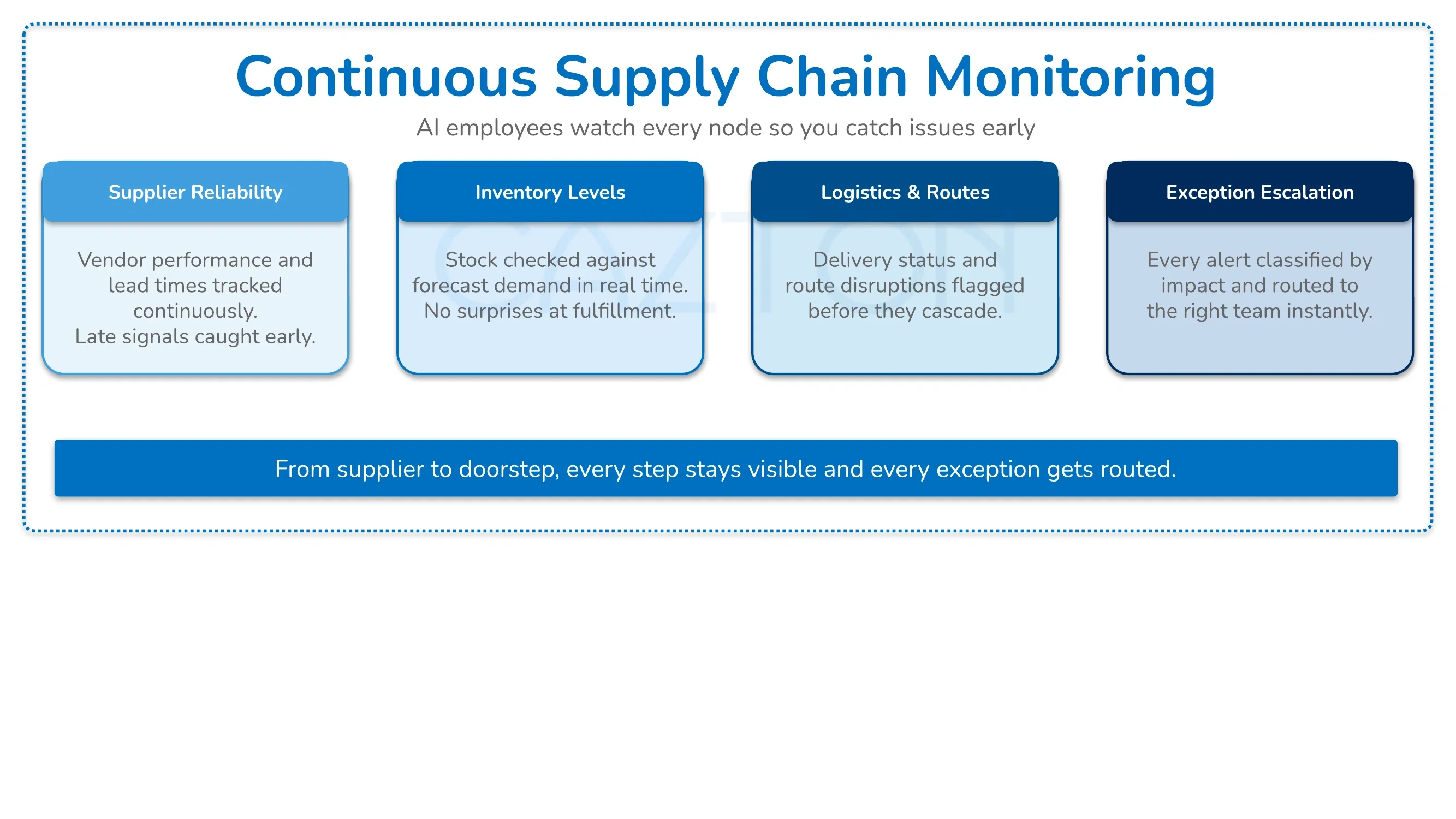
Vendor relationships involve ongoing performance monitoring that most operations teams do not have the bandwidth to conduct rigorously. Delivery timing gets tracked when it causes a problem. Quality defect rates get reviewed during quarterly business reviews. The pattern is reactive: the team learns about vendor performance issues at the point where they are already causing operational impact.
AI employees change that pattern by making vendor performance monitoring a continuous process rather than a periodic one. Delivery timelines are tracked against commitments in real time. Quality metrics update as goods are received and inspected. When a vendor's on-time performance starts trending downward, the AI employee surfaces the signal before a production line waits for material that is not coming.
The alert quality matters as much as the monitoring. Cazton's AI automation practice designs alert thresholds and escalation logic that surfaces meaningful signals rather than generating noise. The operations manager who receives an alert about a vendor should receive it with context: what the deviation is, what the potential operational impact is, and what the resolution options look like.
Exception Handling and Workflow Coordination
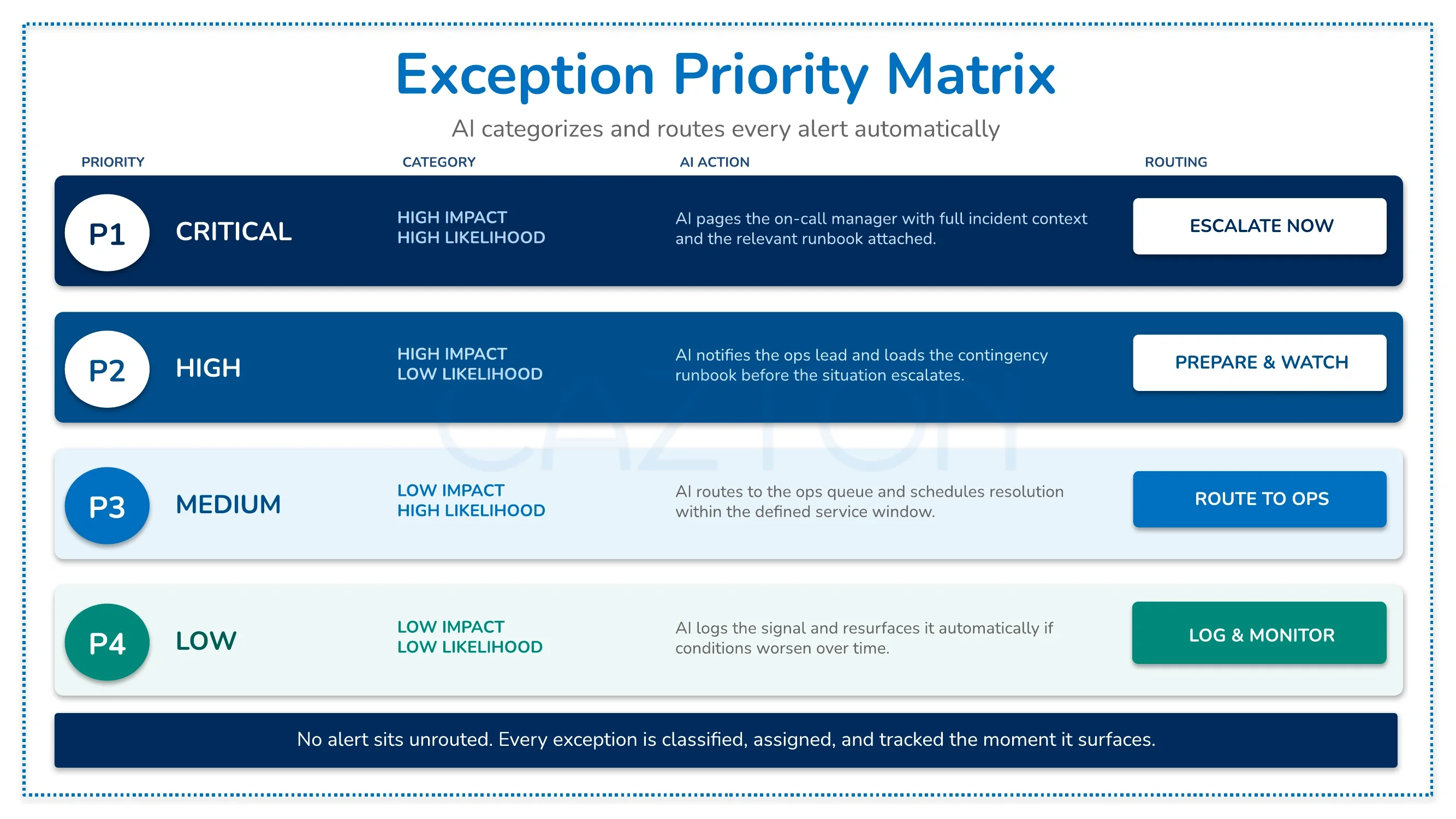
Operations teams spend a larger share of their time on exception handling than most operational analyses capture. Delays, discrepancies, capacity constraints, and carrier failures are not rare events; they are recurring features of complex supply chains. The question is not whether exceptions will occur but how fast they will be detected, how accurately they will be categorized, and how quickly the right person will have the information needed to resolve them.
AI employees detect anomalies as they emerge from operational data rather than waiting for a human to notice something is off. They categorize exceptions by severity and type, route each one to the appropriate team with the relevant context, and track resolution status so nothing sits in a queue without anyone knowing it is there.
Workflow coordination between operations functions is where similar time loss occurs. Handoffs between warehouse, transportation, and customer service teams involve status updates, confirmations, and exception notifications that create coordination overhead without producing operational value. AI employees manage that coordination layer so the people on each team are spending their time on their actual function rather than on tracking what adjacent teams have done.
Operations Platform Integrations
An operations AI employee is only as effective as the data it can access. Demand signals mean nothing if the system cannot see current inventory positions from the WMS. Vendor performance monitoring requires a live connection to delivery records across logistics and ERP data. Route optimization requires real-time carrier and shipment data. Surface-level read-only connections create delayed visibility, not the real-time operational awareness that makes these use cases valuable. Cazton builds these integrations to the underlying platform APIs so your AI employee works from current data and can surface actionable signals rather than yesterday's numbers. Common integration points include:
- ERP systems: SAP and Oracle SCM for inventory records, procurement workflows, and demand planning data that provide the foundation for AI employee monitoring and forecasting.
- Transportation management: TMS platforms and carrier APIs for route optimization, shipment tracking, and delivery performance data.
- Warehousing systems: WMS platforms for inventory position tracking, receiving data, and fulfillment status that feeds inventory intelligence functions.
- Shipping and fulfillment: ShipStation and similar platforms for cross-carrier visibility and fulfillment coordination.
- Communication platforms: Slack and Microsoft Teams for alert delivery and workflow coordination so the AI employee's outputs reach the right people in the tools they already use.
Case Studies: Operations and Supply Chain
When Monthly Forecasting Cycles Were Creating Quarterly Inventory Problems
Challenge: A consumer goods manufacturer came to Cazton with a purchasing and inventory problem that was creating recurring operational friction. Their demand forecasting ran on a monthly cycle, which meant purchasing decisions were made on data that was three to four weeks old by the time it influenced a purchase order. In a product category with meaningful seasonal and promotional variability, that lag produced consistent over-stocking on some SKUs and under-stocking on others. The inventory imbalance was not a strategy failure; it was a timing failure.
Result: Cazton deployed an AI employee that aggregated daily sales data, retailer point-of-sale feeds, and promotional calendars to produce continuously updated demand projections by SKU. The purchasing team received updated demand signals daily rather than waiting for the monthly forecast cycle. Purchasing decisions were based on what was happening in the market now rather than what had happened last month. Inventory positioning improved, the over-stocking and under-stocking cycles became less severe, and the finance team saw the working capital impact of more accurate purchasing reflected in their monthly close.
Catching Vendor Problems Before They Reached the Production Line
Challenge: A mid-market manufacturer sourced components from a network of suppliers across multiple countries. Their approach to vendor performance management was largely reactive: they became aware of problems when a shipment arrived late, when quality issues appeared during receiving inspection, or when a vendor called to explain a delay. By the time any of those triggers occurred, the problem had already developed to the point where options for resolution were limited.
Result: Cazton built an AI employee that monitored each vendor’s delivery performance, quality metrics, and communication patterns against their contract commitments continuously. The AI employee flagged when a vendor’s on-time delivery rate began trending downward, when communication patterns suggested a pending issue, or when order acknowledgment timing deviated from the vendor’s normal patterns. Operations managers received alerts with specific vendor context and severity assessments rather than discovering issues when they had already become production disruptions. The operations team shifted from reacting to vendor failures to managing vendor relationships with current performance data, which changed the nature of vendor conversations from escalations to proactive planning.
Removing Coordination Overhead From a Multi-Modal Logistics Operation
Challenge: A third-party logistics provider managing freight across multiple transportation modes was spending disproportionate operations team time on coordination work that should not have required human involvement. Status updates to clients, carrier confirmations, exception notifications, and handoff communications between warehouse and transportation teams were flowing through email and phone. The operations team spent significant portions of their day tracking and relaying information that existed in their systems but was not being routed automatically.
Result: Cazton deployed an AI employee that integrated with their TMS, their WMS, and their carrier API connections. Routine status updates were generated and delivered automatically. Exceptions were detected, categorized by severity, and routed to the appropriate team with context rather than discovered by a planner checking a system mid-afternoon. Client-facing communications went out on schedule without requiring a dispatcher to compose them. The operations team shifted their time from coordination and status tracking to the capacity planning, route optimization analysis, and carrier relationship work that required their expertise.
Building Your Operations AI Employee with Cazton
Operations and supply chain AI deployments fail in one of two ways: they surface so many alerts that the team stops trusting the signal, or they miss the deviations that matter because the thresholds were not calibrated to the network’s actual patterns. Both outcomes result from insufficient investment in the configuration work that precedes deployment. The AI employee is only as useful as the definitions it operates within, and those definitions require domain knowledge and iterative calibration against real data.
Cazton’s AI consulting practice works with your operations leadership to design AI employees that reflect your network’s actual structure, your risk tolerances, and the decision points where human judgment needs to be in the loop. We connect to your existing systems rather than requiring data to be migrated or replicated, and we build the alert logic and escalation workflows collaboratively with your operations team so the system reflects how they actually work. Our Databricks and data engineering capabilities ensure the underlying data foundation is reliable enough to support continuous monitoring rather than generating false positives that erode team confidence.
Check out more of our AI employees for your business and explore how intelligent workers are transforming operations across every major business function.
Contact Cazton to discuss an AI employee designed for your supply chain environment, whether the priority is demand forecasting accuracy, vendor performance monitoring, or reducing coordination overhead across your logistics operation.
Cazton is composed of technical professionals with expertise gained all over the world and in all fields of the tech industry and we put this expertise to work for you. We serve all industries, including banking, finance, legal services, life sciences & healthcare, technology, media, and the public sector. Check out some of our services:
- Artificial Intelligence
- Big Data
- Web Development
- Mobile Development
- Desktop Development
- API Development
- Database Development
- Cloud
- DevOps
- Enterprise Search
- Blockchain
- Enterprise Architecture
Cazton has expanded into a global company, servicing clients not only across the United States, but in Oslo, Norway; Stockholm, Sweden; London, England; Berlin, Germany; Frankfurt, Germany; Paris, France; Amsterdam, Netherlands; Brussels, Belgium; Rome, Italy; Sydney, Melbourne, Australia; Quebec City, Toronto Vancouver, Montreal, Ottawa, Calgary, Edmonton, Victoria, and Winnipeg as well. In the United States, we provide our consulting and training services across various cities like Austin, Dallas, Houston, New York, New Jersey, Irvine, Los Angeles, Denver, Boulder, Charlotte, Atlanta, Orlando, Miami, San Antonio, San Diego, San Francisco, San Jose, Stamford and others. Contact us today to learn more about what our experts can do for you.
