

AI Employees for Customer Service
- Full request lifecycle: An AI employee handles customer service from initial intake through resolution and CRM logging without requiring human intervention for routine cases.
- Ticket triage: AI employees classify incoming requests by type, urgency, and customer segment before routing or resolving them autonomously.
- Seamless handoffs: When human judgment is required, AI employees transfer cases with a full context summary already prepared so agents never have to reconstruct the situation from scratch.
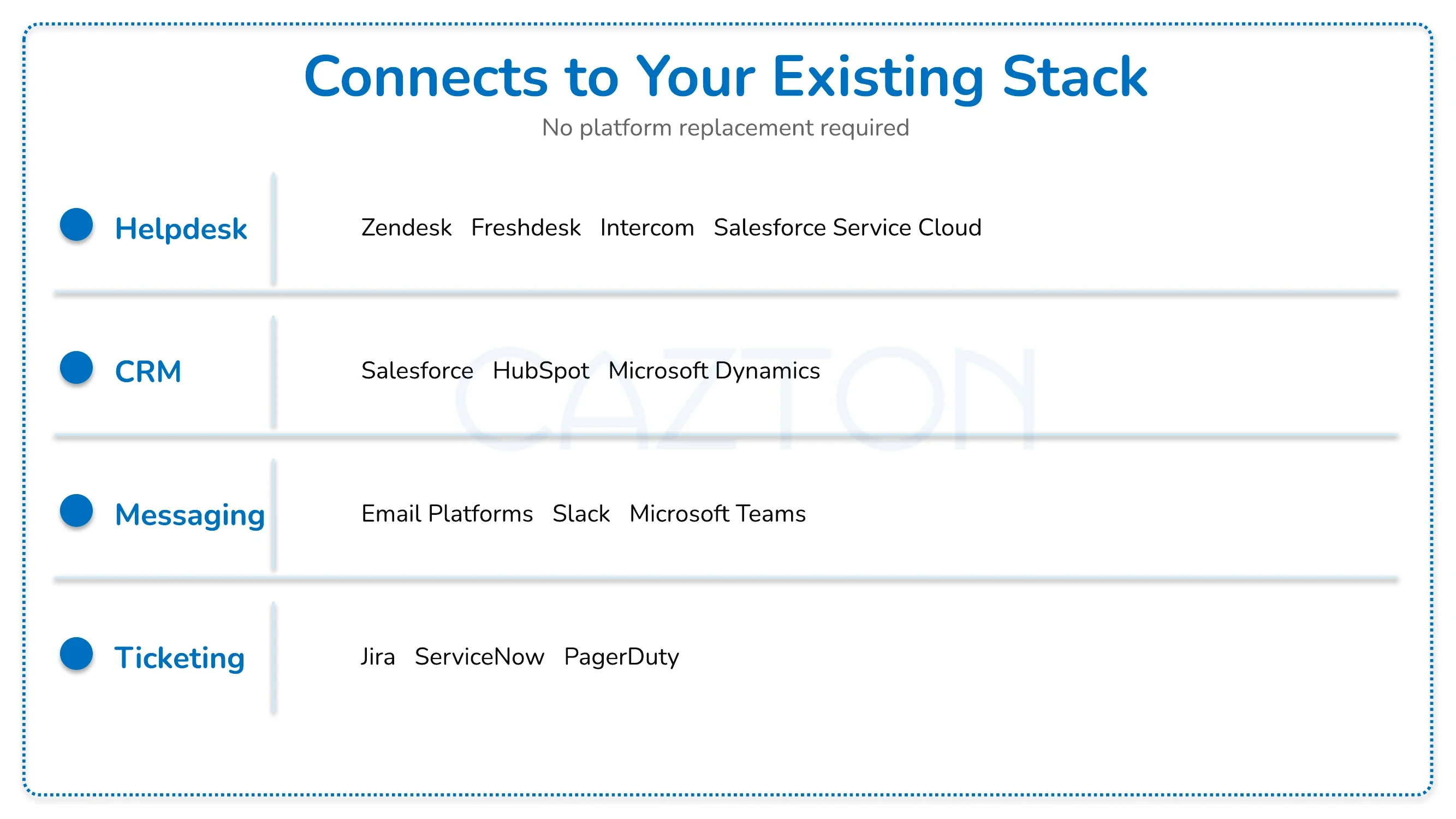
- Helpdesk integration: Works within your existing stack whether your team runs Zendesk, Freshdesk, Intercom, or Salesforce Service Cloud.
- Personalized responses: AI employees draw on customer history to eliminate the repetitive questioning that frustrates customers across multi-channel interactions.
- Automatic CRM logging: Every interaction is recorded automatically so records stay accurate without depending on agents to update them after each case.
- Escalation intelligence: Knowing when to involve a human is as important as knowing when to resolve autonomously, which is what separates an effective AI employee from a brittle chatbot.
- Top clients: We help Fortune 500, large, mid-size and startup companies with AI development, consulting, and hands-on training services. Our clients include Microsoft, Google, Broadcom, Thomson Reuters, Bank of America, Macquarie, Dell and more.
The Customer Service Problem That Does Not Solve Itself With Headcount
Customer service is the function that absorbs every operational gap your business creates before the customer gives up: the confusion your onboarding produces, the billing edge cases your finance team did not anticipate, the delivery failures your logistics occasionally generates, and the product questions your documentation does not answer clearly enough. The structural challenge is that this work is never uniform. A single team handles password resets, refund disputes, product configuration questions, account merge requests, and compliance-sensitive data queries simultaneously, each at a different urgency level, often without enough context about the customer sitting in the queue with it. The inherited response to volume growth has been to hire more agents, but that approach has predictable limits. Customer service carries high turnover because agents spend most of their time on work that does not use their judgment. Training costs and quality variance accumulate. Response times stretch whenever volume spikes coincide with staffing gaps, which they reliably do during product launches, seasonal peaks, and service outages.
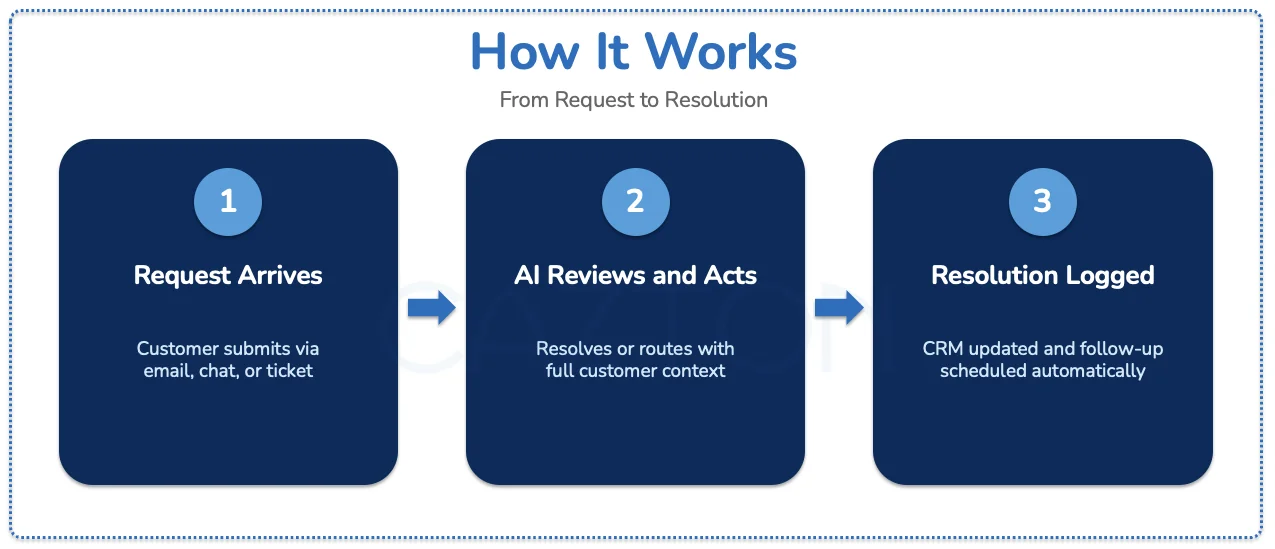
AI employees address the structural problem rather than the staffing one. They handle the segment of the support queue that follows patterns such as order status inquiries, account unlocks, policy clarifications, and return initiations, with no variance in quality, no shift fatigue, and no ceiling on concurrent volume. Your human agents focus on the cases that genuinely require them: complex disputes, escalated accounts, sensitive conversations, and the judgment calls that automation should not attempt. The distinction between an AI employee and a basic chatbot matters: a chatbot follows a script and fails when the conversation goes off-script, while an AI employee reads the full incoming request, retrieves the customer record, determines whether the case falls within its resolution scope, takes action, logs the outcome, and either closes the case or routes it with a complete context summary. That end-to-end capability is what Cazton's AI consulting practice builds and deploys in production.
Core Capabilities for a Customer-Facing Deployment
The phrase "AI in customer service" covers a wide range of implementations, from simple FAQ bots to fully autonomous agents. AI employees sit at the capable end of that spectrum. They handle what scripted systems cannot: multi-step requests, tool integrations, customer history lookups, and conditional routing logic.
Key capabilities include:
- Ticket triage: Classify and prioritize incoming requests by type, urgency, and customer segment before routing or resolving them.
- Autonomous resolution: Answer common questions, process standard requests, and close tickets that fall within defined resolution patterns without escalation.
- CRM read and write: Pull customer history before drafting a response and log every interaction automatically after resolution, keeping records current without manual effort.
- Escalation with context: Identify cases that need a human and hand them off with a full summary, including the customer's history, the current request, and any actions already taken.
- Follow-up scheduling: Trigger satisfaction checks or follow-up messages after resolution on a defined schedule, without manual intervention.
- Personalized responses: Adjust tone, language, and content based on customer tier, interaction history, and channel so every response feels relevant rather than generic.
Ticket Triage and Autonomous Resolution
Most support queues contain a predictable composition: password resets, order status questions, billing inquiries, policy clarifications, and product how-tos. These are not complex problems, but they consume a disproportionate share of team capacity when each one requires a human to open, read, look up, respond, and log. An AI employee reads each incoming message, identifies the request type, pulls the relevant customer record, and resolves the ticket without escalation when it falls within the defined resolution scope. The triage logic itself is where the quality of the deployment is set. Cazton works with your team to map your actual ticket taxonomy before configuring the resolution framework, so the system reflects your real queue rather than a generic category structure.
The shift this creates matters for the team as much as for the customer. Rather than spending the first stretch of every shift clearing a backlog of routine tickets, human agents work on cases that require their expertise. Volume spikes from a product launch, a service disruption, or a seasonal surge no longer automatically translate into staffing emergencies or degraded response times. The AI employee absorbs the predictable volume regardless of load, and your team's attention stays focused where it belongs.
CRM Integration and Accurate Record Keeping
Disconnected systems are one of the most common reasons customer service quality degrades as a team grows. An agent who cannot see a customer's previous interactions asks repetitive questions. A team that cannot see the full interaction history cannot identify patterns in what customers are struggling with. Reports that depend on manual logging reflect what agents remembered to enter rather than what actually happened. AI employees solve this structurally by treating your CRM as both the knowledge source that informs every response and the log target that captures every outcome automatically.
Whether your team runs on Salesforce, Zendesk, Freshdesk, or Intercom, the AI employee reads and writes records in real time as part of the resolution workflow, not as a separate step that depends on agent follow-through. Every resolved ticket, every message sent, and every customer preference captured becomes part of the permanent record. Your agents always have current context on escalated cases, your reporting reflects actual interaction history, and Cazton's integration engineering ensures the data flows reliably between your AI employee and your existing platforms from day one.
Smart Escalation and Human Handoff
Autonomous resolution only works well when the escalation boundaries are correctly defined. An AI employee that attempts too much introduces errors that damage the customer relationship and create more work than the original ticket. One that escalates too conservatively delivers little value. Getting that calibration right is one of the most important parts of building an effective system, and Cazton handles that work collaboratively with your team, mapping your escalation logic to real ticket examples from your actual queue rather than to generic category names in a setup form.
When a ticket exceeds the resolution threshold, the AI employee assembles a structured handoff with the customer's full interaction history, the current request, any actions already taken, and a suggested next step. The agent who picks it up starts informed rather than having to reconstruct context through thread-reading or a follow-up call to the customer. Escalation becomes a smooth transfer rather than a handoff that frustrates both sides, and the data from escalation patterns gives your team ongoing visibility into where the AI employee's resolution scope can be expanded over time.
Platform Compatibility and Integration Depth
One assumption that slows AI adoption in customer service is the belief that deploying an AI employee requires replacing existing software. The opposite is true: AI employees connect to the platforms your team already uses, and the value is delivered without disrupting the tools and workflows your team already knows. Cazton's AI consulting practice handles the integration architecture, built with the authentication, data handling standards, and error recovery that production environments require, not the simplified connections that work in a demo.
Common integration points include:
- Helpdesk platforms: Zendesk, Freshdesk, Intercom, and Salesforce Service Cloud for ticket management, routing, and multi-channel communication.
- CRM systems: Salesforce, HubSpot, and Microsoft Dynamics for customer data read and write access that keeps records accurate without manual agent effort.
- Messaging and email: Direct integration with your existing email routing and communication tools so AI employees handle inbound messages without requiring a channel change.
- Internal tools: Slack and Microsoft Teams for agent notification and escalation handoff workflows so cases surface where your team already works.
- Order and account systems: E-commerce platforms, billing systems, and account management tools that give the AI employee the operational data it needs to resolve issues rather than only answer questions.
Continuous Coverage Without Proportional Staffing Costs
Customer expectations around response time have shifted substantially. Support requests arrive on evenings, weekends, and across time zones that no fixed team can cover cost-effectively, since doing so requires shift premiums, overtime, or offshore arrangements that introduce quality management overhead of their own. AI employees are available continuously, and their capacity does not degrade under volume. A spike at 11pm on a Saturday produces the same response quality as a Tuesday morning.
For growing businesses, this changes the economics of support scaling in a practical way. Adding a product line, entering a new market, or absorbing a seasonal peak does not require a proportional headcount increase when the volume growth consists primarily of pattern-based inquiries the AI employee handles. Your human team scales to the complexity of the case mix rather than to the total ticket count. That is the version of AI automation that shows up in practice: not replacing judgment with automation, but freeing judgment from work that does not require it.
Case Studies: Customer Service and Support
When a Seasonal Surge Became a Structural Problem
Challenge: A consumer e-commerce brand came to Cazton with a pattern they could not break. Each year, their peak sales period generated a support volume their team could not absorb cleanly. They hired seasonal agents, extended shifts, and still fell behind. Customers waited too long on routine inquiries including order tracking, shipping windows, and return initiations, while satisfaction scores dipped at exactly the moment when brand impression carried the most weight. The seasonal hires introduced quality variation that persisted for weeks after training ended.
Result: Cazton deployed an AI employee integrated with their Zendesk instance and their order management platform. The AI employee handled the predictable high-volume inquiry types autonomously, and their existing team shifted entirely to escalations, account disputes, and situations requiring judgment or goodwill decisions. The operation absorbed peak volume without proportional headcount growth, and service quality was consistent regardless of day or hour.
Closing the Overnight Gap for a Global B2B Customer Base
Challenge: A B2B software company with enterprise customers spread across North America, Europe, and Asia had a coverage problem. Their support team was primarily US-based, and customers in other time zones submitted tickets in the evening and waited until the following business day for a first response. For enterprise clients on premium support agreements, this wait was a visible failure, and support responsiveness had started appearing in churn conversations.
Result: Cazton built an AI employee integrated with their HubSpot Service Hub and internal knowledge base. The system provided immediate first response and autonomous resolution for cases that did not require engineering involvement, around the clock. Escalations requiring an engineer were routed with full context and appropriate priority so the team could triage effectively when their day began. The coverage gap closed without establishing support offices in additional time zones.
Freeing Licensed Staff from High-Volume, Low-Complexity Queries
Challenge: A regional financial services organization found that a large share of their daily support volume consisted of routine, low-risk inquiries: account statement questions, transaction history lookups, fee explanations, and branch information. These queries were consuming agent time that needed to be available for more consequential conversations such as fraud disputes, account modifications requiring identity validation, and loan inquiries that required licensed staff.
Result: Cazton deployed an AI employee with access to the relevant account data, built to the compliance standards the financial services environment required. Routine inquiries resolved autonomously with clear escalation paths for anything touching account modifications, sensitive data, or regulated decisions. Licensed staff spent their time on the work those licenses existed to support, and the team handled a higher proportion of conversations that required their expertise.
Building Your Customer Service AI Employee with Cazton
Deploying an effective AI employee for customer service requires more than connecting an API to your helpdesk. It requires understanding your ticket taxonomy in detail, mapping your escalation logic to real cases rather than theoretical ones, modeling your CRM data structure so reads and writes happen correctly, and defining quality thresholds that reflect what your specific customers expect. Getting those elements right is what separates a system that genuinely reduces pressure on your team from one that creates new problems.
Cazton's AI agent practice has designed and deployed customer service AI employees across industries with different compliance requirements, different support stacks, and different escalation cultures. We cover the full implementation scope: agent design, integration engineering, resolution logic configuration, testing against your actual ticket history, and the observability layer that lets your team monitor performance in production. Our emphasis is on getting the configuration right before anything goes live rather than iterating through failures in front of your customers.
Check out more of our AI employees for your business and explore how intelligent workers are transforming operations across every major business function.
If your support team is handling volume that should not require human attention, if your response times have stretched beyond what your customers accept, or if quality varies too much across your team, this is a practical place to start. Contact Cazton to discuss a customer service AI employee configured for your specific environment, queue composition, and team structure.
Cazton is composed of technical professionals with expertise gained all over the world and in all fields of the tech industry and we put this expertise to work for you. We serve all industries, including banking, finance, legal services, life sciences & healthcare, technology, media, and the public sector. Check out some of our services:
- Artificial Intelligence
- Big Data
- Web Development
- Mobile Development
- Desktop Development
- API Development
- Database Development
- Cloud
- DevOps
- Enterprise Search
- Blockchain
- Enterprise Architecture
Cazton has expanded into a global company, servicing clients not only across the United States, but in Oslo, Norway; Stockholm, Sweden; London, England; Berlin, Germany; Frankfurt, Germany; Paris, France; Amsterdam, Netherlands; Brussels, Belgium; Rome, Italy; Sydney, Melbourne, Australia; Quebec City, Toronto Vancouver, Montreal, Ottawa, Calgary, Edmonton, Victoria, and Winnipeg as well. In the United States, we provide our consulting and training services across various cities like Austin, Dallas, Houston, New York, New Jersey, Irvine, Los Angeles, Denver, Boulder, Charlotte, Atlanta, Orlando, Miami, San Antonio, San Diego, San Francisco, San Jose, Stamford and others. Contact us today to learn more about what our experts can do for you.
