

AI Employees for Marketing
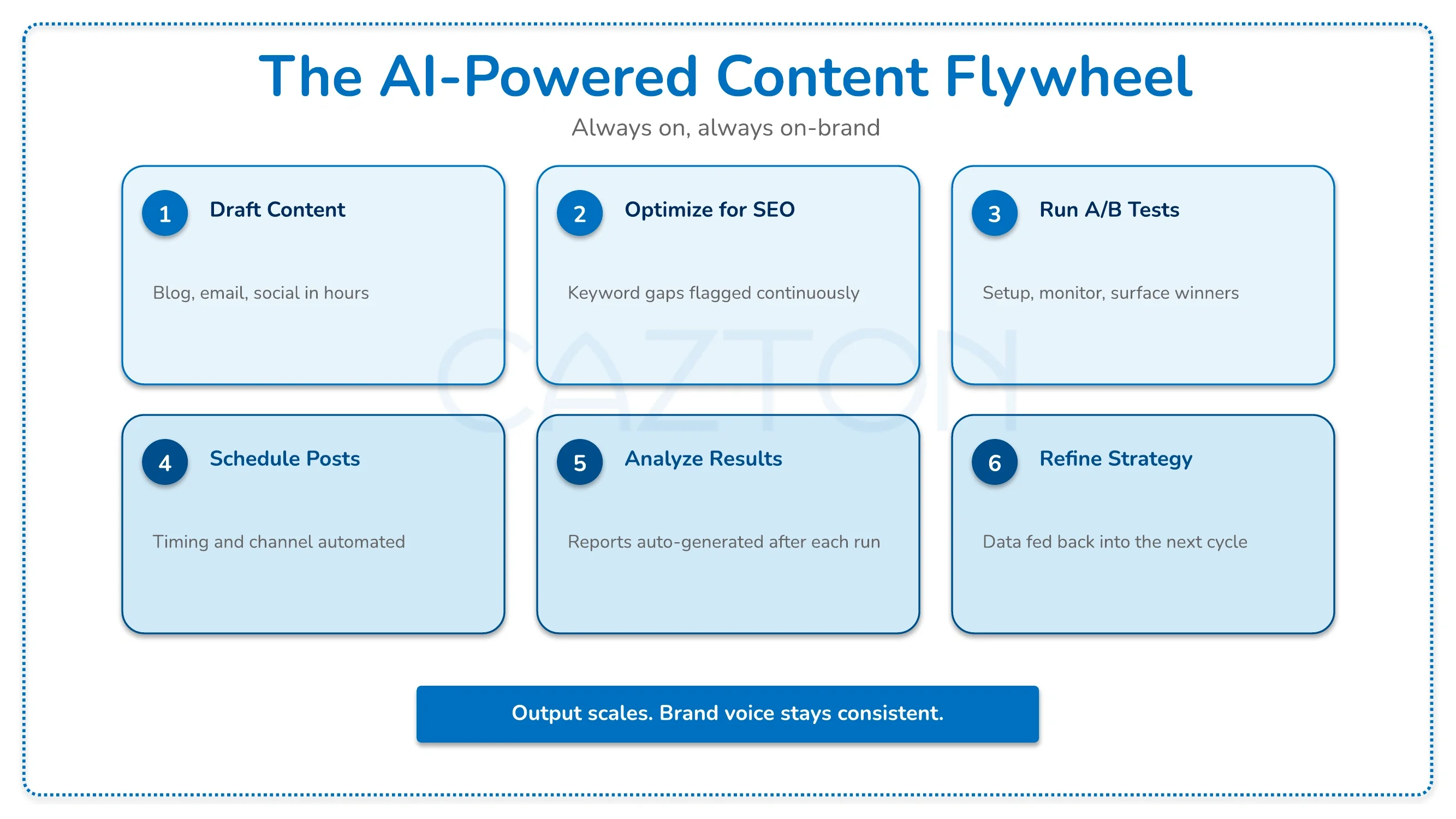
- Execution layer coverage: An AI employee for marketing drafts content, schedules posts, runs A/B tests, analyzes campaign performance, and optimizes for SEO continuously.
- Content production: AI employees produce first drafts across formats, from blog posts to email campaigns to social copy, at a pace no human team can sustain alone.
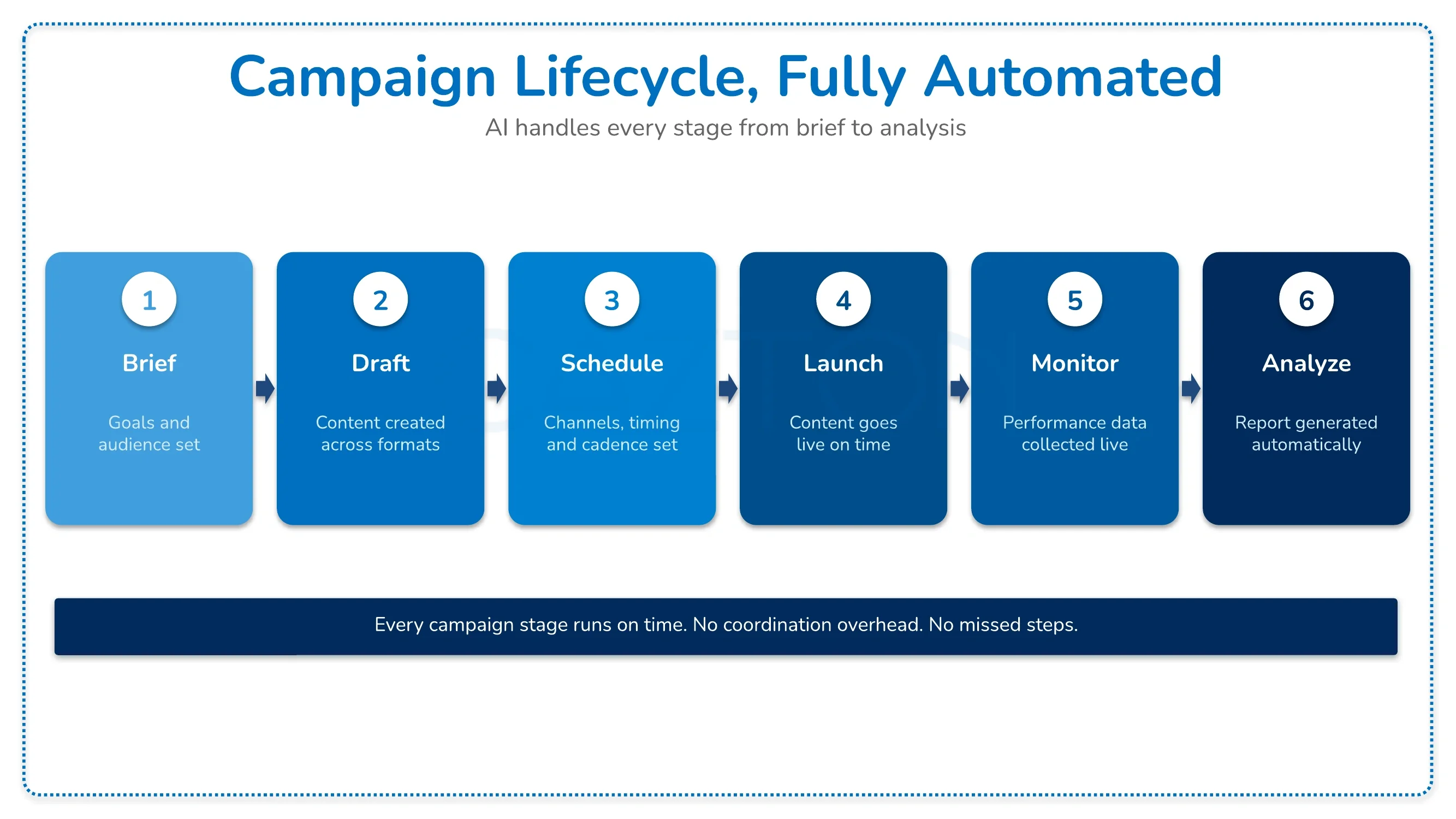
- Campaign coordination: AI employees manage the timing, channel, and audience segment coordination that makes campaigns run as planned rather than as resources allow.
- A/B testing: AI employees manage test setup, monitor results, and surface winning variants so your team acts on data rather than assumptions.
- SEO monitoring: AI employees track keyword performance, content gaps, and on-page optimization signals and surface recommendations your team can act on continuously.
- Post-campaign analysis: AI employees generate campaign analysis automatically so your team learns from every campaign, not just the ones where someone found time to look.
- Brand consistency: AI employees work from a defined brand voice and content framework so output stays consistent even at high production volume.
- Top clients: We help Fortune 500, large, mid-size and startup companies with AI development, consulting, and hands-on training services. Our clients include Microsoft, Google, Broadcom, Thomson Reuters, Bank of America, Macquarie, Dell and more.
Where Marketing Teams Spend Their Time and What Gets Left Behind
Marketing teams carry a contradiction at the center of their work. The activities that actually differentiate a brand, such as strategy, creative direction, message development, and understanding the customer deeply enough to speak to them genuinely, require human thinking and cannot be delegated without significant loss. But the activities that consume the majority of marketing team time do not require those things: they require execution, consistency, and volume. The resulting tension is visible in almost every marketing team at scale. Content calendars fill with ambitious commitments that get deprioritized when campaign work takes over. Analysis from the last campaign never gets written up because the next one started before there was time. The team is busy by any objective measure, but the output that would actually drive growth is often the output that gets skipped.
The consistency problem compounds the volume problem. A strong brand voice is not a document. It is a discipline that requires consistent application across every piece of content a company produces. At the output scale most marketing teams aim for, maintaining that consistency manually is genuinely difficult: the sixth blog post sounds different from the first, and copy written under deadline sounds different from copy written with time. AI employees address both problems. They handle the production layer of marketing, including drafting content, managing posting schedules, running A/B tests, generating performance analysis, and monitoring SEO signals, while your team directs strategy, refines creative output, and focuses on the positioning decisions that require their expertise. Cazton’s AI marketing practice is built around the principle that AI employees should expand what your marketing team can accomplish, not replace the human judgment that makes marketing work.
Core Capabilities for a Marketing AI Employee
Marketing AI employees operate across the full content and campaign lifecycle. The most valuable capabilities are those that directly address the volume and consistency constraints that limit most marketing teams.
Core capabilities include:
- Content generation: Draft blog posts, email copy, social media content, landing page copy, and ad creative based on briefs, brand guidelines, and target audience specifications.
- Campaign planning and execution: Coordinate multi-channel campaigns across email, social, and paid channels, managing timing, audience segmentation, and content scheduling.
- A/B test management: Set up and monitor split tests on subject lines, headlines, CTAs, and content formats, then surface winning variants with supporting performance data.
- SEO monitoring and optimization: Track keyword rankings, identify content gaps, flag on-page optimization opportunities, and generate recommendations for improving organic visibility.
- Performance analysis: Generate post-campaign reports with engagement metrics, conversion data, and trend comparisons so your team understands what worked and why.
- Scheduling and distribution: Manage content posting schedules across channels, ensure timing aligns with audience behavior patterns, and maintain calendar consistency without manual coordination.
Content Generation at Volume
Content production is where the output gap between AI-supported and unsupported marketing teams is most visible. A blog post that takes a writer several hours to draft can be produced as a high-quality first draft by an AI employee in a fraction of that time, leaving the writer to edit, refine, and apply the judgment that elevates the content rather than generating it from scratch.
The same principle applies across formats. Email campaigns, social posts, product descriptions, ad copy, and landing page content all benefit from AI-generated drafts that your team refines rather than builds entirely by hand. The constraint on content volume shifts from production capacity to review capacity, which is a fundamentally better problem to have.
Brand consistency is the other output-quality factor. AI employees work from a defined brand voice framework, which means the content they generate reflects your tone, your terminology, and your messaging priorities consistently across every piece, even at high output volumes where human consistency typically degrades.
Campaign Execution and A/B Testing
Campaign execution involves more coordination than it appears to from the outside: audience segmentation, timing logic, channel sequencing, follow-up rules, and performance monitoring all run simultaneously across a single campaign. Managing that coordination manually across multiple campaigns creates the kind of operational complexity that leads to errors, missed timing, and inconsistent execution.
AI employees handle campaign coordination as a continuous operational process rather than a series of manual tasks. Campaigns run on schedule, audiences receive the right content at the right time, and performance data feeds back into the system automatically rather than requiring manual export and analysis.
A/B testing works better when it runs continuously rather than only when the team has time to set up a test. Your AI employee manages test configuration, monitors results against statistical thresholds, and surfaces winning variants so your team can make fast decisions based on data. Cazton's AI marketing practice designs these test frameworks to reflect the variables that actually matter for your conversion goals rather than testing for testing's sake.
SEO and Performance Intelligence
SEO is one of the areas where the gap between what teams intend to do and what they actually do is widest. Keyword research, content gap analysis, on-page optimization, and ranking monitoring all require consistent attention to produce results, but they consistently get deprioritized in favor of campaign deadlines.
An AI employee treats SEO as an ongoing operational task rather than a periodic project. It monitors keyword performance, identifies content where optimization would improve ranking, flags competitor movements that affect your visibility, and surfaces specific recommendations your team can act on without having to find the signals themselves. The result is an organic search program that improves continuously rather than in occasional bursts when the team gets to it.
Performance analysis follows the same continuous logic. After each campaign closes, your AI employee generates a structured report covering what the campaign achieved, where performance fell short of targets, and what the data suggests about the next iteration. Your team gets that learning automatically, not only when someone allocates time to pull it together.
Marketing Platform Integrations
The effectiveness of a marketing AI employee depends on the quality of its connection to your existing stack. Content generation needs to reach your CMS to be actionable. Campaign execution needs real access to your email and automation platforms, not a file export. Analytics data needs to flow back into the system for A/B test interpretation and performance reporting to be meaningful. Cazton builds these integrations to your tool APIs so your AI employee operates from live data and writes results directly to your platforms rather than requiring manual handoffs. Common integration points include:
- Marketing automation platforms: HubSpot and Adobe Marketo Engage for campaign management, lead nurture, and email execution.
- Email service providers: Mailchimp and similar tools for list management, campaign delivery, and performance tracking.
- Analytics: Google Analytics and platform-native reporting for behavioral data and conversion tracking that feeds performance analysis and A/B test interpretation.
- Social media management: Hootsuite and similar scheduling tools for content distribution across channels.
- Content management: CMS platforms where published content lives, enabling your AI employee to flag optimization opportunities on live pages rather than only reviewing drafts.
Quality Control and Brand Integrity
One concern that comes up consistently in marketing AI deployments is whether AI-generated content will drift from brand standards over time or across volume. The answer depends entirely on the quality of the framework the AI employee operates within. Without a clear brand voice document, a defined content framework, and a review process for output above a certain sensitivity threshold, quality drift is a real risk.
Cazton's AI consulting practice builds those frameworks as part of the deployment process, not as optional documentation. Your AI employee operates from a defined set of brand guidelines, content templates, and quality checkpoints that are designed before the system goes into production, so the output reflects your standards from the start.
Case Studies: Marketing and Content Creation
From Dormant Channels to a Publishing Operation
Challenge: A B2B technology company had a content strategy they believed in but could not execute consistently. Their marketing team was small, and the combination of campaign work, event support, and sales enablement left little capacity for the blog and SEO content that was supposed to drive organic pipeline. The content calendar was regularly delayed, publishing happened in bursts rather than consistently, and their keyword rankings reflected the inconsistency. Organic search was underperforming relative to what the existing domain authority should have enabled.
Result: Cazton deployed an AI employee with a defined brand voice framework, their approved topic clusters, and integration into their CMS and SEO monitoring tools. The AI employee produced structured first drafts for blog posts and landing page updates on a consistent cadence, flagged on-page optimization opportunities on existing content, and monitored keyword ranking changes that warranted a response. The marketing team shifted from producing content from scratch to editing, refining, and approving a steady stream of drafts. Publishing frequency increased substantially, and topical coverage across their SEO priority areas expanded without the team increasing in size.
Breaking a Campaign Performance Plateau With Continuous Testing
Challenge: A consumer brand had been running email marketing for years with results that had flattened. Open rates and click-through rates had not meaningfully changed in a long time, and the team had accepted performance at current levels as the baseline. The reason was straightforward when examined: A/B testing was happening rarely, when the team had capacity to structure a test, which meant the email program was not learning and optimizing on a useful timescale.
Result: Cazton built an AI employee integrated with their email platform that managed A/B test configuration, monitoring, and result analysis as continuous background operations rather than periodic projects. Subject line variants, preview text combinations, call-to-action placements, and send time variations were tested systematically against defined audience segments on a rolling basis. Winning variants were implemented automatically. The marketing team reviewed weekly summaries of what was working rather than initiating tests one at a time. Email performance improved significantly over the following quarters as the program accumulated learning that the team had not previously had the infrastructure to gather.
Scaling a Marketing Agency Without Scaling Headcount Proportionally
Challenge: A marketing agency was facing a growth constraint that is common in the services business: adding clients was adding headcount at a ratio that compressed margins and made growth feel expensive rather than profitable. The team spent a significant share of their hours on content production work such as drafting blog posts, social copy, and email sequences for clients, that did not require senior judgment but did require time. Senior talent was doing execution work that left less capacity for strategy, client relationships, and the higher-value services the agency wanted to grow.
Result: Cazton designed an AI employee deployment with brand voice and content framework documentation for each of the agency’s major clients. The AI employee produced first drafts across content types for those clients, managed scheduling and distribution workflows, and generated performance reports after each campaign period. Senior team members reviewed and refined output rather than producing from scratch. The agency added new clients without proportional headcount growth, senior talent shifted toward strategy and client relationship work, and the margin profile of the content delivery function improved.
Building Your Marketing AI Employee with Cazton
Marketing AI deployments fail in a predictable way: the AI employee produces content that requires as much rework as a draft from scratch would have, the team stops trusting the output, usage drops, and the deployment becomes a cautionary example rather than a working solution. The root cause is almost always the same: inadequate brand voice documentation, undefined content frameworks, and quality standards that were never made explicit before the system went into production.
Cazton builds those foundations before any content is generated. Our AI marketing practice works with your team to produce the brand voice documentation, content templates, and quality checkpoints that govern AI employee output from the start. The integrations we build into your CMS, your email platform, your analytics stack, and your social management tools are designed to fit your existing workflow rather than require your team to add a new process layer. And the oversight structure we design gives you the review control and performance visibility to trust what the system is producing and iterate on it over time.
Check out more of our AI employees for your business and explore how intelligent workers are transforming operations across every major business function.
If your team is constrained by content production volume, running campaigns without the analysis needed to improve them, or struggling to maintain brand consistency at the output scale the business requires, this is a practical starting point. Contact Cazton to discuss a marketing AI employee built for your team’s content and campaign needs.
Cazton is composed of technical professionals with expertise gained all over the world and in all fields of the tech industry and we put this expertise to work for you. We serve all industries, including banking, finance, legal services, life sciences & healthcare, technology, media, and the public sector. Check out some of our services:
- Artificial Intelligence
- Big Data
- Web Development
- Mobile Development
- Desktop Development
- API Development
- Database Development
- Cloud
- DevOps
- Enterprise Search
- Blockchain
- Enterprise Architecture
Cazton has expanded into a global company, servicing clients not only across the United States, but in Oslo, Norway; Stockholm, Sweden; London, England; Berlin, Germany; Frankfurt, Germany; Paris, France; Amsterdam, Netherlands; Brussels, Belgium; Rome, Italy; Sydney, Melbourne, Australia; Quebec City, Toronto Vancouver, Montreal, Ottawa, Calgary, Edmonton, Victoria, and Winnipeg as well. In the United States, we provide our consulting and training services across various cities like Austin, Dallas, Houston, New York, New Jersey, Irvine, Los Angeles, Denver, Boulder, Charlotte, Atlanta, Orlando, Miami, San Antonio, San Diego, San Francisco, San Jose, Stamford and others. Contact us today to learn more about what our experts can do for you.
