

AI Employees for E-commerce
- Operational coverage: An AI employee for e-commerce handles inventory signals, product recommendations, order tracking, customer questions, and abandoned cart recovery across your store.
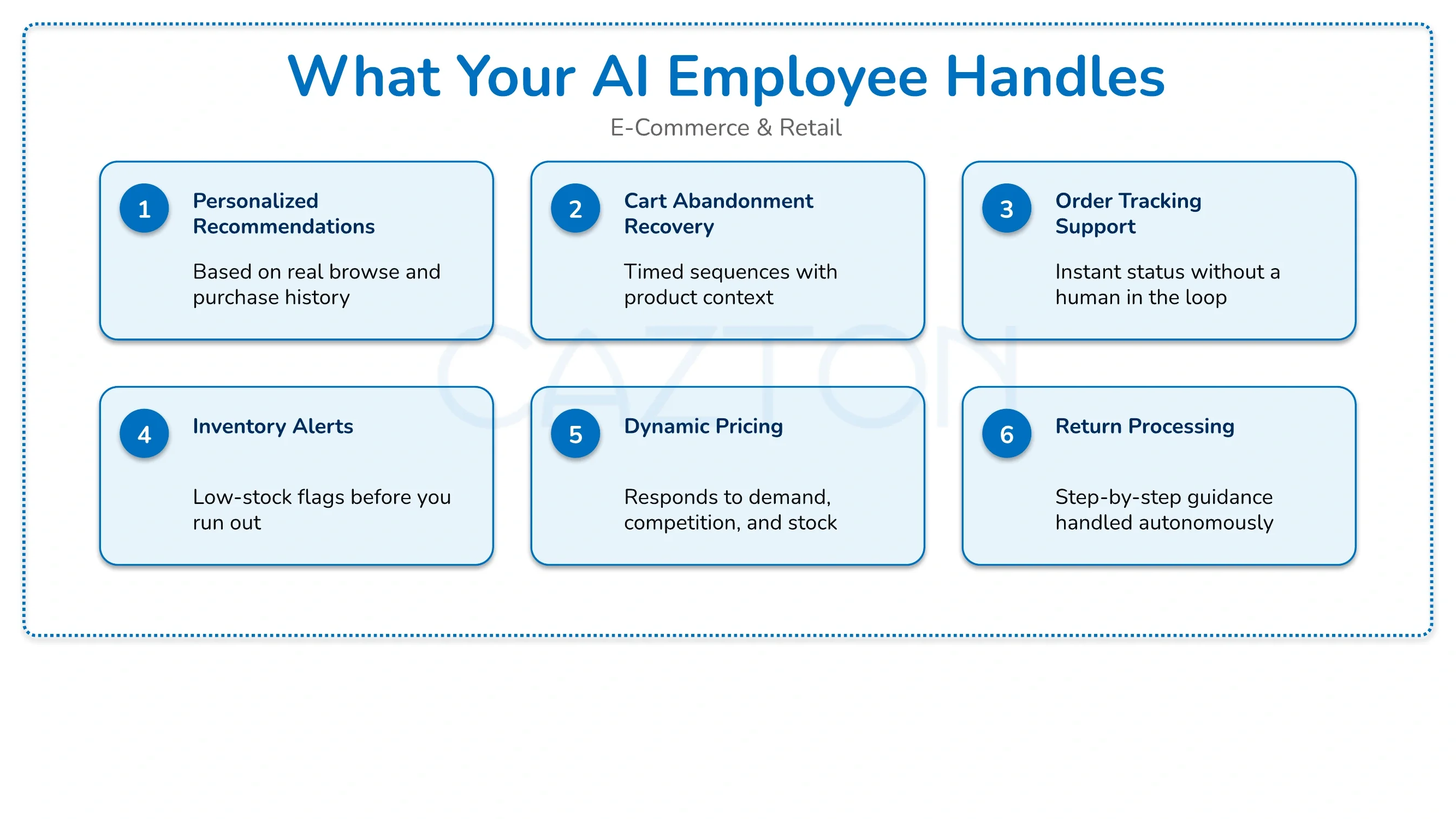
- Personalized recommendations: Product suggestions are based on each customer's actual browse and purchase history, not static rules that treat every visitor the same.
- Inventory management: AI employees monitor stock levels, flag replenishment needs early, and help prevent both stockouts and excess inventory situations.
- Cart abandonment recovery: Recovery sequences run automatically at the right time with relevant product context to bring customers back before the purchase window closes.
- Customer service at scale: AI employees handle order status, returns, shipping questions, and product inquiries at any hour without additional staffing.
- Platform integration: Connects to Shopify, WooCommerce, BigCommerce, Klaviyo, and the other platforms your store already runs on without requiring a replatforming project.
- Dynamic pricing: Pricing decisions based on demand signals, competitive data, and inventory levels are complex to run manually but well-suited to an AI employee working from live data.
- Top clients: We help Fortune 500, large, mid-size and startup companies with AI development, consulting, and hands-on training services. Our clients include Microsoft, Google, Broadcom, Thomson Reuters, Bank of America, Macquarie, Dell and more.
What E-Commerce Brands Lose When Operations and Commerce Are Managed Manually
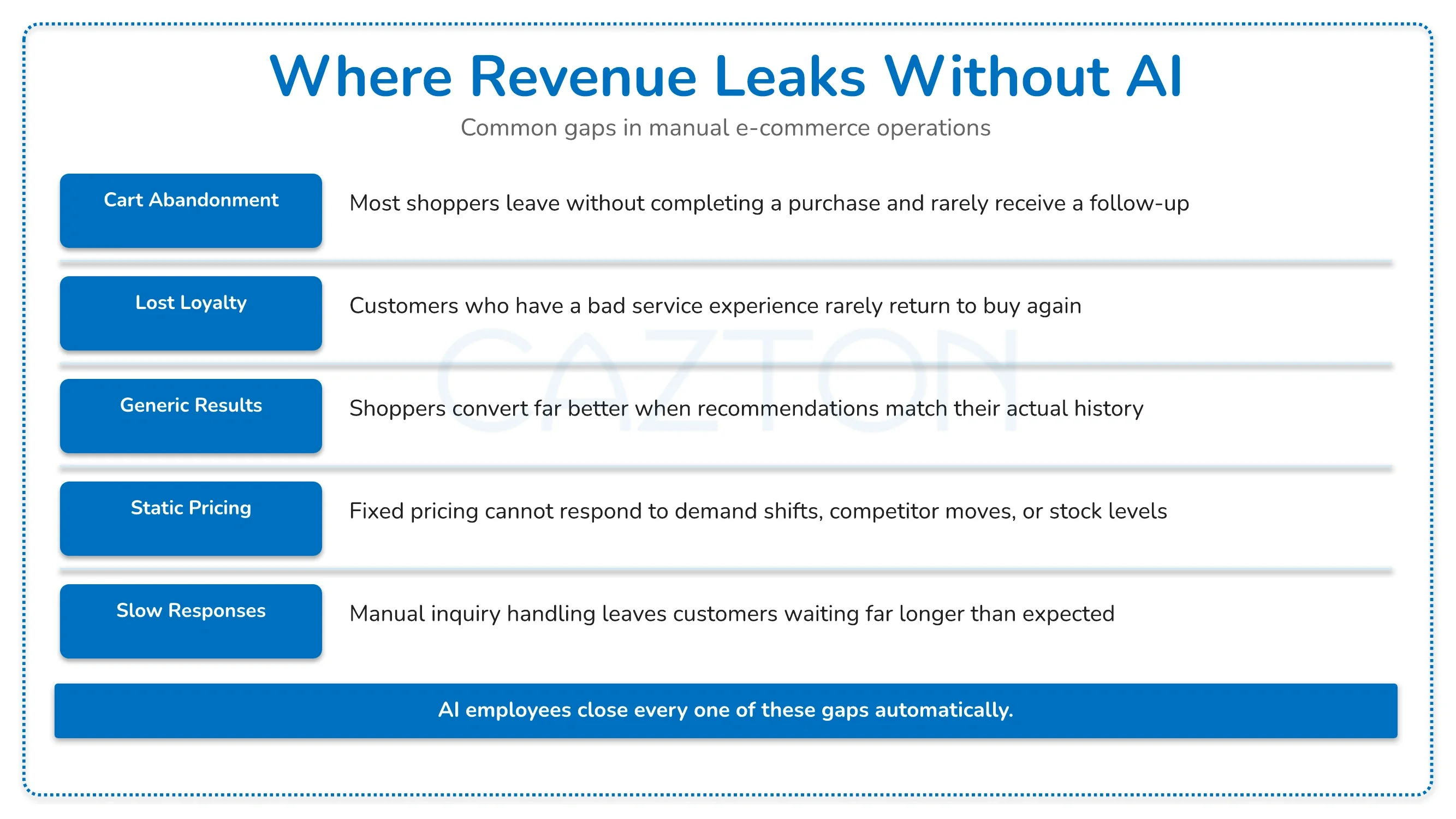
E-commerce is one of the few business environments where operational failures and commercial failures are indistinguishable from the customer’s perspective. A stockout is not a supply chain problem to the customer who clicked add to cart. It is a brand failure. A generic recommendation engine that surfaces unrelated products is not a technology limitation. It is a missed sale. A checkout abandonment that goes without recovery is not a conversion problem. It is revenue left on the table while the customer was still interested. The challenge is that both the operational and commercial layers require real-time data and fast execution that manual processes cannot deliver at scale: inventory management depends on knowing stock positions as they change, personalization depends on behavioral data from the current session, and cart recovery depends on reaching the customer within the right window.
Customer acquisition costs in retail have risen substantially across paid channels, making conversion rate and retention increasingly important. It is cheaper to convert and retain existing visitors and customers than to replace them. But improving conversion requires personalization, and improving retention requires consistent service quality and proactive recovery, both of which have historically required expensive tooling or significant manual effort. AI employees work across both dimensions simultaneously: they monitor inventory, handle customer service volume, power personalization workflows, manage abandoned cart recovery sequences, and surface pricing recommendations from live demand data. Retailers that can deliver the personalized recommendations, instant service, and seamless recovery sequences customers have come to expect hold the competitive position that margin-constrained manual operations cannot. Cazton’s AI automation practice helps retailers close that gap with purpose-built AI employees rather than point solutions.
Core Capabilities for an E-Commerce AI Employee
E-commerce AI employees operate across multiple functions simultaneously, which is part of what makes them valuable in a retail context. The same AI employee that handles a customer service inquiry can also update the order record, check inventory status, and trigger a follow-up message, within the same interaction.
Core capabilities include:
- Personalized recommendations: Serve product suggestions based on individual browse history, purchase patterns, and session behavior rather than generic popularity rankings.
- Inventory monitoring: Track stock levels across SKUs, flag replenishment needs before they become stockouts, and alert your team to slow-moving inventory that may require a pricing or promotion response.
- Order and fulfillment tracking: Handle outbound customer communications about order status and shipping updates automatically, reducing inbound inquiry volume on the most common support topic.
- Abandoned cart recovery: Trigger personalized recovery sequences when a customer leaves without completing a purchase, timed to the window when re-engagement is most likely.
- Customer support: Resolve order, return, and product questions at any hour without requiring live agent staffing for routine inquiry types.
- Dynamic pricing inputs: Monitor demand signals and inventory levels to surface pricing recommendations that reflect current conditions rather than static price sheets.
Personalization and Conversion Optimization
Personalization in e-commerce has a simple commercial logic: customers who see products relevant to them buy more often than customers who see the same generic catalog view as everyone else. The challenge has always been that doing personalization well requires continuous data processing at the individual customer level, which is impractical to run manually and challenging to maintain as your catalog and customer base grow.
An AI employee handles this continuously. It reads each customer's session behavior, cross-references their purchase and browse history, and surfaces recommendations that reflect what they are actually likely to buy. Those recommendations appear in the right contexts, whether on product pages, in email campaigns, or in follow-up sequences, and they update as customer behavior evolves rather than reflecting a static snapshot.
Cazton's AI marketing practice supports e-commerce deployments where personalization extends beyond the storefront into email and messaging campaigns, so the customer experience is consistent across every touchpoint your AI employee manages.
Inventory Management and Fulfillment Operations
Inventory is where operational errors are most visible to customers. A product page that shows "in stock" on an item that has already sold out creates a bad experience and often a support ticket. Replenishment that happens too late creates a stockout that costs revenue. Excess inventory that builds up because demand was overestimated creates cash flow and storage problems that are equally costly to resolve.
AI employees reduce these errors by monitoring stock levels in real time and surfacing signals early enough to act on them. Replenishment alerts go out when inventory reaches a defined threshold, not after it hits zero. Slow-moving inventory surfaces as a flag before it becomes an overstock problem. Fulfillment tracking catches delays before customers have to ask about their order.
For retailers operating across multiple channels or warehouses, this visibility becomes even more valuable. Your AI employee aggregates the signals that would otherwise require manual review across separate systems and surfaces the ones that require attention.
Customer Service and Abandoned Cart Recovery
E-commerce customer service has a distinctive profile: high volume, predictable question types, and strong customer sensitivity to response time. The most common inquiries, order status, return requests, shipping questions, and product details, are well within what an AI employee handles autonomously. Your support team reserves its time for escalated situations, disputed charges, damaged goods, and anything where customer relationship repair requires human judgment.
Abandoned cart recovery applies the same operational logic to the conversion problem. Customers who leave without completing a purchase represent qualified intent that has not converted yet. An AI employee monitors for those sessions and triggers a recovery sequence at the optimal window, with product-specific context that is more relevant than a generic "you left something in your cart" message. Recovery rates improve when the outreach is timely and specific, both of which are properties an AI employee maintains consistently across every abandoned session.
E-Commerce Platform Integrations
The value of an e-commerce AI employee depends on how deeply it connects to the data that drives your store. Recommendation quality requires live behavioral tracking. Cart recovery timing requires real-time session signals. Inventory alerts require continuous stock position updates. Surface-level integrations that pull data on a delay produce delayed responses. Cazton builds these integrations to your platform's native APIs so your AI employee is working from current data rather than a cached snapshot. Common integration points include:
- Commerce platforms: Shopify, WooCommerce, and BigCommerce for product catalog, inventory, and order management data.
- Email and messaging: Klaviyo and Mailchimp for recovery sequences, post-purchase flows, and personalized campaign delivery.
- Helpdesk: Gorgias and Zendesk for customer service ticket management and communication routing.
- Analytics: Google Analytics and platform-native reporting for the behavioral data that feeds recommendation and recovery logic.
Case Studies: E-Commerce and Retail
Recovering Revenue That Was Walking Out the Digital Door
Challenge: A direct-to-consumer apparel brand came to Cazton with a cart abandonment rate that was consistent with industry averages but represented a large absolute revenue figure at their traffic volume. They had a basic email recovery sequence in place, but it was not personalized, it triggered on a fixed delay regardless of session behavior, and it treated all abandoned carts identically whether the customer had saved one item or filled the cart before stopping.
Result: Cazton deployed an AI employee integrated with their Shopify store and email and SMS platforms. The AI employee triggered recovery sequences based on session behavior rather than a fixed timer, personalized the messaging based on the specific items abandoned, the customer’s purchase history, and the applicable promotion opportunities, and managed the sequence cadence based on response signals. Customers who had previously browsed similar items received different treatment than first-time visitors. The recovery rate on abandoned carts improved measurably, and the team replaced a static sequence with a live system that learned from customer behavior.
Solving an Inventory Imbalance That Was Causing Stockouts in the Wrong Places
Challenge: A multi-location specialty retailer with a mix of physical and online sales channels was experiencing a recurring problem: certain SKUs would be stocked out at the locations generating the most demand while excess inventory sat at lower-demand locations. The imbalance was driven by a purchasing and allocation process that ran on monthly cycles and could not respond to demand shifts between cycles. Customer-facing failures at the high-demand locations were creating avoidable lost sales.
Result: Cazton built an AI employee that monitored inventory positions across all locations in real time, projected depletion timelines by SKU based on current demand rates, and surfaced rebalancing recommendations, along with the data supporting them, to the merchandising team on a continuous basis rather than on a monthly report cycle. The team retained decision authority on transfers and reorders, but they made those decisions from current information rather than from last month’s numbers. Stockout incidents at high-demand locations decreased, and excess inventory at lower-demand locations cleared faster than before.
Containing Customer Service Volume During Growth Without Adding Headcount
Challenge: A consumer electronics brand was growing order volume quickly and was running into a customer service scaling challenge. The volume of order status inquiries, shipping delay questions, and return initiation requests was growing proportionally with sales, but the margin profile of the business did not support a proportional headcount increase in customer service. Response times were stretching and satisfaction scores were beginning to reflect it.
Result: Cazton deployed an AI employee integrated with their fulfillment platform and their helpdesk. The AI employee handled order status inquiries by pulling live fulfillment data, answered shipping timeline questions with current carrier tracking information, and guided customers through the return process autonomously in the cases that followed standard policy. The human CS team received escalations including damaged item claims, complex exchanges, and situations requiring goodwill decisions, rather than the entire queue. Order volume continued to grow without a proportional increase in CS staffing, and response times on the routine queries returned to an acceptable range.
Building Your E-Commerce AI Employee with Cazton
Retail deployments require more care than back-office implementations because the AI employee operates in customer-facing contexts where errors are visible and consequential. A poorly timed cart recovery message that reaches a customer who has already completed a purchase elsewhere is a brand misstep. A recommendation engine that repeatedly surfaces irrelevant products becomes a friction point rather than a conversion tool. Getting the configuration right before launch is not optional. It is the difference between a system that builds customer trust and one that erodes it.
Cazton designs e-commerce AI agent systems with your catalog structure, your customer segments, and your conversion funnel as the design inputs. We map your existing data flows, identify the highest-leverage points in your customer journey, and build integration connections that let your AI employee work from live data. Our team has deployed retail AI employees across DTC brands, multi-location retailers, and marketplace sellers with different platforms, different product categories, and different customer bases. That experience shapes how we approach your specific environment rather than applying a generic template.
Check out more of our AI employees for your business and explore how intelligent workers are transforming operations across every major business function.
If your store is losing revenue to cart abandonment, inconsistent inventory management, or customer service that cannot scale with your order volume, this is a practical starting point. Contact Cazton to discuss an e-commerce AI employee built for your retail environment.
Cazton is composed of technical professionals with expertise gained all over the world and in all fields of the tech industry and we put this expertise to work for you. We serve all industries, including banking, finance, legal services, life sciences & healthcare, technology, media, and the public sector. Check out some of our services:
- Artificial Intelligence
- Big Data
- Web Development
- Mobile Development
- Desktop Development
- API Development
- Database Development
- Cloud
- DevOps
- Enterprise Search
- Blockchain
- Enterprise Architecture
Cazton has expanded into a global company, servicing clients not only across the United States, but in Oslo, Norway; Stockholm, Sweden; London, England; Berlin, Germany; Frankfurt, Germany; Paris, France; Amsterdam, Netherlands; Brussels, Belgium; Rome, Italy; Sydney, Melbourne, Australia; Quebec City, Toronto Vancouver, Montreal, Ottawa, Calgary, Edmonton, Victoria, and Winnipeg as well. In the United States, we provide our consulting and training services across various cities like Austin, Dallas, Houston, New York, New Jersey, Irvine, Los Angeles, Denver, Boulder, Charlotte, Atlanta, Orlando, Miami, San Antonio, San Diego, San Francisco, San Jose, Stamford and others. Contact us today to learn more about what our experts can do for you.
