

AI Employees for Sales
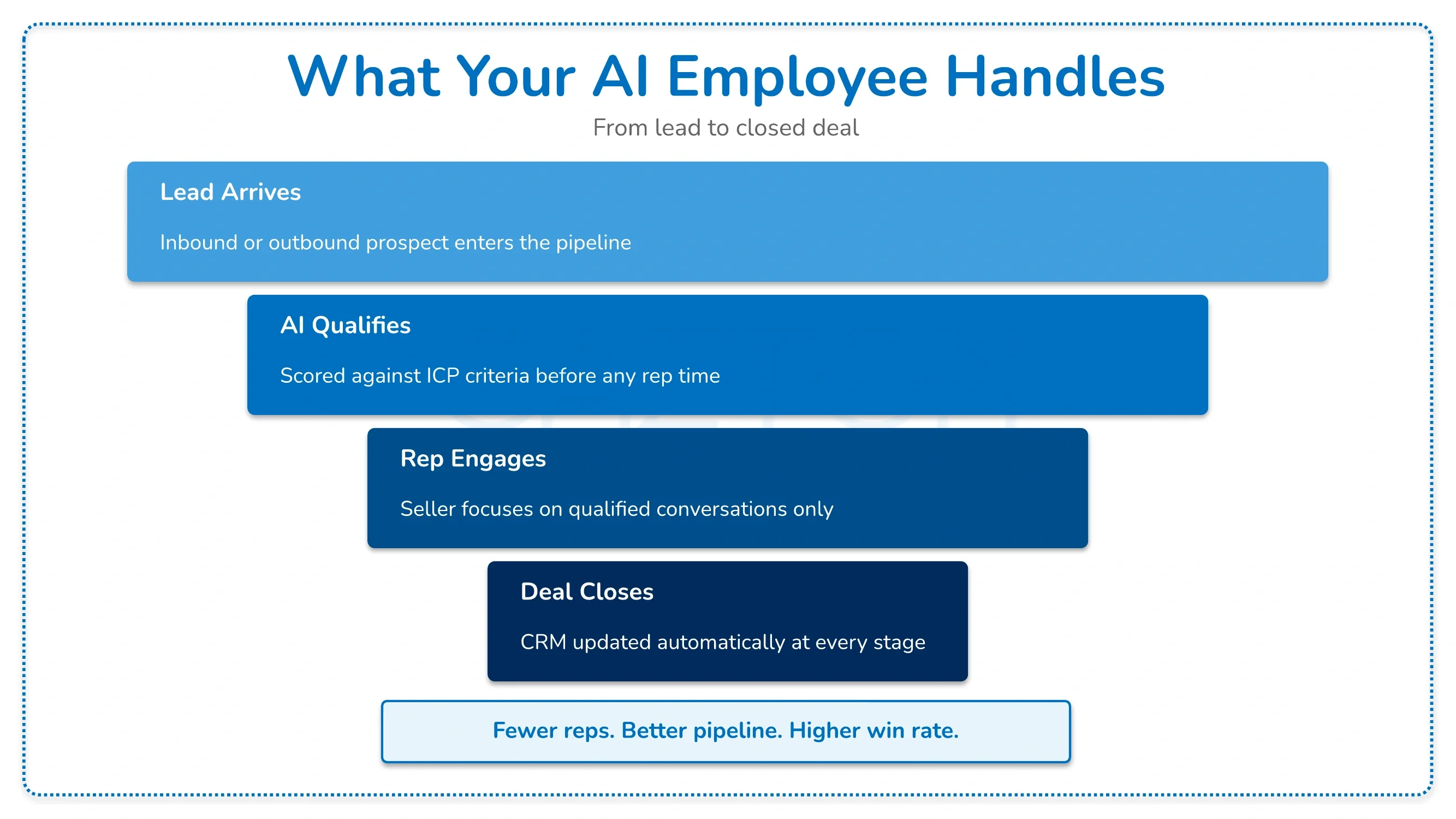
- Pipeline focus: An AI employee for sales handles outreach, qualification, CRM updates, and meeting scheduling so your human sellers focus on closing rather than prospecting.
- Lead qualification: AI employees score and qualify incoming leads against your ideal customer profile before they reach a human, so reps work the pipeline that actually converts.
- Personalized outreach at scale: AI employees draft and send personalized outreach based on prospect data, then manage follow-up sequences automatically.
- CRM accuracy: An AI employee updates Salesforce or HubSpot after every interaction so your pipeline data reflects reality rather than what got entered at week's end.
- Meeting scheduling: AI employees handle the coordination, find open slots, send confirmations, and set reminders without requiring a rep to manage any of it manually.
- Forecast reliability: Sales forecasting improves when the underlying CRM data is current and complete, which AI employees maintain continuously.
- Nurture sequences: AI employees keep relationships with prospects who are not yet ready to buy active without consuming rep time that should go to active opportunities.
- Top clients: We help Fortune 500, large, mid-size and startup companies with AI development, consulting, and hands-on training services. Our clients include Microsoft, Google, Broadcom, Thomson Reuters, Bank of America, Macquarie, Dell and more.
What B2B Sales Teams Are Spending Their Time On and What It Is Costing Them
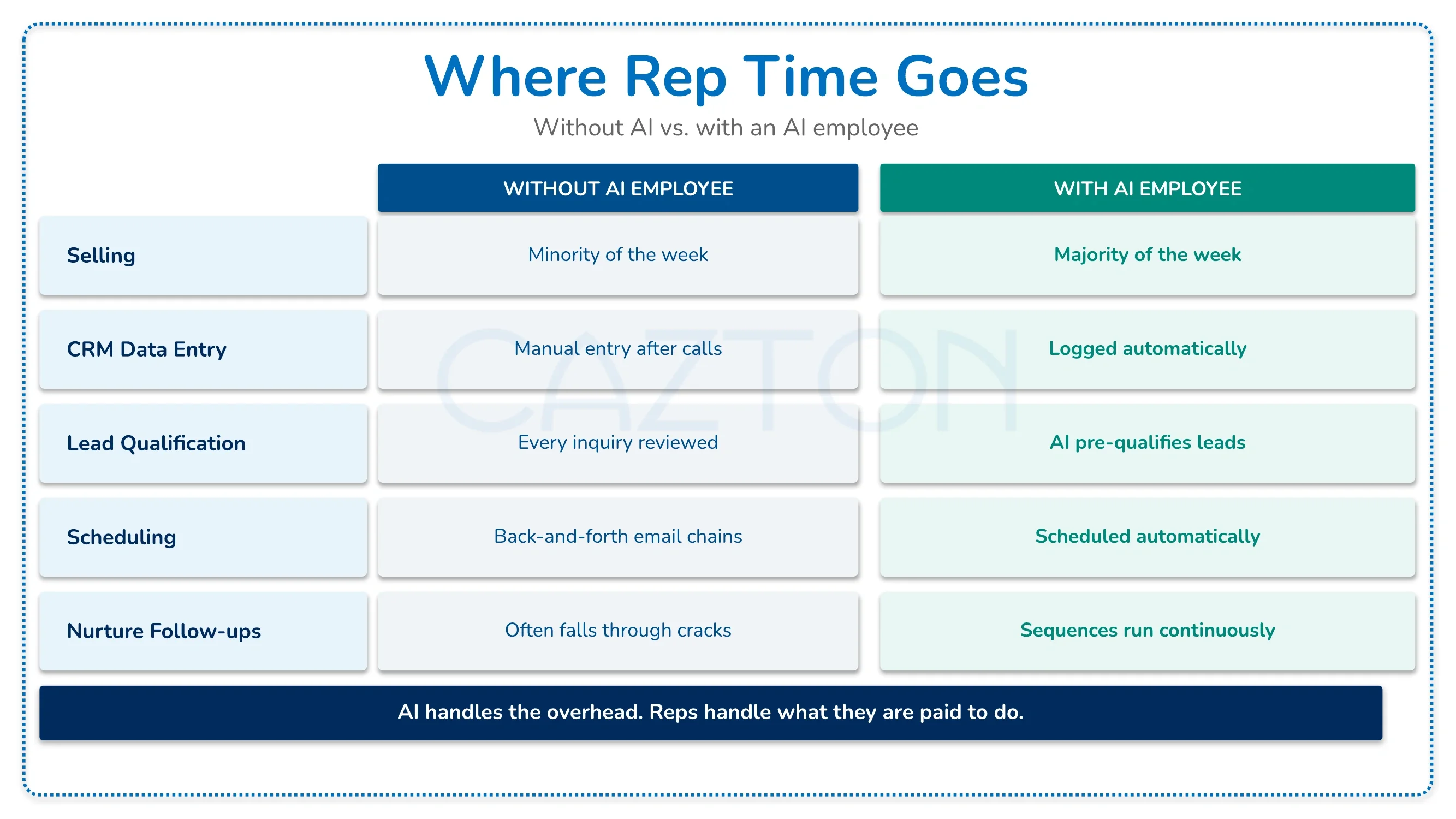
Sales is the function where time allocation is most directly connected to revenue. The activities that move deals forward, such as discovery conversations, solution presentations, relationship development, and negotiation, require human skill and cannot be delegated to automation. But surveys of how B2B sales reps actually spend their time consistently show that selling is a minority of the workweek: the majority goes to CRM logging, responding to low-intent inbound inquiries, sending follow-ups, manually qualifying leads that turn out not to fit the ICP, and managing the scheduling logistics that surround every meeting. The opportunity cost is real and visible: when reps spend significant portions of their time on non-selling activity, they carry fewer qualified opportunities, pipeline quality degrades because qualification is done quickly and inconsistently under time pressure, and CRM records fall behind reality because reps log calls at the end of the week rather than after each interaction.
The inbound qualification problem is particularly common in companies that have invested heavily in demand generation: marketing produces volume, but qualifying that volume falls to reps who then spend time on conversations that were never going to convert. On the outbound side, personalized outreach at scale is extremely time-consuming when done manually: reps either send generic messaging quickly or write personalized messages slowly, sequences fall behind, and prospects who would have responded to a third touch never receive it. AI employees address these allocation problems at the structural level: they handle lead qualification, outbound outreach sequencing, CRM maintenance, meeting scheduling, and nurture management so your reps spend the majority of their available time on the work that requires them. That shift changes the output of the same sales team without requiring additional headcount. Cazton’s AI automation practice builds sales AI employees to create exactly these conditions.
Core Capabilities for a Sales AI Employee
Sales AI employees operate across the top and middle of the funnel, handling the activities that feed your human sellers rather than competing with them. The specific capabilities that matter depend on your go-to-market motion, but the patterns below apply broadly across B2B sales environments.
Key capabilities include:
- Lead qualification and scoring: Evaluate incoming leads against your ideal customer profile using firmographic data, behavioral signals, and engagement history before routing to a rep.
- Outbound outreach: Draft and send personalized prospecting emails and LinkedIn messages at scale, manage follow-up sequences, and track responses automatically.
- CRM maintenance: Log calls, meetings, and email activity automatically so your pipeline records stay current without depending on rep discipline to enter data after every interaction.
- Meeting scheduling: Handle the scheduling coordination between prospects and reps, including availability lookup, confirmation, and reminders, without manual back-and-forth.
- Nurture sequencing: Keep not-yet-ready prospects engaged through a defined outreach cadence so they reach your reps when buying intent is higher.
- Pipeline data for forecasting: Maintain a current, complete record of deal stage, activity history, and next steps so your forecast reflects the actual state of the pipeline.
Lead Qualification and Pipeline Quality
Every sales team has a version of the same problem: inbound volume looks healthy, but a large portion of it does not match what your team actually closes. When reps qualify every lead themselves, they spend time on conversations that should never have been scheduled, and that time comes directly out of the capacity they need for deals that will close.
An AI employee qualifies leads at the front of the process using the criteria you define: company size, industry, role, engagement signals, and whatever firmographic filters reflect your actual customer profile. Leads that do not match get a response that keeps the door open while they continue to develop. Leads that do match are routed to a rep with a summary of why they qualified and what context the rep should know before the first conversation.
This changes the composition of your pipeline. Your reps work a shorter list of better-fit opportunities rather than a longer list that includes noise. And your CRM reflects that quality because the AI employee is maintaining the records rather than leaving it to rep memory at the end of the week.
Outbound Outreach at Scale
Personalized outbound is one of the most time-intensive parts of a sales rep's week. Researching a prospect, drafting a relevant message, and managing the follow-up sequence for each contact takes time that compounds quickly across a full outreach list. AI employees handle this work by combining prospect data with a defined messaging framework to generate outreach that is specific enough to be useful without requiring rep time to produce.
Sequences run on the schedule you define. Follow-ups go out at the right intervals. Responses are monitored and categorized so your AI employee knows when to hand a thread to a rep and when to continue the automated sequence. The consistency of execution that is difficult to maintain manually becomes a structural property of the process rather than a goal to aim for.
Cazton's AI automation practice designs these outbound systems with guardrails that keep your brand voice consistent and your messaging compliant with the communication standards your team and your prospects expect.
CRM Accuracy and Sales Forecasting
Sales forecasting depends entirely on the data underneath it, and that data depends on when and how accurately it gets into your CRM. The gap between when an activity happens and when a rep logs it is where forecast reliability breaks down. When deal stages are updated infrequently and reflect where a deal was rather than where it is, when calls and emails from the previous week get logged in a batch on Friday afternoon, and when active opportunities go without a logged next step because the rep was in back-to-back calls, the pipeline your sales leader presents to leadership is a lagging indicator rather than a current one.
Every call your rep takes, every email that goes out, every meeting that gets scheduled, and every follow-up that completes gets logged automatically in Salesforce, HubSpot, or whichever platform your team runs on. Pipeline data is current because the AI employee maintains it continuously, not because reps found time to update it. That currency flows directly into the reliability of your forecast, the quality of coaching conversations your sales leadership can have with each rep, and the board-level confidence in the numbers. Cazton designs the CRM data mapping that drives this automation to match your existing field structure rather than requiring your team to adapt to a new schema.
Integration with Your Sales Stack
Sales AI employees need to operate inside your existing tools to be useful. A system that requires reps to switch contexts, re-enter data, or manage the AI employee separately from the CRM and outreach tools they already use will not sustain adoption. Cazton designs sales AI employee integrations that fit the workflow rather than adding to it. The AI employee reads from and writes to your existing platforms, and your reps' experience of it is that their tools are working better, not that there is a new tool to manage. Common integration points include:
- CRM platforms: Salesforce, HubSpot, and Microsoft Dynamics for pipeline management, contact records, and activity logging.
- Sales engagement tools: Outreach and similar platforms for sequence management, email tracking, and response monitoring.
- Prospecting databases: LinkedIn Sales Navigator and Apollo for firmographic data and contact enrichment that feeds qualification and outreach personalization.
- Calendar and scheduling: Google Calendar and Microsoft Outlook for meeting scheduling, confirmation, and reminder workflows.
Sales AI Employees for Different Go-To-Market Models
The specific configuration of a sales AI employee varies depending on how your team sells. Inbound-heavy models benefit most from qualification and routing capabilities that filter volume before it reaches reps. Outbound-heavy models benefit most from sequence automation and personalized prospecting at scale. Account-based motions benefit from the AI employee's ability to coordinate outreach across multiple contacts within a target account and track engagement signals across the full account.
Cazton's AI consulting practice works with your sales leadership to map your actual go-to-market motion before designing the AI employee configuration. The goal is a system that fits the way your team sells, not one that requires your team to change how they work to accommodate the technology.
Case Studies: Sales and Lead Generation
An Inbound Problem Disguised as a Sales Capacity Problem
Challenge: An enterprise software company was generating strong inbound lead volume from content and events, but their sales team’s performance was inconsistent in ways that did not map cleanly to rep skill. Some reps were hitting quota and others were not, and the variation seemed to correlate with how much time each rep chose to invest in qualifications before agreeing to a first call. The reps who spent time qualifying were having better conversations but fewer of them. Those who jumped at volume were having more calls but converting less.
Result: Cazton deployed an AI employee that qualified every inbound lead against the company’s ICP criteria before it reached a rep. The AI employee pulled firmographic data, reviewed behavioral signals from the marketing platform, asked qualification questions through an automated pre-meeting sequence, and scored each lead with the relevant context summarized. Reps received leads that had already been screened rather than raw inbound. The conversation quality improved across the team, and the time each rep spent on pre-meeting research decreased because the AI employee had already assembled the relevant background.
Fixing CRM Data Quality Before It Destroyed Forecast Reliability
Challenge: A professional services firm had a Salesforce instance with data quality problems that had accumulated over several years. Reps were inconsistent about logging activity. Deal stages were updated infrequently and often reflected where a deal had been rather than where it was. The revenue forecast that leadership presented to the board was based on pipeline data that the sales manager knew was unreliable, but correcting it manually was not feasible alongside every other responsibility the team carried.
Result: Cazton built an AI employee that integrated with their Salesforce environment and their communication tools. The AI employee automatically logged calls and emails as they occurred, updated deal stages based on activity patterns and rep notes, flagged stale opportunities that had gone without activity beyond a defined threshold, and generated a weekly pipeline summary that reflected current status rather than last week’s state. Within two months of deployment, the revenue forecast the team was working from was materially more accurate, and reps spent less time on CRM administration because the AI employee was handling the logging.
Scaling Outbound Without Scaling the SDR Team
Challenge: A B2B SaaS company in a competitive market had concluded that outbound was necessary for pipeline health but was struggling with the economics of the SDR model. The cost per SDR, combined with ramp time and turnover, made scaling the outbound function expensive and slow. They wanted to increase outbound volume and personalization without a proportional increase in SDR headcount.
Result: Cazton designed an AI employee that owned the outbound sequencing function: researching target accounts, drafting personalized first-touch emails based on company context and recent activity signals, managing follow-up cadences, and routing warm responses to SDRs for qualification conversations. SDRs shifted their time from sequence management to the conversations the AI employee had initiated, running more calls per week because the prospecting overhead had been removed. The outbound program reached more target accounts with consistent messaging quality, and the economics of the function improved without requiring the company to double their SDR headcount.
Building Your Sales AI Employee with Cazton
Sales AI employees require careful configuration because the consequences of getting it wrong are visible: bad outreach damages prospect relationships, miscalibrated qualification logic sends the wrong leads to your reps, and CRM automation that does not map correctly to your data model creates records your team cannot use for forecasting. Unlike back-office deployments where errors surface in reports, sales AI employee failures show up in front of prospects and in leadership dashboards.
Cazton brings AI agent architecture experience to sales deployments with an emphasis on configuration precision before go-live. We work with your sales leadership to define qualification criteria that reflect your actual ICP, build outreach frameworks that your team controls and can iterate, establish CRM data mapping that matches your existing field structure, and create the operational oversight process that keeps the AI employee useful as your market and messaging evolve. We have deployed sales AI employees across B2B companies with different GTM models including inbound-heavy, outbound-led, and account-based approaches, and that experience shapes how we design for your specific motion.
Check out more of our AI employees for your business and explore how intelligent workers are transforming operations across every major business function.
If your reps are spending time on work that should not require their attention, if your pipeline quality is inconsistent, or if your forecast accuracy has been a persistent challenge, this is a practical starting point. Contact Cazton to discuss a sales AI employee configured for your team’s go-to-market structure.
Cazton is composed of technical professionals with expertise gained all over the world and in all fields of the tech industry and we put this expertise to work for you. We serve all industries, including banking, finance, legal services, life sciences & healthcare, technology, media, and the public sector. Check out some of our services:
- Artificial Intelligence
- Big Data
- Web Development
- Mobile Development
- Desktop Development
- API Development
- Database Development
- Cloud
- DevOps
- Enterprise Search
- Blockchain
- Enterprise Architecture
Cazton has expanded into a global company, servicing clients not only across the United States, but in Oslo, Norway; Stockholm, Sweden; London, England; Berlin, Germany; Frankfurt, Germany; Paris, France; Amsterdam, Netherlands; Brussels, Belgium; Rome, Italy; Sydney, Melbourne, Australia; Quebec City, Toronto Vancouver, Montreal, Ottawa, Calgary, Edmonton, Victoria, and Winnipeg as well. In the United States, we provide our consulting and training services across various cities like Austin, Dallas, Houston, New York, New Jersey, Irvine, Los Angeles, Denver, Boulder, Charlotte, Atlanta, Orlando, Miami, San Antonio, San Diego, San Francisco, San Jose, Stamford and others. Contact us today to learn more about what our experts can do for you.
