

AI Employees for Finance
- High-volume processing: An AI employee for finance handles invoice processing, expense matching, AP/AR tracking, and routine compliance checks without requiring manual review for standard cases.
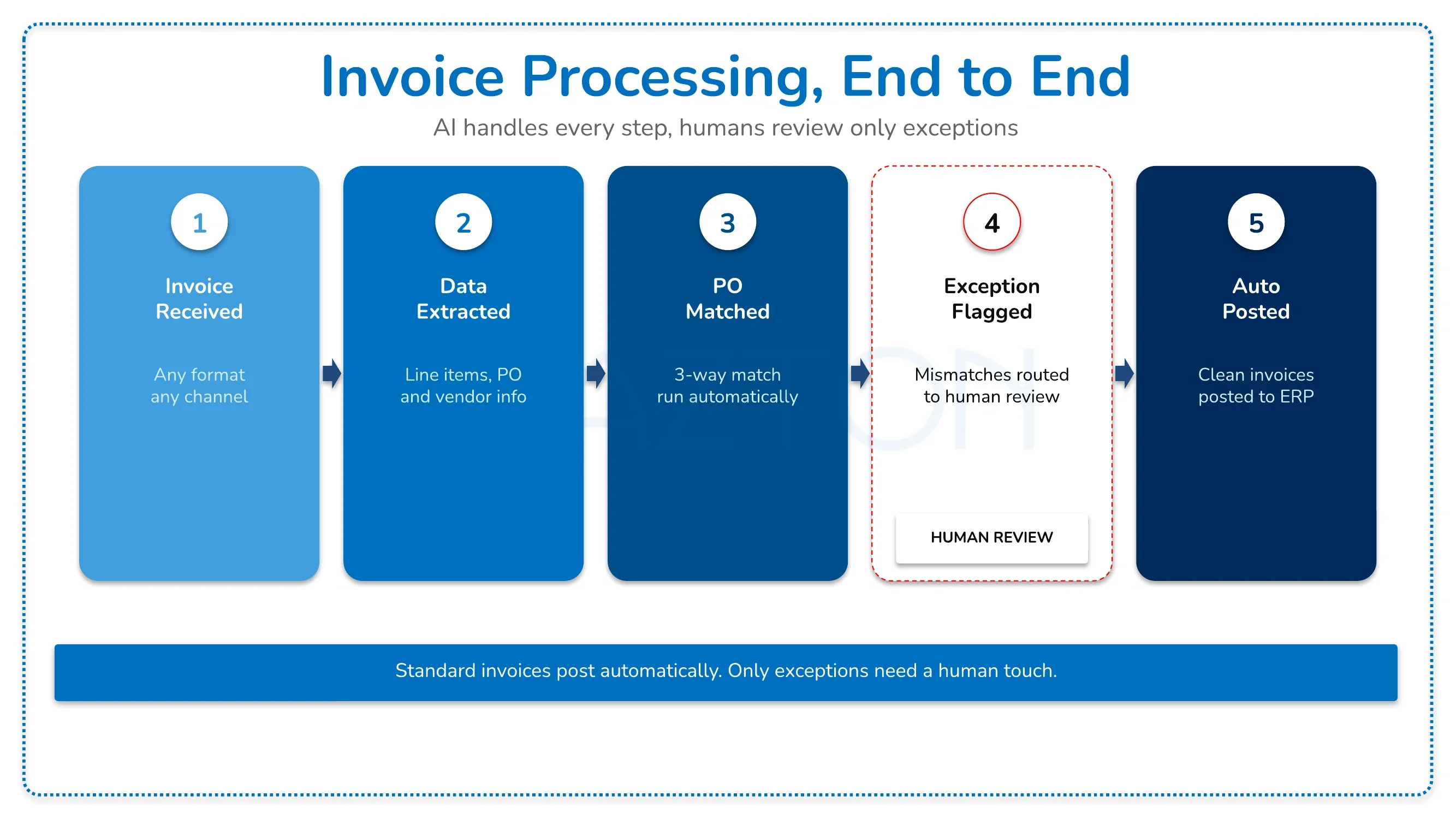
- Invoice automation: AI employees read, validate, and match invoices against purchase orders so your team reviews exceptions rather than every document.
- Anomaly detection: Built-in detection flags unusual transactions, duplicate entries, and policy violations before they compound into larger problems.
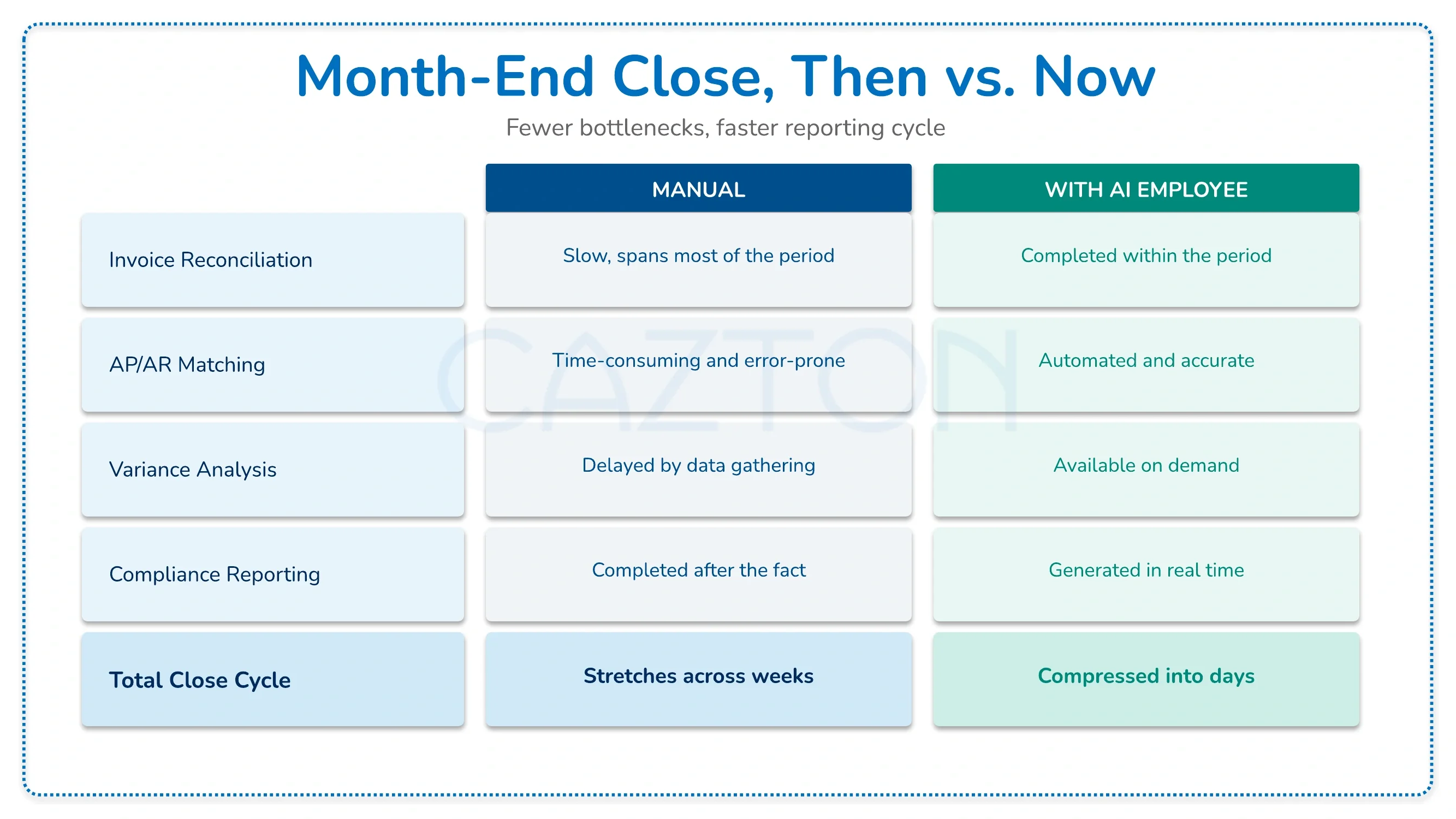
- Close cycle acceleration: AI employees handle the reconciliation work that creates bottlenecks at period end so your team can close faster and with higher accuracy.
- Compliance reporting: AI employees apply reporting rules uniformly across high data volumes, without the variance that comes from manual review at scale.
- ERP integration: Works inside QuickBooks, Xero, NetSuite, and SAP so your AI employee connects to your existing financial systems rather than requiring a separate workflow layer.
- Cash position visibility: AP and AR automation reduces the lag between transaction and record, giving your finance team a more current view of cash position and outstanding obligations.
- Top clients: We help Fortune 500, large, mid-size and startup companies with AI development, consulting, and hands-on training services. Our clients include Microsoft, Google, Broadcom, Thomson Reuters, Bank of America, Macquarie, Dell and more.
Where Finance and Accounting Teams Lose Time They Cannot Afford to Lose
Finance and accounting sit at an unusual intersection: the function is too important to tolerate errors, and the most error-prone work is also the most repetitive. Invoice matching, expense reconciliation, AP and AR management, and period-end close all involve high volumes of structured data and rules that should work the same way every time. In practice, they do not, because humans do not perform repetitive tasks with consistent accuracy at high volumes under time pressure. The structural problem runs deeper: most of what finance teams spend their time on is not actually finance. It is data management. A senior accountant who spends a meaningful portion of their week keying invoice data, chasing approvals through email chains, and reconciling discrepancies that should not exist is not doing the work their experience qualifies them for.
The downstream effects compound. AP teams that fall behind strain vendor relationships and introduce cash flow uncertainty. Month-end close that runs long delays the reporting cycles leadership depends on for decisions. Compliance checks performed by hand have coverage gaps that surface during audits rather than before them. Earlier finance automation meant rigid rule-based tools that broke when invoice formats deviated from expectations. An AI employee handles that variation: it reads a non-standard invoice format, checks it against the purchase order, identifies the discrepancy, and routes it for human review rather than processing it incorrectly. The combination of broad processing capability and accurate exception handling is what makes AI employees practical in production finance environments. Hours spent matching invoices and generating routine reports are hours not spent on forecasting, scenario modeling, and the capital allocation decisions that Cazton’s AI automation practice builds AI employees to give back to your finance team.
Core Capabilities for Finance and Accounting Deployment
Finance AI employees operate across the full transaction lifecycle, from intake through reconciliation and reporting. The capabilities that matter most in practice are those that reduce the gap between when a transaction occurs and when it is accurately reflected in your systems.
Core capabilities include:
- Invoice processing: Extract data from incoming invoices, validate against purchase orders, and route exceptions for human review while processing standard cases automatically.
- Expense reconciliation: Match expense submissions against policy rules, flag out-of-policy items, and prepare reconciled reports for approval.
- AP and AR automation: Track outstanding payables and receivables, generate payment runs, and send reminders based on due date and customer payment history.
- Anomaly detection: Identify unusual patterns in transaction data, including duplicates, policy violations, and amounts that fall outside expected ranges based on historical data.
- Compliance reporting: Apply regulatory and internal policy rules consistently across transaction data and generate reports in the required format for audit and review.
- Period-end support: Accelerate financial close by handling reconciliation tasks that typically create bottlenecks at month-end and quarter-end.
Invoice Processing and Accounts Payable Automation
Invoice processing is one of the clearest early deployments for a finance AI employee because the underlying task is well-defined, high-volume, and costly when done manually at scale. Your AI employee receives incoming invoices across channels, extracts the relevant fields, validates line items against corresponding purchase orders, checks vendor records, and routes anything that does not match for human review.
Standard cases are processed, matched, and logged without human intervention. Exceptions surface in a structured queue with the specific discrepancy identified, the relevant purchase order and receiving documentation attached, and the variance calculated, giving the reviewer everything needed to make a decision in seconds rather than spending time reconstructing the issue themselves. This shifts what your AP team does: instead of processing volume, they manage vendor relationships, resolve exceptions that require negotiation or judgment, and act on the visibility the AI employee provides rather than spending time creating it.
Accounts payable automation extends the same pattern across your payment cycle. Your AI employee tracks due dates, prepares payment runs based on terms and cash position inputs, and flags anything that requires an exception decision before processing. Cazton's AI consulting team designs these workflows with your existing approval hierarchy in mind, so automation fits inside your controls rather than bypassing them.
Anomaly Detection and Compliance Monitoring
Financial data contains signals that manual review often misses, not because analysts are careless, but because the volume of transactions makes comprehensive review impractical. An AI employee embedded in your financial workflows monitors every transaction against the patterns established by your historical data and your policy rules.
When something deviates from those patterns, whether a duplicate invoice, a vendor amount that falls outside the expected range, or an expense that violates policy, the AI employee flags it before it progresses further in the workflow. That early detection is more valuable than catching errors at audit time, when corrections are costlier and the downstream effects are harder to unwind.
Compliance reporting follows the same logic: consistent application of rules across high transaction volumes is exactly what AI employees do reliably and what humans struggle to maintain at scale. Cazton's AI consulting practice works with your finance and compliance teams to configure the specific rule sets your reporting environment requires, whether SOX documentation, internal audit standards, or industry-specific financial regulations, so the AI employee generates the reports your auditors and controllers need without requiring your team to assemble them manually at each reporting cycle.
Financial Close and Reconciliation Support
Period-end close is a predictable pressure point for most finance teams. The work is concentrated, the deadlines are firm, and delays in reconciliation compress the time available for review and sign-off. AI employees reduce that pressure by handling the reconciliation tasks that typically accumulate during the close cycle.
Balance sheet reconciliations, intercompany eliminations, accrual calculations, and variance analysis each involve pulling data from multiple sources, applying defined logic, and producing a structured output for review. An AI employee handles those steps and surfaces the results in the format your team uses to complete the close, whether that is a spreadsheet, a report in your ERP, or a structured data file for downstream processing.
Cazton's big data practice supports finance AI deployments that involve aggregating data from multiple systems, including ERPs, data warehouses, and reporting tools, so your AI employee works from a consolidated, accurate data foundation rather than having to reconcile source systems itself.
System Integrations for Finance AI Employees
Integration quality determines how much of your finance AI employee's output you can actually trust. A system that reads invoice data from one source and posts results to another will produce accurate outputs only if the connection handles edge cases such as non-standard field mapping, document parsing variation, and ERP posting rules specific to your chart of accounts, correctly from the start. Cazton's integration engineering handles that depth of connection so your AI employee operates reliably inside your existing financial infrastructure rather than requiring ongoing manual reconciliation to verify what it has processed. Common integration points include:
- ERP and accounting platforms: QuickBooks, Xero, NetSuite, and SAP for transaction records, chart of accounts, and financial reporting output.
- Spreadsheet and reporting tools: Microsoft Excel and Google Sheets where finance teams continue to do analysis and reporting outside the ERP.
- Payment and billing systems: Stripe and similar platforms for revenue transaction data and reconciliation against your accounting records.
- Document and email systems: Invoice intake from email, PDF parsing, and document management integration for AP workflows.
Audit Readiness and Control Preservation
One concern that consistently comes up in finance AI deployments is audit trail integrity. Finance teams operate under requirements to document who made what decision and on what basis. AI employees are designed to work within those requirements rather than around them.
Every action an AI employee takes is logged: what data was reviewed, what rule was applied, what the outcome was, and whether the case was resolved automatically or routed for human approval. That log is available for audit at any point and provides a cleaner trail than many manual workflows, where the reasoning behind a decision may not be captured at all. Cazton's AI governance practice ensures these audit requirements are built into the system design from the start, not added as an afterthought.
Case Studies: Finance and Accounting
When an AP Team Was Buried Under Paper
Challenge: A mid-size manufacturing company came to Cazton with an accounts payable operation that had not scaled with the business. Their AP team was processing a large volume of invoices monthly, the majority arriving as PDF attachments or scanned paper. Three-way matching against purchase orders was done manually. Exception handling happened through email. The team was consistently behind, payment runs were delayed, and early payment discounts the company was entitled to were being missed because approvals could not complete in time.
Result: Cazton deployed an AI employee integrated with their ERP system and email infrastructure. The AI employee extracted invoice data, performed three-way matching against open POs, categorized exceptions by type, and routed them to the appropriate approver with the relevant context pre-populated. Standard invoices cleared without human intervention. Approvers received exception notifications with everything they needed to make a decision rather than having to locate the PO, find the receiving document, and calculate the variance themselves. The AP team shifted from processing volume to managing exceptions, vendor communications, and process improvement.
Shortening a Close Cycle That Consumed the Finance Team Every Month
Challenge: A professional services firm with multiple operating entities and a complex intercompany structure was running a month-end close cycle that stretched well into the following month. The reconciliation work across entities was manual: pulling balances, matching intercompany transactions, identifying discrepancies, and resolving them through a coordination process involving multiple people across locations. By the time the books were closed, leadership was already asking questions the team could not yet answer.
Result: Cazton designed an AI employee deployment that automated the reconciliation workflows across their entities. Intercompany balances were matched automatically, discrepancies were flagged with supporting detail, and the reconciliation status for each entity was visible in real time rather than only knowable after someone had completed their portion of the work. The close cycle shortened meaningfully, and the finance team spent the time they recovered on the analysis and reporting their leadership was waiting for rather than on the reconciliation work that preceded it.
Restoring Expense Policy Compliance Across a Distributed Workforce
Challenge: A technology company with a large distributed employee base had an expense reporting problem that was easy to diagnose and difficult to solve at manual review scale. Policy violations including out-of-category spend, missing receipts, and amounts above per-meal limits were common, but the volume of expense reports submitted monthly made thorough manual review impractical. Reviewers were approving reports they had not fully examined, and the cost of uncaught violations was accumulating.
Result: Cazton deployed an AI employee integrated with their expense management platform. Every submission was reviewed against the full policy ruleset before it reached a human approver. Violations were flagged with the specific rule citation, the dollar amount at issue, and a suggested action for the approver. Approvers handled exceptions rather than conducting full reviews. Comprehensive coverage and specific flagging changed the economics of expense policy enforcement without requiring additional headcount in finance.
Building Your Finance AI Employee with Cazton
Finance is a domain where automation confidence matters as much as automation capability. Your team needs to trust that what the AI employee processes is processed correctly, that what it flags is genuinely worth reviewing, and that every action it takes is logged in a format that satisfies your audit requirements. Those are not features to add later. They are design requirements that determine whether the deployment earns the team's trust or creates skepticism that is hard to recover from.
Cazton designs finance AI agent deployments with your existing controls and audit requirements as the starting point. We work with your finance leadership and your accounting team to map actual workflows rather than idealized ones, define exception thresholds based on your real risk tolerance, and build integration connections into the systems that contain your financial data. We have deployed finance AI employees across organizations with different ERP environments, different compliance requirements, and different levels of existing automation maturity. That range of experience informs every deployment we take on.
Check out more of our AI employees for your business and explore how intelligent workers are transforming operations across every major business function.
If your team is spending a disproportionate share of its time on transaction processing rather than financial analysis, or if your close cycles are consistently running longer than they should, this is a practical place to start. Contact Cazton to discuss an AI employee built for your finance and accounting environment.
Cazton is composed of technical professionals with expertise gained all over the world and in all fields of the tech industry and we put this expertise to work for you. We serve all industries, including banking, finance, legal services, life sciences & healthcare, technology, media, and the public sector. Check out some of our services:
- Artificial Intelligence
- Big Data
- Web Development
- Mobile Development
- Desktop Development
- API Development
- Database Development
- Cloud
- DevOps
- Enterprise Search
- Blockchain
- Enterprise Architecture
Cazton has expanded into a global company, servicing clients not only across the United States, but in Oslo, Norway; Stockholm, Sweden; London, England; Berlin, Germany; Frankfurt, Germany; Paris, France; Amsterdam, Netherlands; Brussels, Belgium; Rome, Italy; Sydney, Melbourne, Australia; Quebec City, Toronto Vancouver, Montreal, Ottawa, Calgary, Edmonton, Victoria, and Winnipeg as well. In the United States, we provide our consulting and training services across various cities like Austin, Dallas, Houston, New York, New Jersey, Irvine, Los Angeles, Denver, Boulder, Charlotte, Atlanta, Orlando, Miami, San Antonio, San Diego, San Francisco, San Jose, Stamford and others. Contact us today to learn more about what our experts can do for you.
