

AI Employees for Legal & Compliance
- Document-intensive work automation: An AI employee for legal and compliance handles contract review, regulatory monitoring, document search, and standard agreement generation without requiring the judgment calls that define legal practice.
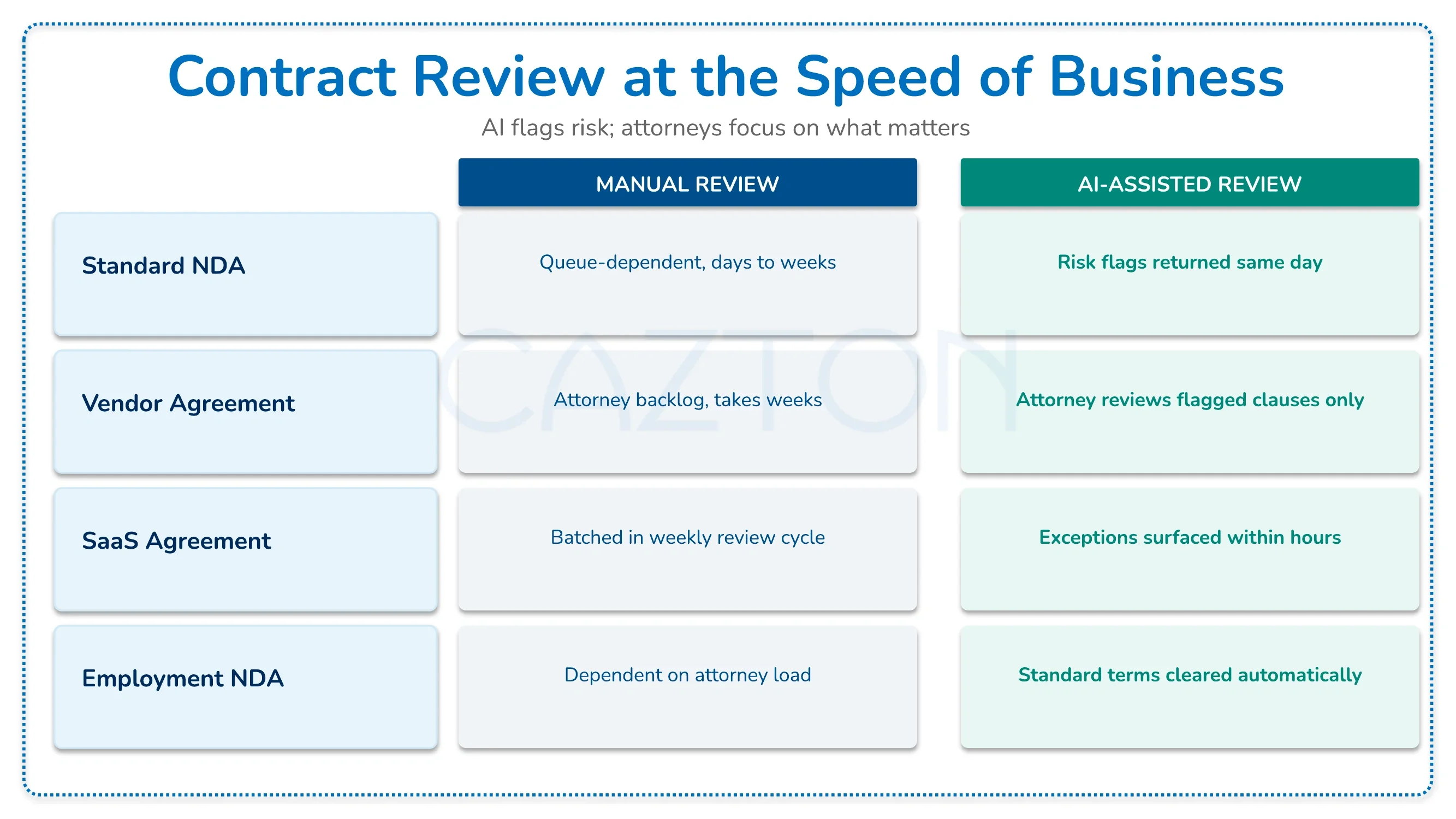
- Contract review: AI employees review agreements against defined risk parameters and flag clauses that require attorney attention so legal teams focus on provisions that carry actual legal risk.
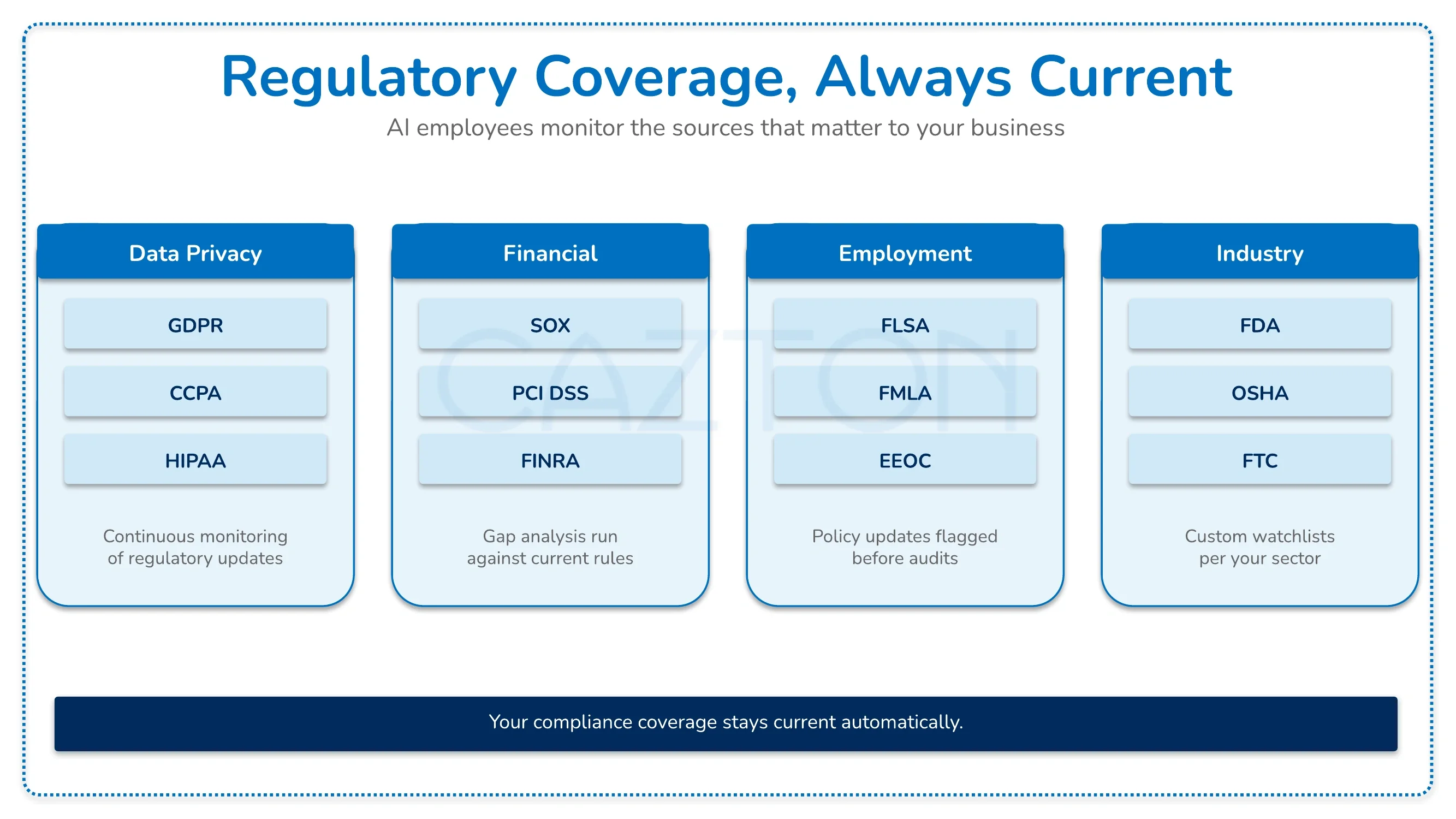
- Regulatory monitoring: AI employees track the regulatory sources relevant to your business and surface material updates before they become compliance gaps.
- Document search and summarization: AI employees locate relevant precedents, extract key terms, and generate structured summaries so attorneys get the information they need without conducting the search themselves.
- Standard agreement generation: AI employees generate first drafts from defined templates so attorneys spend time on negotiation and exception review rather than routine document assembly.
- Compliance gap analysis: AI employees run comparisons against regulatory requirements continuously, flagging gaps as they emerge rather than surfacing them during scheduled audits.
- Due diligence support: AI employees process documents at speed, flag issues requiring attorney review, and provide structured summaries so legal teams receive organized findings rather than raw documents.
- Top clients: We help Fortune 500, large, mid-size and startup companies with AI development, consulting, and hands-on training services. Our clients include Microsoft, Google, Broadcom, Thomson Reuters, Bank of America, Macquarie, Dell and more.
The Legal Function’s Real Capacity Problem
Legal and compliance teams face a structural mismatch between what they are needed for and how their time is actually allocated. An attorney’s value comes from legal judgment: identifying risks in a contract that require negotiation, advising on regulatory exposure, making strategic decisions about how to structure transactions or respond to disputes. But a significant portion of what legal and compliance staff spend their time doing does not require that judgment. Reviewing a standard vendor contract for common risk factors follows a checklist-style logic. Generating an NDA involves filling variables into a template. Monitoring regulatory sources for updates that affect compliance obligations is systematic tracking, not legal analysis. All of this work is necessary. None of it optimally requires the people who are currently doing it.
The volume problem compounds the capacity problem. A mid-market company going through a busy growth period might generate dozens of vendor agreements, partnership contracts, and customer agreements in a single month. An in-house legal team of two or three attorneys reviewing all of those agreements in addition to their regulatory, employment, and dispute work cannot maintain a review turnaround that keeps business moving at the pace business requires. Regulatory compliance monitoring has the same dynamic: the number of frameworks that apply across employment, data privacy, financial reporting, and industry-specific obligations has grown substantially, and tracking those changes and maintaining compliance documentation consumes time without requiring legal judgment to execute. AI employees handle the document processing and monitoring work that precedes legal judgment so that judgment is better informed and faster to apply when it matters. Cazton builds legal AI employees that surface issues for attorney review rather than replace attorney review, and our AI governance practice ensures that confidentiality, privilege, and data handling requirements are built into the architecture from the start.
Core Capabilities for a Legal and Compliance AI Employee
Legal and compliance AI employees address the document volume, the research burden, and the monitoring continuity requirements that most teams struggle to meet with existing staff capacity. Core capabilities include:
- Contract review and risk flagging: Review agreements against defined risk parameters, flag clauses that deviate from standard terms or exceed defined risk thresholds, and generate structured summaries of flagged provisions for attorney review.
- Standard agreement generation: Draft NDAs, vendor agreements, consulting contracts, and other standard documents from defined templates with the variable information specific to each transaction.
- Regulatory monitoring: Track regulatory sources across the jurisdictions and frameworks relevant to your business, surface material updates, and flag changes that require policy or process updates.
- Document search and summarization: Locate relevant documents across large repositories, extract key terms and provisions, and generate structured summaries that give legal teams organized findings rather than raw search results.
- Compliance gap analysis: Compare current practices and documentation against regulatory requirements, flag discrepancies, and track remediation status so compliance teams have a continuous view of their gap position rather than a point-in-time audit result.
- Due diligence document processing: Process large document sets under time constraints, flag issues for attorney review, and summarize findings in a structured format that accelerates the overall due diligence process.
Contract Review and Document Drafting
Contract review is one of the clearest examples of work where AI employees produce immediate capacity gains. The review of a standard vendor agreement against a defined set of risk parameters, acceptable deviation ranges, and required clause inclusions follows a consistent logic that an AI employee can apply faster and more consistently than a manual read. The attorney's time then goes to the flagged provisions: the non-standard risk allocation, the liability cap that is outside acceptable range, the indemnification language that needs negotiation.
Standard agreement generation follows the same efficiency logic. An NDA or vendor services agreement that follows a defined template requires customization of specific fields, variable language based on the transaction type, and occasionally adjustment to non-standard terms. An AI employee generates the first draft with those customizations applied so the attorney reviews and refines rather than drafting from a blank template.
Cazton's AI consulting practice works with legal teams to define the risk parameters, flagging logic, and template frameworks that govern AI employee contract work. The quality of that configuration determines the quality of the AI employee's output, and it is the work that requires legal expertise to do correctly.
Regulatory Monitoring and Compliance Intelligence
Regulatory monitoring is difficult to do well manually because the volume of relevant regulatory activity across jurisdictions, agencies, and subject matter areas is too large for any team to track comprehensively while also doing the compliance implementation work that monitoring is supposed to inform. Teams that try typically track a subset of sources and discover coverage gaps when something they should have caught becomes an issue.
AI employees remove that coverage gap by monitoring the relevant regulatory sources continuously. When a material update occurs in a regulatory area that affects your compliance obligations, your AI employee surfaces it with the relevant context: what changed, which regulatory framework it affects, and what the potential compliance implications are. Your compliance team receives intelligence rather than noise, because the scope of monitoring is defined to match your actual regulatory exposure.
Cazton's AI governance practice is central to how we build compliance monitoring AI employees. The overlap between AI governance and regulatory compliance is significant, particularly for organizations that use AI systems in regulated functions. We design monitoring frameworks that reflect both your existing regulatory obligations and the emerging requirements specific to AI-driven business operations.
Due Diligence and Document Repository Search
Due diligence processes compress high-volume document review into compressed timelines. The conventional approach requires assembling a review team, dividing the document set, and coordinating findings across reviewers working in parallel. The results are inconsistent in terms of what each reviewer flags and at what threshold, and the volume limits how deeply any individual document receives attention.
AI employees process documents at a speed and consistency not achievable through manual review. Every document in the set receives the same review logic applied against the same flagging parameters. The attorneys receive organized findings with flagged items surfaced for their review rather than raw document sets to process themselves. The role of legal judgment in due diligence shifts from document processing to evaluating the flagged risks and making the strategic calls those risks inform.
Repository search follows the same principle. Finding relevant precedent, locating a specific clause across a contract repository, or identifying all agreements with a particular counterparty or term structure requires search capabilities that manual methods do not provide at the speed and accuracy the AI employee delivers. The AI automation infrastructure Cazton builds for legal teams makes these capabilities available within the workflows attorneys and paralegals already use.
Legal Platform Integrations
Legal AI employee effectiveness depends on integration into the systems where contracts and compliance-relevant documents actually live. Contract review needs access to the contract as stored in your CLM or repository, not a PDF uploaded for one-time processing. Regulatory monitoring needs to write findings to the workflow where attorneys track obligations, not generate a separate report file. Cazton builds these integrations to your legal technology stack so your AI employee operates within your existing processes rather than requiring a parallel one. Common integration points include:
- Contract lifecycle management: Platforms like Ironclad and ContractPodAi where contracts are stored, tracked, and managed through signature and renewal cycles.
- Document management: iManage, NetDocuments, and similar systems where legal documents and matter files are organized and searched.
- E-signature platforms: DocuSign and similar tools for agreement execution that the AI employee can trigger and track as part of the contract workflow.
- Legal research platforms: LexisNexis and Westlaw integrations that allow the AI employee to retrieve and summarize relevant legal research as part of matter support functions.
- Practice management systems: Clio and similar platforms for matter tracking, billing, and client communication that tie AI employee outputs to the operational records of the legal function.
Case Studies: Legal and Compliance
When Contract Review Turnaround Was Creating Business Friction
Challenge: A technology company’s in-house legal team was handling a growing volume of vendor agreements, software licensing contracts, and partnership agreements alongside their employment, regulatory, and dispute work. Their review turnaround on commercial contracts had stretched to two weeks during busy periods, which was creating friction with business teams trying to close deals and finalize vendor relationships. The legal team was not behind because they were slow; they were behind because there was more work than their capacity could handle without all of it looking the same from a prioritization standpoint.
Result: Cazton built a contract review AI employee that processed incoming agreements against the legal team’s defined risk parameters, flagged clauses that deviated from standard terms or exceeded the thresholds the attorneys established, and generated a structured risk summary for each document. The legal team reviewed the summaries and the flagged provisions rather than reading each contract from beginning to end. Standard agreements with no material issues were cleared faster. Agreements with complex or unusual terms got more attorney attention because the routine review work was no longer consuming the same time. The business teams experienced a shorter turnaround on commercial contracts, and the legal team spent their review time on the provisions that actually required their judgment.
Keeping Compliance Current Across a Multi-Jurisdiction Regulatory Landscape
Challenge: A financial services firm with operations across multiple jurisdictions had a regulatory monitoring challenge. The compliance team was responsible for tracking updates across securities regulations, data privacy frameworks, anti-money-laundering requirements, and consumer protection rules in each jurisdiction where the firm operated. The volume of regulatory publications, guidance documents, and enforcement actions relevant to their business exceeded what the team could systematically review without some of it falling through the gaps.
Result: Cazton deployed a regulatory monitoring AI employee that tracked the relevant regulatory sources across each applicable jurisdiction, processed new publications for relevance to the firm’s specific activities, and delivered structured summaries of material updates to the compliance team with an initial assessment of whether each update required a policy review, a process change, or a reporting action. The compliance team shifted from attempting to monitor an unmanageable volume of regulatory output to receiving curated, actionable summaries of what had changed and what it meant. Their gap assessment work became systematic rather than dependent on the volume of regulatory reading each team member had managed to complete in a given week.
Compressing a Diligence Timeline Without Reducing Coverage
Challenge: A private equity firm managing an active deal pipeline had a diligence timeline problem. Their diligence process required reviewing large document sets including contracts, employment agreements, regulatory filings, and litigation records, under the time pressure that M&A transactions impose. Their attorneys and outside counsel were spending significant hours on document review and extraction work to identify the issues that required legal analysis, which compressed the time available for the actual analysis and created cost pressure on every transaction.
Result: Cazton built a diligence AI employee that processed deal-specific document sets, extracted key terms and provisions, flagged risk areas against the firm’s defined diligence criteria, and organized findings in a structured format categorized by issue type and severity. The attorneys conducting diligence received organized findings rather than raw documents, which meant their time went to analyzing the issues the AI employee surfaced rather than finding those issues in the document volume. Diligence coverage improved because the document processing work was no longer the constraint, and the timeline became more predictable because the extraction phase that had previously been variable in duration was now handled by the AI employee at consistent speed.
Building Your Legal AI Employee with Cazton
Legal AI deployments require attention to the accuracy standards legal work demands, the confidentiality requirements governing the documents being processed, and the clear boundary between AI-assisted processing and attorney judgment. Cazton builds legal AI employees with those requirements as foundational architecture decisions. The systems we deploy are designed to surface issues for attorney review and to make attorney time more productive, not to replace the legal analysis that organizations depend on their attorneys to provide.
The configuration work matters as much as the technology. Defining which risk factors to flag, what deviation from standard terms looks like in your specific contract types, which regulatory sources apply to your jurisdictions and industries, and how escalation thresholds should be calibrated to your risk tolerance. All of that is done in collaboration with your legal team. Our AI governance practice ensures data handling, access controls, and privilege considerations are addressed in the design. Cazton’s experience across enterprise technology and regulated industries means we have already encountered the edge cases that legal AI deployments surface in practice.
Check out more of our AI employees for your business and explore how intelligent workers are transforming operations across every major business function.
Contact Cazton to discuss a legal and compliance AI employee built for your team’s document volume, regulatory monitoring scope, and review workflow requirements.
Cazton is composed of technical professionals with expertise gained all over the world and in all fields of the tech industry and we put this expertise to work for you. We serve all industries, including banking, finance, legal services, life sciences & healthcare, technology, media, and the public sector. Check out some of our services:
- Artificial Intelligence
- Big Data
- Web Development
- Mobile Development
- Desktop Development
- API Development
- Database Development
- Cloud
- DevOps
- Enterprise Search
- Blockchain
- Enterprise Architecture
Cazton has expanded into a global company, servicing clients not only across the United States, but in Oslo, Norway; Stockholm, Sweden; London, England; Berlin, Germany; Frankfurt, Germany; Paris, France; Amsterdam, Netherlands; Brussels, Belgium; Rome, Italy; Sydney, Melbourne, Australia; Quebec City, Toronto Vancouver, Montreal, Ottawa, Calgary, Edmonton, Victoria, and Winnipeg as well. In the United States, we provide our consulting and training services across various cities like Austin, Dallas, Houston, New York, New Jersey, Irvine, Los Angeles, Denver, Boulder, Charlotte, Atlanta, Orlando, Miami, San Antonio, San Diego, San Francisco, San Jose, Stamford and others. Contact us today to learn more about what our experts can do for you.
