
AI Employees for IT Support
- Tier 1 and operational coverage: An AI employee for IT support handles ticket triage, password resets, access provisioning, system monitoring, and basic troubleshooting without requiring engineering expertise.
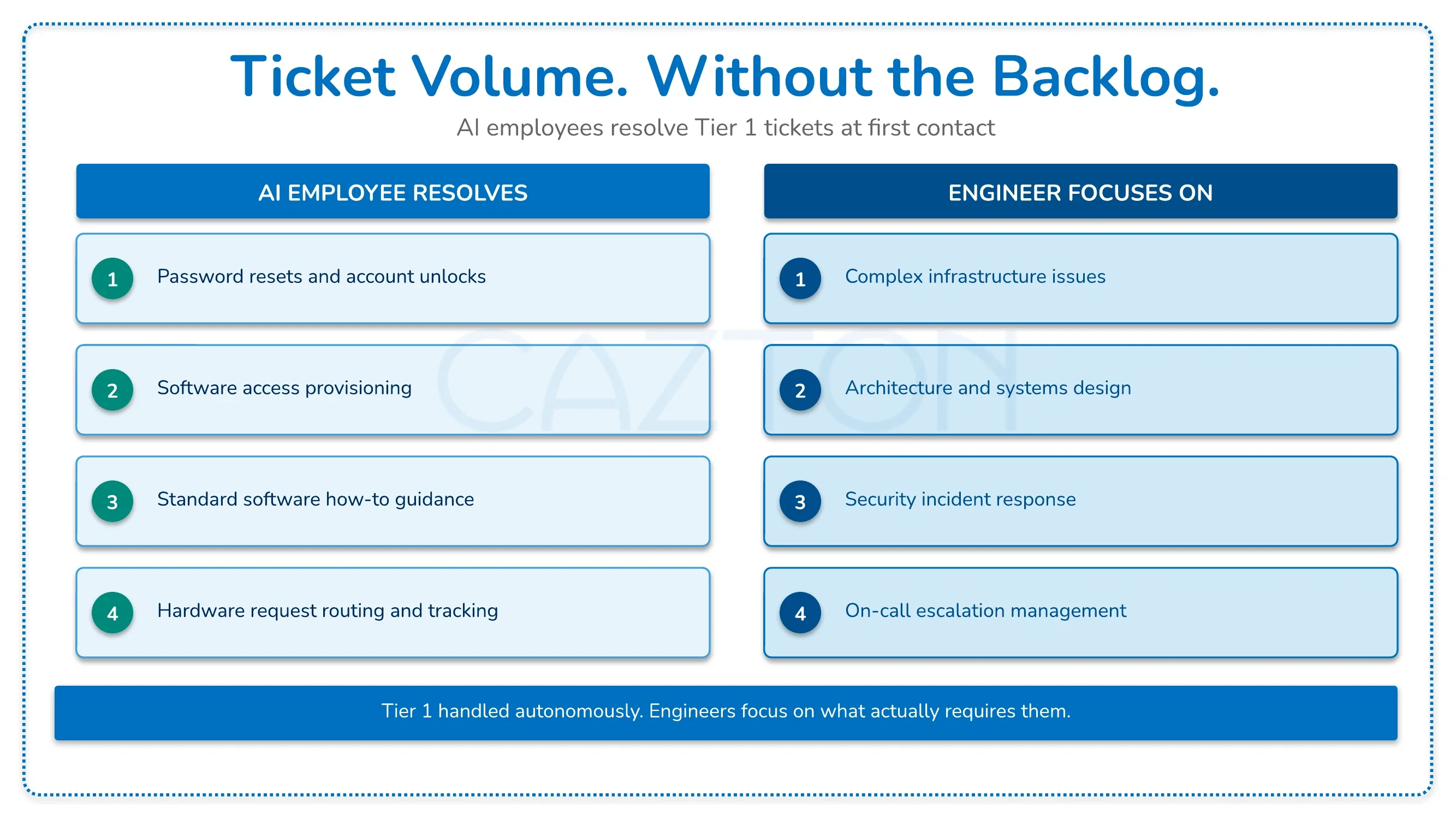
- First-contact resolution: AI employees handle a large share of incoming tickets autonomously, resolving issues that follow known patterns immediately rather than routing everything through a human queue.
- Access and identity tasks: Password resets and access provisioning are resolved automatically, freeing IT staff for work that requires system knowledge and engineering judgment.
- Continuous monitoring: AI employees monitor system health, detect anomalies, and surface alerts with relevant context so engineers are notified before users report issues.
- Patch management: AI employees track patch status, schedule updates within defined maintenance windows, and flag systems running behind current security release standards.
- User onboarding: AI employees run the provisioning sequence automatically so new employees have accounts, access, and device setup completed on day one without manual coordination per hire.
- Incident pattern analysis: AI employees analyze ticket history to identify recurring issues and surface recommendations that address root causes rather than individual symptoms.
- Top clients: We help Fortune 500, large, mid-size and startup companies with AI development, consulting, and hands-on training services. Our clients include Microsoft, Google, Broadcom, Thomson Reuters, Bank of America, Macquarie, Dell and more.
Why IT Teams Stay Reactive Even When They Know the Problems
IT’s role in a modern organization has expanded significantly beyond what most IT teams are staffed to handle. The support function manages the daily operational needs of every employee in the company: access requests, device issues, software problems, connectivity failures, and a continuous stream of inquiries that arrive without any predictable pattern. The infrastructure function runs the systems those employees depend on, monitors performance and security posture, and maintains the patch and update cycles that keep the environment secure. What makes this difficult is ticket volume composition: a substantial portion of support tickets involve issues that follow well-understood resolution patterns such as password resets, account lockouts, access provisioning requests, and standard software installation problems, and in aggregate they consume hours of engineering time per day. Engineers who have the expertise to solve complex infrastructure problems spend significant portions of their time on the operational work that does not require that expertise.
The downstream effect is felt in the work that does require engineering attention. System monitoring becomes reactive when the team is too occupied with support volume to review infrastructure health proactively. Patch management falls behind because scheduling and executing updates requires coordination time the team does not have. An environment where patch management runs behind schedule is an environment where known vulnerabilities exist in production systems, and an environment where offboarding is handled manually is an environment where access revocation is inconsistent, which is a pattern that appears in security incident reports when organizations examine what allowed a breach to occur. AI employees address the composition problem: they handle first-contact resolution for known issues, password and access workflows through identity management integrations, system monitoring with context-rich alerting, and patch scheduling within approved maintenance windows. What remains in the human queue is the work that genuinely requires engineering expertise. Cazton’s cloud and infrastructure practice means our AI employees are built with the security controls, audit trails, and access governance that enterprise IT environments require.
Core Capabilities for an IT Support AI Employee
IT support AI employees cover both the user-facing support layer and the infrastructure monitoring and maintenance functions that require continuous attention. Core capabilities include:
- Ticket triage and first-contact resolution: Classify incoming tickets by issue type and complexity, resolve known-pattern issues immediately through guided troubleshooting or automated action, and route complex issues to the appropriate engineer with relevant diagnostic context.
- Password and access management: Handle password reset requests, account unlock workflows, and access provisioning requests automatically through integration with identity management systems, with audit logging for security and compliance review.
- System monitoring and alerting: Monitor infrastructure health metrics, detect anomalies against defined baselines, and surface alerts with context so engineers receive actionable information rather than raw metric notifications.
- Patch and update management: Track patch status across systems, schedule updates within approved maintenance windows, verify update completion, and flag systems that are behind current security release standards.
- User onboarding and offboarding: Automate the account provisioning, access configuration, and device setup sequences for new hires, and manage the access revocation and account deactivation steps for departing employees.
- Incident pattern analysis: Analyze ticket history to identify recurring issues, surface systemic infrastructure problems behind repeat support requests, and generate recommendations for root cause resolution rather than symptom treatment.
Tier 1 Support and Ticket Resolution
The economics of IT support improve significantly when the subset of tickets that follow standard resolution patterns are handled without human involvement. The challenge is not identifying which tickets those are; most IT teams know exactly what their most common ticket types are. The challenge is building the automation to handle them reliably and connecting it to the ticketing system, identity management platform, and communication tools the team already uses.
Cazton's AI automation practice builds those integrations as production-ready systems rather than prototypes. An AI employee that handles password resets is connected to your identity provider with appropriate authentication and audit logging. An AI employee that resolves connectivity issues walks through the diagnostic sequence and applies the fix when the pattern matches a known resolution, not when someone gets to the ticket.
The ticket routing logic for issues beyond first-contact resolution is equally important. An AI employee that escalates well, with the right engineer, the right context, and a clear articulation of what has already been tried, makes the escalated tickets faster to resolve. The engineer arrives at the problem with information rather than having to reconstruct the diagnostic path from the user's original description.
System Monitoring and Infrastructure Maintenance
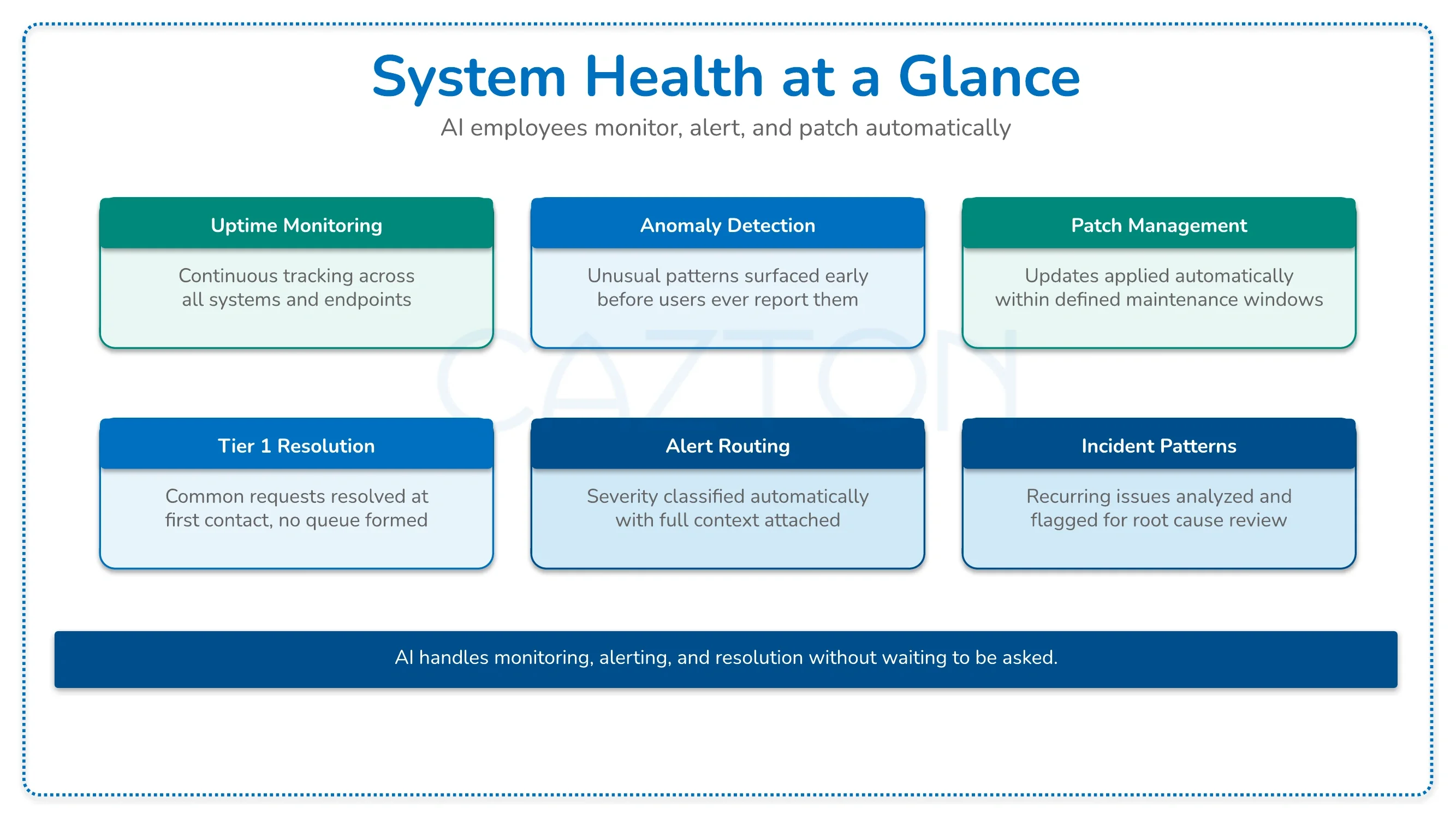
System monitoring requires attention that does not align with business hours. Infrastructure issues develop overnight, during weekends, and during periods when the IT team is stretched across other priorities. Teams that rely on user-reported issues as their primary signal are discovering problems after they have already affected productivity or, in security scenarios, after a window for prevention has closed.
AI employees monitor system health continuously, detect deviations from baseline performance metrics, and surface alerts with enough context that the engineer who receives the notification understands what is being flagged and why it matters. The difference between an alert that says a server's CPU utilization is elevated and one that says CPU utilization has been trending upward for six hours and is now at a level historically associated with service degradation in similar configurations is the difference between noise and actionable intelligence.
Patch management operates on similar logic. Software vulnerabilities have windows between disclosure and exploitation, and organizations that manage patch cycles manually are often operating within those windows for longer than they should be. An AI employee that tracks patch status across systems and schedules updates in approved maintenance windows closes those windows systematically rather than reactively.
User Lifecycle Management and Onboarding
IT onboarding failures are some of the most visible organizational problems a new hire experiences. Credentials that are not ready on day one, software that has not been provisioned, access to systems that requires a ticket, and a device that arrives without the configuration the role requires are all common and all preventable with a well-designed onboarding automation sequence.
AI employees run that sequence as a triggered workflow from the moment a new hire record is created in HR systems. Account provisioning initiates automatically. Access rights apply based on role configuration. Device setup steps generate and route to the appropriate IT team member. The new hire receives communication about what has been set up and what they need to do before day one, rather than discovering the gaps after they arrive.
Offboarding carries security implications that make its importance higher than its operational simplicity might suggest. An AI employee that monitors HR system changes and triggers access revocation workflows as departing employees are recorded prevents the access lingering that represents one of the most common and preventable internal security risks. Cazton's DevOps practice builds these lifecycle management systems with the security controls and audit logging that compliance and security teams require.
IT Platform Integrations
An IT support AI employee that cannot create, update, and close tickets in your service management platform adds a manual handoff to every interaction it handles. One that cannot provision or revoke access in your identity management system routes access requests rather than resolving them. Integration depth determines whether the AI employee closes issues or just triages them. Cazton builds these integrations bidirectionally so your AI employee reads current system state and writes results back to the authoritative system. Common integration points include:
- Service management platforms: ServiceNow and Jira Service Management for ticket creation, routing, status tracking, and resolution documentation.
- Identity and access management: Microsoft Entra ID (formerly Azure AD), Okta, and similar platforms for password reset, account provisioning, and access management workflows.
- Monitoring and observability: Infrastructure monitoring tools including Datadog, Splunk, and cloud-native monitoring services for system health visibility and anomaly detection.
- Communication platforms: Slack and Microsoft Teams for alert delivery, user-facing support interactions, and IT team coordination so the AI employee operates within the channels the organization already uses.
- Endpoint management: Microsoft Intune, Jamf, and similar tools for device configuration and software deployment that enable automated provisioning workflows.
Case Studies: IT Support and Software Maintenance
When Password Resets and Access Requests Were Taking Engineering Time Every Day
Challenge: A large enterprise came to Cazton with an IT support volume problem. Their helpdesk was handling thousands of tickets per month, and analysis of their ticket distribution showed that the largest category by volume was straightforward identity and access requests: password resets, account unlocks, application access provisioning, and VPN credential issues. These tickets were not complex, but each one required a helpdesk engineer to pick it up, verify the requester, execute the action in the relevant system, and close the ticket. The aggregate time this consumed was preventing the IT team from keeping pace with higher-priority infrastructure and security work.
Result: Cazton built an AI employee integrated with their ServiceNow instance and their Microsoft Entra ID environment. The AI employee handled identity and access tickets autonomously: it verified the requester through the organization’s existing authentication workflow, executed the access action, and closed the ticket with a complete audit log. Their helpdesk engineers stopped receiving password reset and basic access requests entirely. The IT team had the time back to work on infrastructure improvements, security remediation, and the complex support issues that required engineering expertise. The audit trail generated by the AI employee met the organization’s compliance review requirements for access management documentation.
Moving from User-Reported Outages to Early Detection
Challenge: A SaaS company’s infrastructure team was operating in a reactive monitoring posture. Their alerting systems generated high volumes of low-context notifications, which the team had over time learned to treat as background noise. The consequence was that meaningful infrastructure events such as performance degradation, database connection pool exhaustion, and memory pressure on application hosts were often discovered through user-reported tickets rather than through the monitoring system. By the time an engineer was investigating, the event had already affected users.
Result: Cazton deployed an infrastructure monitoring AI employee that aggregated signals across their application, database, and network layers, identified anomaly patterns against defined baselines, and generated actionable alerts with specific diagnostic context rather than raw metric notifications. The alerting configuration was calibrated to the infrastructure’s actual behavior patterns to reduce false positives that had trained the team to ignore alerts. The operations team shifted from discovering incidents after users reported them to receiving early detection with enough context to triage effectively before the issue had caused broad impact.
Closing the Onboarding Backlog During a Period of Rapid Hiring
Challenge: A company going through a high-velocity hiring period was generating IT onboarding requests faster than their team could process them. Each new hire required account creation across multiple systems, device enrollment, application access provisioning based on their role, and initial credential delivery. The steps were well-defined; the problem was that executing them manually for each new employee created a queue that meant some new hires started without full system access and spent their first days following up with IT rather than working.
Result: Cazton built an onboarding AI employee that integrated with their HRIS and their identity management and endpoint management systems. When a new hire record was created in the HRIS with a start date, the AI employee initiated the provisioning sequence automatically: account creation, role-based access assignment, device enrollment trigger, and credential delivery timed to the start date. The IT team received a confirmation when the sequence completed and a notification for any step that required manual intervention. New hires arrived with their accounts and access provisioned and ready. The IT team’s onboarding work shifted from executing each provisioning step manually to reviewing completed sequences and handling exceptions.
Building Your IT Support AI Employee with Cazton
IT support AI deployments touch the security and access control infrastructure that governs what every employee in the organization can see and do. That means audit logging, approval workflows, and escalation logic need to be built to the standard your security team requires from the start, not as items added to the design after the functional capabilities are working. Cazton builds IT support AI employees with security requirements as design inputs, not constraints discovered during implementation. The access workflows we automate maintain the approval chains your security policies require, and the audit trails we generate support the compliance reviews your team is accountable for.
Our cloud and infrastructure practice has deployed AI employees that integrate with ServiceNow, Jira Service Management, Microsoft Entra ID, Okta, Intune, and Jamf across enterprise environments with varying security postures and compliance requirements. That experience means the integration patterns and security controls we bring to your deployment reflect what works in production rather than what looks clean in a proof of concept. We design the tier 1 resolution logic, the monitoring alert calibration, and the lifecycle automation workflows in collaboration with your IT leadership so the system reflects how your team actually operates.
Check out more of our AI employees for your business and explore how intelligent workers are transforming operations across every major business function.
Contact Cazton to discuss an AI employee designed for your IT support environment, whether the priority is reducing ticket volume, improving monitoring coverage, or closing the gaps in patch management and user lifecycle workflows.
Cazton is composed of technical professionals with expertise gained all over the world and in all fields of the tech industry and we put this expertise to work for you. We serve all industries, including banking, finance, legal services, life sciences & healthcare, technology, media, and the public sector. Check out some of our services:
- Artificial Intelligence
- Big Data
- Web Development
- Mobile Development
- Desktop Development
- API Development
- Database Development
- Cloud
- DevOps
- Enterprise Search
- Blockchain
- Enterprise Architecture
Cazton has expanded into a global company, servicing clients not only across the United States, but in Oslo, Norway; Stockholm, Sweden; London, England; Berlin, Germany; Frankfurt, Germany; Paris, France; Amsterdam, Netherlands; Brussels, Belgium; Rome, Italy; Sydney, Melbourne, Australia; Quebec City, Toronto Vancouver, Montreal, Ottawa, Calgary, Edmonton, Victoria, and Winnipeg as well. In the United States, we provide our consulting and training services across various cities like Austin, Dallas, Houston, New York, New Jersey, Irvine, Los Angeles, Denver, Boulder, Charlotte, Atlanta, Orlando, Miami, San Antonio, San Diego, San Francisco, San Jose, Stamford and others. Contact us today to learn more about what our experts can do for you.
