
AI Employees for Human Resources
- Recruiting and HR operations: An AI employee for human resources handles resume screening, candidate sourcing, interview scheduling, onboarding coordination, and routine employee queries.
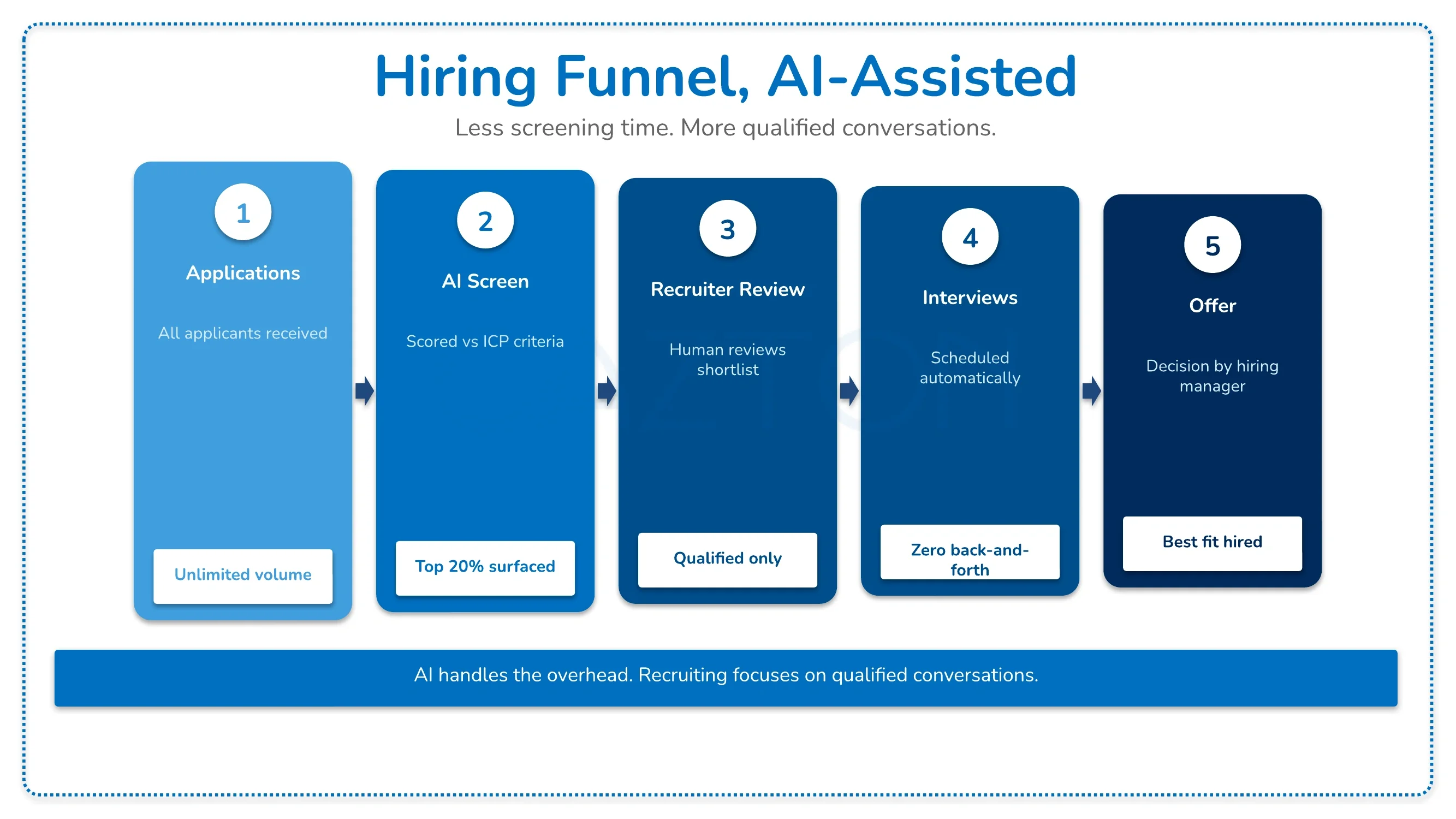
- Resume screening: AI employees screen incoming applications against role requirements and surface the strongest candidates for human review rather than requiring recruiters to read every submission manually.
- Candidate sourcing: AI employees search across platforms, identify profiles that match role criteria, and initiate outreach so recruiters spend time on qualified conversations rather than finding them.
- Interview coordination: AI employees handle scheduling logistics across candidate and interviewer availability, cutting the time between application and first conversation.
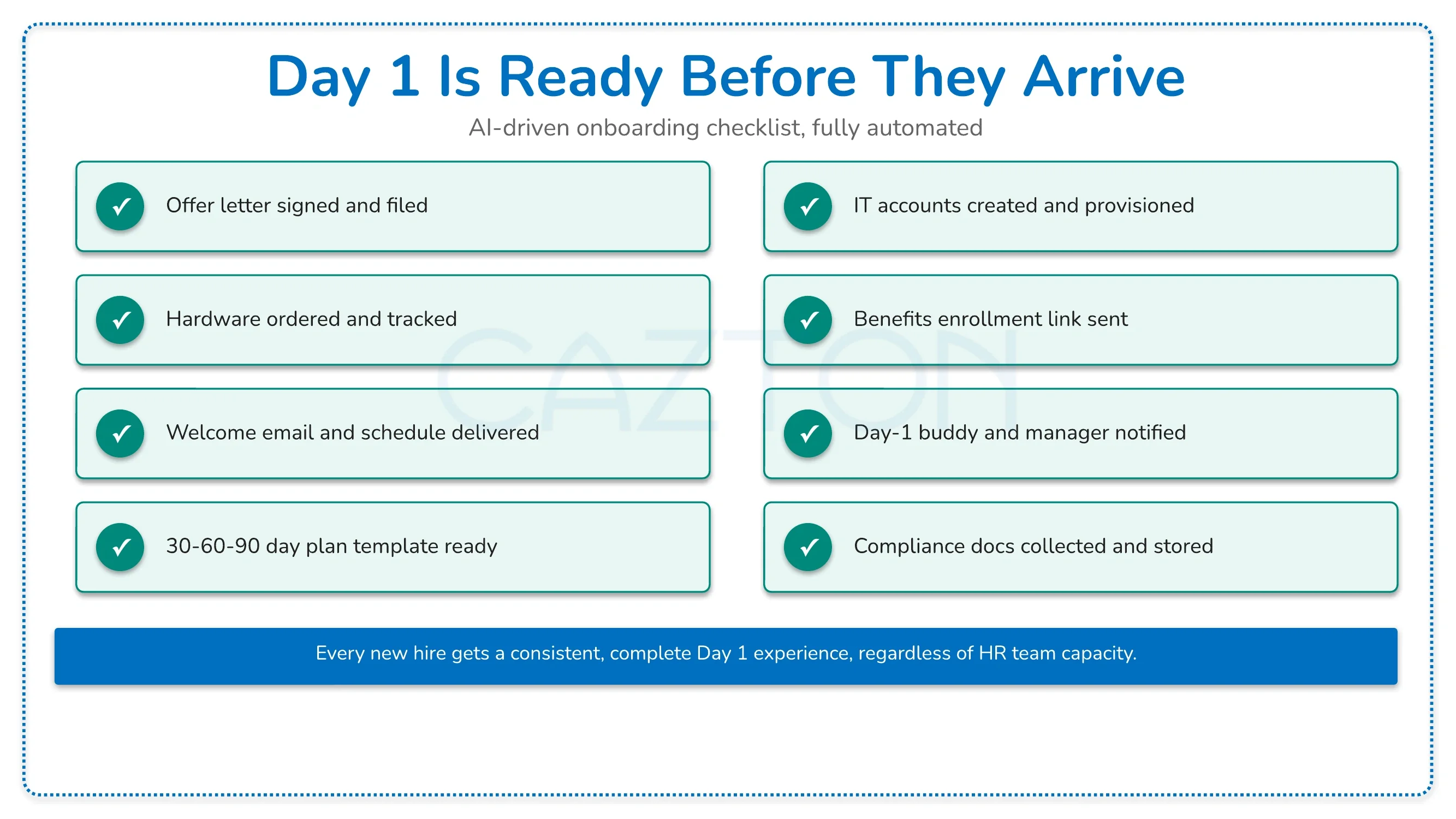
- Onboarding automation: AI employees automate document collection, system access coordination, and early check-ins so new hires get a structured experience without requiring disproportionate staff attention per hire.
- Employee query resolution: An AI employee resolves routine HR queries on benefits, PTO policies, and payroll immediately, escalating only those that require human judgment or policy exceptions.
- Compliance tracking: AI employees monitor policy updates and flag compliance gaps so HR teams stay current without treating regulatory tracking as a separate full-time task.
- Top clients: We help Fortune 500, large, mid-size and startup companies with AI development, consulting, and hands-on training services. Our clients include Microsoft, Google, Broadcom, Thomson Reuters, Bank of America, Macquarie, Dell and more.
Why HR and Recruiting Teams Lose Talent and Time to Operational Overhead
Human resources and recruiting carry a structural contradiction that grows more acute as organizations scale. The work that determines whether a company wins on talent, including building relationships with exceptional candidates, creating onboarding experiences that set people up to succeed, and having the kind of employee conversations that build retention, requires human judgment, empathy, and time. But the operational work that HR and recruiting teams are responsible for is high-volume, time-sensitive, and repeatable: screening resumes, coordinating interview schedules, collecting onboarding documents, answering policy questions, tracking compliance requirements. The hiring side of this problem is visible in the data every recruiter lives with: applications arrive faster than they can be reviewed meaningfully, and a significant portion of time-to-fill is consumed by coordination rather than evaluation. Strong candidates are in other processes and making decisions on timescales that do not accommodate delays.
On the employee support side, the problem compounds with headcount. A company that grows from a hundred employees to a thousand does not need ten times more HR staff to answer policy questions, but without automation it faces a meaningful increase in operational burden per HR staff member. The compliance dimension adds another layer: employment law varies by jurisdiction, changes regularly, and creates documentation requirements that become increasingly difficult to maintain reliably as operations expand. AI employees address the operational layer specifically by screening applications, sourcing candidates, scheduling interviews, running onboarding sequences, resolving routine employee queries, and monitoring compliance documentation, so HR professionals spend their time on the decisions and conversations that require their actual expertise. Cazton builds these systems with the fairness, privacy, and escalation requirements that HR deployments specifically demand.
Core Capabilities for an HR and Recruiting AI Employee
HR AI employees cover both the talent acquisition cycle and ongoing employee support functions. The most valuable capabilities are those that remove operational bottlenecks from the team's workflow rather than only automating simpler peripheral tasks.
Core capabilities include:
- Resume screening and ranking: Evaluate incoming applications against role requirements, identify the strongest candidates, and surface them for recruiter review with supporting rationale.
- Candidate sourcing and outreach: Search LinkedIn, job boards, and professional networks to identify profiles that match role criteria, then initiate personalized outreach through sequences your recruiting team defines.
- Interview scheduling: Coordinate availability across candidates and interviewers, send confirmations, manage reschedules, and keep the scheduling logistics out of your recruiters' inboxes.
- Onboarding automation: Trigger and track document collection, IT provisioning requests, benefits enrollment steps, and early check-in communications so new hires move through onboarding without requiring manual follow-up at each step.
- Employee HR query resolution: Answer questions about PTO policies, benefits coverage, payroll timing, and company policies immediately, with escalation logic for questions that require human review.
- Compliance monitoring: Track regulatory updates relevant to your HR policies, flag documentation gaps, and alert the HR team to changes that require policy or process updates.
Recruiting Operations: From Application to Offer
Recruiting pipelines stall at predictable points. Applications come in faster than recruiters can screen them. Scheduling coordination creates delays between stages that let good candidates lose interest or accept competing offers. Offer-stage communication becomes rushed because the process before it consumed more time than it should have.
AI employees resolve those stalls at the source. Resume screening happens as applications arrive rather than accumulating until a recruiter finds a block of time to review them. Interview scheduling initiates as soon as a candidate advances rather than waiting for a coordinator to identify a window and send the invite. Candidates feel the pace of the process, and that pace signals organizational competence during a period when they are also evaluating whether they want to join.
Cazton's recruiting practice understands how talent pipeline quality connects to business outcomes. An AI employee designed for recruiting operations accelerates time-to-interview and time-to-offer without sacrificing the quality of judgment that determines which candidates make it to each stage.
Onboarding and Employee Support
Onboarding is consistently under-resourced relative to its impact on new hire retention and time-to-productivity. The tasks involved are clear, the sequence is known, and the failures happen most often not because anyone made a bad decision but because someone forgot to follow up, a system access request sat in a queue, or a new hire did not know who to ask about a specific process.
AI employees run the onboarding sequence as a continuous tracking process. Document completion is monitored, missing steps trigger automated follow-up, system provisioning status is checked and escalated if delayed, and the new hire receives structured communication at each stage rather than silence between events. The experience reflects an organization that prepared for them rather than one that is working through a checklist reactively.
Employee HR support follows the same pattern. Most employee queries are routine and answerable directly from policy documentation. An AI employee handles that resolution immediately and at any hour rather than requiring the employee to wait for an HR generalist's response. Cazton's AI automation frameworks define the escalation boundaries so sensitive queries, policy exceptions, and anything requiring human judgment route to the right person without the AI attempting to make decisions outside its defined scope.
Data Quality and Compliance
HR systems accumulate data quality problems when updates are entered manually and inconsistently. Candidate records get out of sync with actual pipeline status. Employee records reflect outdated information. Compliance documentation gets filed in one system but not updated in another. The downstream consequences range from reporting inaccuracies to audit exposure.
AI employees maintain data consistency as a default behavior rather than as an additional task. Updates in one system propagate to connected systems through the integration layer, and discrepancies trigger alerts rather than accumulating silently. Compliance monitoring runs continuously so HR teams know about regulatory changes before they create exposure rather than after an audit identifies the gap.
Cazton's AI consulting practice designs compliance monitoring frameworks that reflect the specific jurisdictions and regulatory categories relevant to your organization, so your AI employee is tracking the right obligations rather than generating noise from irrelevant sources.
HR Platform Integrations
The value of an HR AI employee depends on how deeply it connects to the operational systems that manage your workforce. A resume screening tool that cannot update the ATS requires manual entry. An onboarding sequence that cannot confirm IT provisioning status cannot reliably close that loop. An employee query system that cannot access current benefits and policy documentation gives incomplete answers. Cazton builds these integrations to your HRIS, ATS, payroll, and communication platform APIs so your AI employee has the data it needs and writes results to the right systems. Common integration points include:
- HRIS platforms: Workday and BambooHR for employee records, benefits administration, and policy management.
- ATS platforms: Greenhouse, Lever, and similar applicant tracking systems where candidate records live and pipeline stages are managed.
- Sourcing tools: LinkedIn Recruiter and job board APIs for candidate discovery and outreach sequencing.
- Payroll systems: ADP and similar platforms for payroll query resolution and data consistency monitoring.
- Communication tools: Slack, Microsoft Teams, and email for employee query handling and recruiter coordination without requiring a separate interface.
Case Studies: Human Resources and Recruiting
When Time-to-Interview Was Costing Candidates to Competing Offers
Challenge: A high-growth technology company was losing candidates to competing offers at a pattern they could identify but could not easily fix. The time between application submission and first interview was extending longer than it should have, and post-mortems on unsuccessful hires consistently showed that candidates who declined or went dark had received faster process timelines from other companies. The recruiting team was not slow by intent. They were managing high application volumes on popular roles with manual screening and manual scheduling coordination.
Result: Cazton deployed an AI employee integrated with their ATS and calendar systems. The AI employee reviewed incoming applications against defined role criteria within hours of submission, ranked candidates with supporting context for recruiter review, and automatically initiated scheduling with top-ranked candidates rather than waiting for a recruiter to manually reach out. Recruiters received a prepared shortlist and a scheduling queue rather than a raw application pile. Time-to-first-interview shortened substantially, and the recruiting team shifted their energy to the conversations and evaluations that required their judgment rather than the logistics that preceded them.
Scaling Onboarding Without Scaling the HR Team
Challenge: A regional healthcare organization was onboarding a large number of new employees each month and running into a consistent problem: onboarding quality was uneven. Some new hires arrived on day one with everything in order. Others were still waiting for system access, had not received their benefits enrollment instructions, or were missing documentation that compliance required. The variability was not the result of anyone doing their job poorly; it was the result of a manual onboarding process that depended on individual follow-through and had no systematic tracking.
Result: Cazton built an AI employee that integrated with their HRIS, their IT provisioning system, and their communication platforms. When a new hire record was created, the AI employee triggered the full onboarding sequence: benefits enrollment instructions went out on schedule, document collection requests were sent and tracked, IT provisioning requests were initiated with the appropriate system access for the role, and new hire check-in communications were sent at defined intervals in the first weeks. Compliance completeness was monitored automatically so gaps surfaced before the compliance deadline rather than after. The HR team reviewed exception reports and handled escalations rather than managing each individual case.
Reclaiming HR Generalist Time From the Policy Question Queue
Challenge: A manufacturing company had grown to a size where the volume of routine employee HR questions had become a real burden on their HR generalist team. Policy questions, PTO balance inquiries, benefits coverage questions, and payroll timing requests were coming in continuously throughout the workday. HR generalists were capable and experienced, but a large portion of their time was going to questions that had deterministic, policy-based answers rather than to the employee relations work, performance management support, and compliance oversight that actually required their skill.
Result: Cazton deployed an AI employee accessible via the company’s existing communication platform. The AI employee answered policy-based questions immediately by drawing from the company’s HR policies and benefits documentation, escalated to an HR generalist any question that involved a judgment call, a policy exception, or a sensitive personal situation, and logged all interactions for HR review. Employees got answers faster than before. HR generalists received a reduced volume of routine queries and a higher proportion of the interactions that actually warranted their attention. The team’s capacity for strategic and complex work expanded without any change in headcount.
Building Your HR AI Employee with Cazton
HR and recruiting AI deployments require careful design around two specific risks: bias in candidate evaluation and privacy in employee data handling. An AI employee that screens candidates based on criteria that inadvertently correlate with protected characteristics creates legal and reputational exposure. An AI employee that handles employee queries without appropriate data access controls and audit logging creates privacy and compliance risk. Cazton treats both as design requirements, not as concerns to address if they come up.
The HR AI employees Cazton deploys are built to accelerate the operational layer, covering the screening, scheduling, onboarding, and query resolution work, while leaving hiring decisions, disciplinary actions, and policy exceptions firmly with your HR team and your managers. The AI employee handles the work that should not require human judgment; your team makes the calls that do. We work with your HR leadership and your legal team to define the scope, the escalation rules, and the oversight structure before anything goes into production. That upfront configuration is what keeps the deployment ethical, compliant, and trusted by the employees who interact with it.
Check out more of our AI employees for your business and explore how intelligent workers are transforming operations across every major business function.
Contact Cazton to discuss an HR and recruiting AI employee designed for your organization’s scale, hiring model, and employee population.
Cazton is composed of technical professionals with expertise gained all over the world and in all fields of the tech industry and we put this expertise to work for you. We serve all industries, including banking, finance, legal services, life sciences & healthcare, technology, media, and the public sector. Check out some of our services:
- Artificial Intelligence
- Big Data
- Web Development
- Mobile Development
- Desktop Development
- API Development
- Database Development
- Cloud
- DevOps
- Enterprise Search
- Blockchain
- Enterprise Architecture
Cazton has expanded into a global company, servicing clients not only across the United States, but in Oslo, Norway; Stockholm, Sweden; London, England; Berlin, Germany; Frankfurt, Germany; Paris, France; Amsterdam, Netherlands; Brussels, Belgium; Rome, Italy; Sydney, Melbourne, Australia; Quebec City, Toronto Vancouver, Montreal, Ottawa, Calgary, Edmonton, Victoria, and Winnipeg as well. In the United States, we provide our consulting and training services across various cities like Austin, Dallas, Houston, New York, New Jersey, Irvine, Los Angeles, Denver, Boulder, Charlotte, Atlanta, Orlando, Miami, San Antonio, San Diego, San Francisco, San Jose, Stamford and others. Contact us today to learn more about what our experts can do for you.
