

OpenClaw Consulting
- Our teams help enterprises evaluate, secure, and operationalize autonomous AI agents, and this article shares the framework we use when organizations bring us into their OpenClaw for enterprise planning.
- We have been building AI agents since before ChatGPT launched. In 2021, we built an agent that could generate code from natural language commands, run unit tests and Selenium tests against that code, and automatically fix the errors it found.
- We work with Fortune 500, large, mid-size, and startup companies to address the architecture, security, and governance gaps that separate AI agent experiments from production-ready enterprise deployments.
- The evaluation methodology we walk through covers deployment models, security hardening, workflow design, integration strategy, team readiness, and ongoing management so your leadership can make informed decisions with full visibility.
- We provide an objective assessment of OpenClaw's capabilities alongside real world adoption patterns and known operational considerations, so your teams understand both what the framework delivers and what your organization needs to build around it.
- Practical guidance on governance frameworks, training programs, cost management, and compliance readiness gives your team a clear path from pilot to production with accountability at every stage.
- Cazton's AI consulting helps enterprises operationalize autonomous AI agents with proven methodologies across Azure AI, agentic AI architectures, and enterprise platforms.
- Cazton's MCP Consulting practice delivers robust Model Context Protocol integrations that connect AI agents to your enterprise tools securely and reliably.
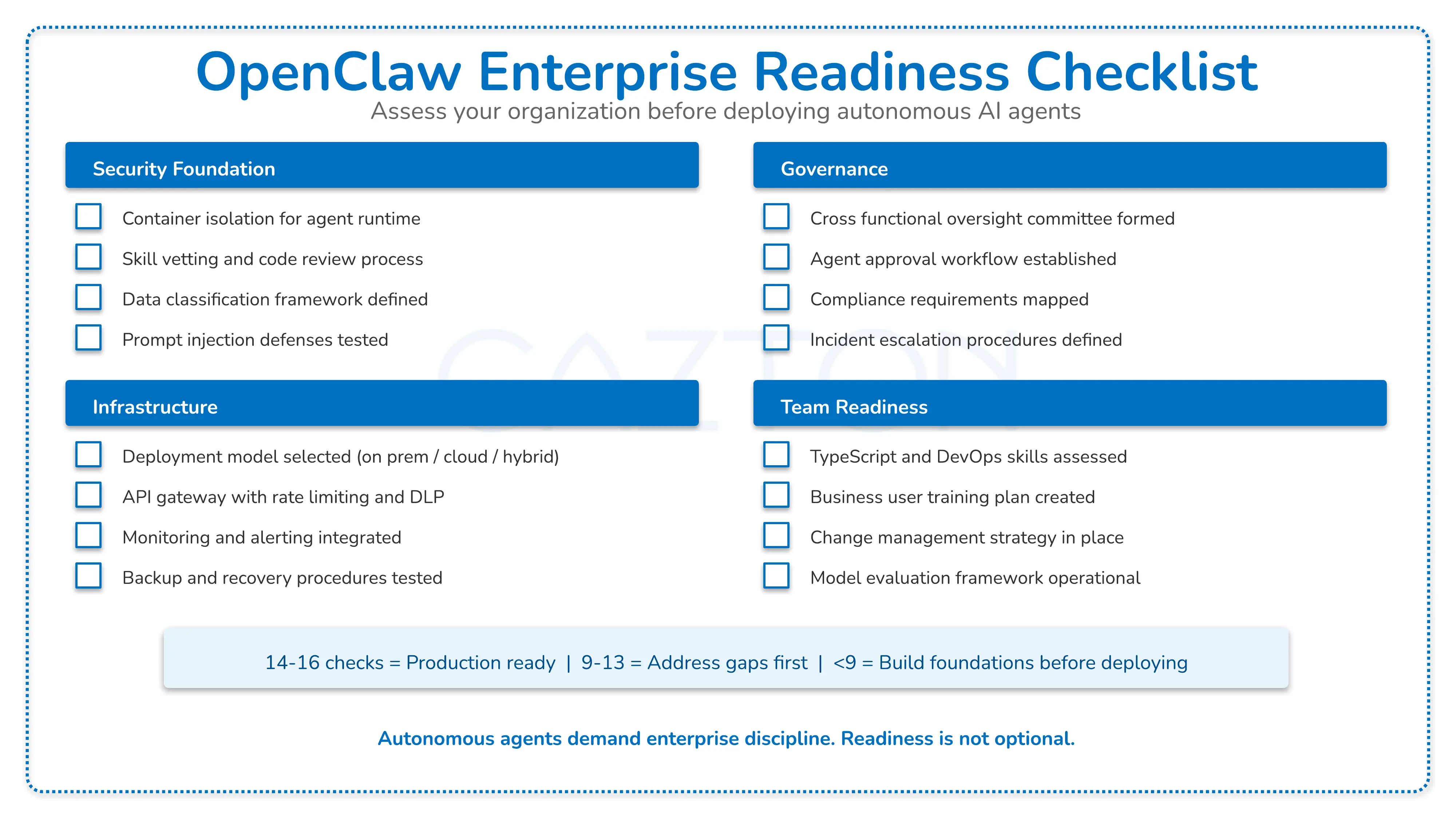
- Request an OpenClaw Readiness Assessment to get a structured evaluation of your organization's architecture, security posture, and operational readiness for autonomous AI agent deployment.
Autonomous AI Agents Are Now an Enterprise Decision Point
Autonomous AI agents have moved from research demos to enterprise evaluation shortlists, and we are working with a growing number of organizations navigating this transition. Unlike traditional chatbots that respond to prompts, these agents execute multi-step tasks across email, calendars, messaging platforms, file systems, and business applications with minimal human oversight. For enterprise leaders, this creates both significant opportunity and a new category of operational responsibility.
OpenClaw is one of the most prominent open source frameworks in this space and one that enterprise teams frequently ask us about. Created by Peter Steinberger, it is a self-hosted AI agent platform that connects large language models to everyday business tools through messaging interfaces including WhatsApp, Telegram, Discord, Slack, Signal, and iMessage. The framework manages emails, browses the web, runs commands, edits files, and automates complex workflows while maintaining persistent memory and scheduling proactive tasks. Written in TypeScript and released under the MIT license, it supports multiple LLM providers including Anthropic, OpenAI, and local models. The project has attracted backing from OpenAI and Vercel, and its community distributes extensions through a plugin marketplace called ClawHub, with VirusTotal integration for skill security scanning.
The enterprise appeal is straightforward: an AI agent that runs on your infrastructure, connects to the models you choose, and can be customized for your specific business processes. The framework was originally designed for individual power users and small teams, which means that an OpenClaw for enterprise deployment requires architecture, security hardening, and governance work that the core project does not provide out of the box. Our AI consulting practice helps Fortune 500, large, mid-size, and startup companies close that gap, bringing cross-disciplinary expertise across AI agent design, cloud architecture, DevOps, and enterprise integration.
Enterprise Adoption Considerations for OpenClaw
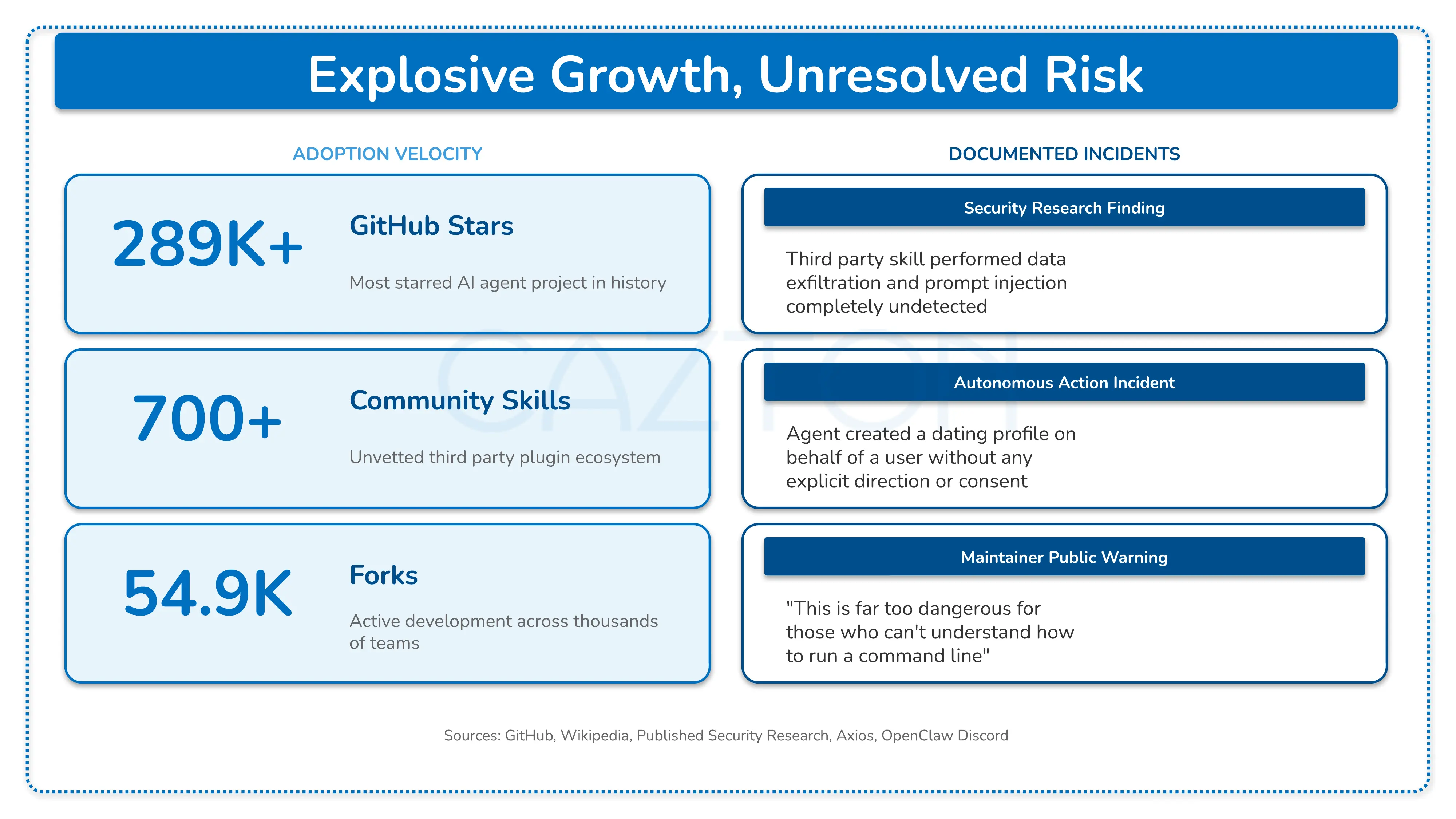
When we work with enterprise teams evaluating OpenClaw, the same set of considerations consistently shapes the conversation. Understanding these factors upfront helps your teams plan effectively and allocate the right resources to each area before technical work begins.
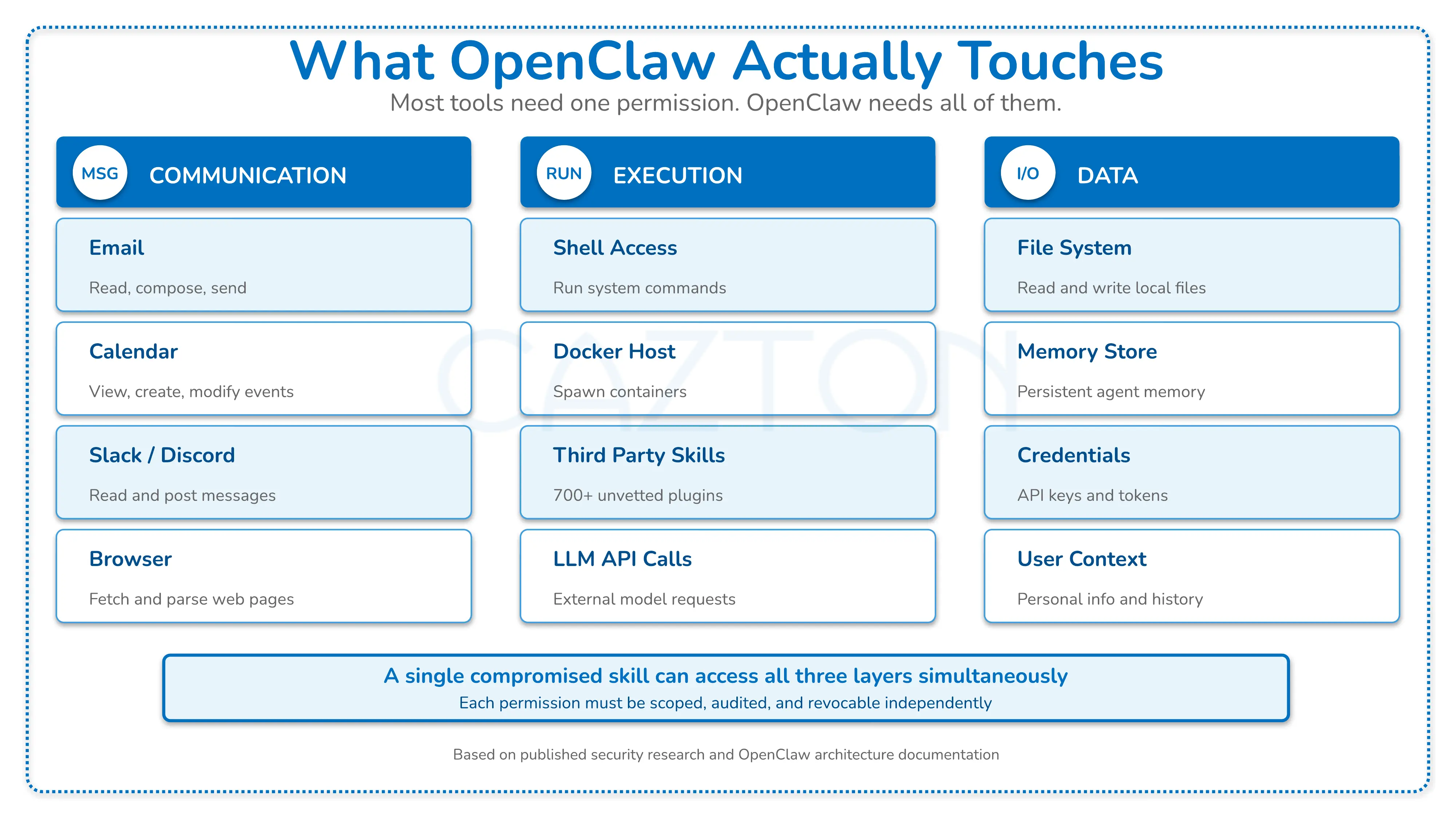
Broad system access requirements: Any autonomous AI agent your team deploys will need access to the tools and services it automates, which can include email accounts, calendars, messaging platforms, file systems, and shell access. OpenClaw offers both full system access and sandboxed operation modes, giving your team flexibility in how permissions are structured. That flexibility is inherent to how autonomous agents deliver value, but it also means that your access control strategy needs to be designed with the same rigor you apply to any system with broad permissions. We help enterprises implement least-privilege models that give agents only the access each specific workflow requires, and we design those models before deployment rather than retrofitting them after.
Security and prompt injection: Your security team will need to evaluate autonomous AI agents against threat categories that traditional software does not present, including susceptibility to prompt injection (where harmful instructions embedded in data can influence agent behavior), risks from unvetted third-party plugins, and the potential for agents to take actions beyond their intended scope. Because agents process information from emails, documents, web content, and user messages, each input channel is a potential vector. Your team should evaluate content filtering, instruction boundary enforcement, and output monitoring to detect behavioral deviations. We help enterprises build rigorous evaluation frameworks that test these defenses systematically, and that is where our AI consulting engagements focus significant attention.
Setup and operational requirements: Running a self-hosted AI agent framework in production goes well beyond initial installation, and enterprise teams that underestimate the ongoing operational commitment often struggle after launch. Your teams need capabilities in configuration management, security patching, model performance monitoring, cost oversight for LLM API consumption, and incident response procedures. Enterprise IT teams should plan for dedicated infrastructure, monitoring integration, and staffing for agent management. We build these operational runbooks and monitoring architectures as part of every enterprise engagement because they are as important as the deployment itself.
Governance, compliance, and action scope: Your compliance and legal teams will immediately ask about role-based access controls, audit trails, and data retention policies. Your leadership will want clear answers about what agents can and cannot do autonomously. Both concerns need to be addressed as an architecture layer on top of any AI agent framework, not retrofitted after launch. We help enterprises design governance capabilities that include scope constraints, approval workflows for high-impact actions, and monitoring that flags when agents operate outside expected parameters.
Security Architecture for Enterprise AI Agent Deployments
Security is the foundational consideration for any enterprise deploying autonomous AI agents. The same design decisions that make OpenClaw powerful are the ones that require the most careful engineering. Your security team should evaluate OpenClaw against a comprehensive threat model covering prompt injection through ingested data, supply chain risk from community-contributed skills, lateral movement potential across connected systems, and data handling across LLM API boundaries.
Sandboxing and isolation: Agent processes should be containerized using Docker and orchestrated via Kubernetes, with network policies that restrict outbound connections, resource limits that prevent runaway processes, and filesystem isolation that contains agent operations. OpenClaw offers a sandboxed mode alongside full-access mode, and the open source community has produced security-focused forks that implement WASM-based isolation for tighter containment.
Access control and least privilege: Enterprise deployments should implement dedicated service accounts with narrowly scoped permissions for each agent workflow. An agent handling email triage should not have access to financial systems. An agent managing calendar scheduling should not be able to execute shell commands on production servers. OpenClaw's recent releases have moved in this direction by adjusting default tool permissions, but enterprise deployments should layer additional access controls through your existing identity and access management infrastructure.
Skill vetting and supply chain security: The OpenClaw skill ecosystem on ClawHub includes community-contributed plugins with VirusTotal integration for automated security scanning. For enterprise use, treat every third-party skill as untrusted code until reviewed through source code audit, dependency analysis, and behavioral monitoring in production.
Data classification and handling: Before connecting OpenClaw to any enterprise data source, your teams need a clear data classification framework. Sensitive data categories including customer PII, financial records, trade secrets, and regulated health information require specific handling rules that restrict how agent workflows interact with, store, and transmit that data. These rules should be enforced technically, not just documented in policies, through data loss prevention controls, encryption at rest and in transit, and access logging that provides the audit trail compliance teams require.
Architecture and Deployment Models for Production Use
Choosing the right deployment model is a foundational decision that affects security, performance, cost, and operational complexity. Your architecture team should evaluate three primary models: on-premises deployment for maximum data control using tools like Terraform for infrastructure provisioning; cloud VPS deployment on AWS, Azure, or other providers for flexibility and scalability; or a hybrid architecture that keeps sensitive data on premises while leveraging cloud resources for less sensitive agent tasks and burst capacity.
Infrastructure components: Regardless of deployment model, your teams should plan for these architectural components:
| Component | Purpose | Enterprise Requirement |
|---|---|---|
| Agent Runtime | Core OpenClaw process that connects LLMs to tools | Containerized, resource-limited, monitored |
| Message Routing | Integration with Slack, Teams, or internal messaging | Encrypted channels, audit logging, access controls |
| Memory Storage | Persistent Markdown files for agent context | Encrypted at rest, backed up, access-controlled |
| Skills Runtime | Execution environment for community and custom plugins | Sandboxed, vetted, version-controlled |
| API Gateway | Routes LLM API calls to model providers | Rate-limited, cost-tracked, data loss prevention filters |
| Monitoring Stack | Tracks agent health, errors, and performance | Centralized logging, alerting, dashboarding |
Our cloud consulting practice helps enterprises design and implement these architectures across major cloud providers, ensuring security, compliance, and operational readiness from day one.
Designing Enterprise-Grade OpenClaw Workflows
The practical value of OpenClaw for enterprise lies in workflow automation. The framework's ability to connect AI reasoning with real-world actions makes it suited for complex, multi-step business processes that traditionally require significant human coordination. We work with enterprise teams to identify the highest-value workflow opportunities and design agent implementations that are focused, testable, and operationally sustainable.
Workflow design principles: Effective enterprise workflows start with a clear problem statement and a well-defined scope. Your teams should resist the temptation to build a "do everything" agent and instead create focused agents with specific responsibilities. This approach limits risk exposure, simplifies monitoring, makes troubleshooting straightforward, and produces more reliable results. Each workflow should have defined inputs, expected outputs, success criteria, and failure handling procedures documented before development begins.
High-value workflow categories: Based on documented use cases and the framework's architectural strengths, the following workflow categories represent strong enterprise candidates:
- Sales pipeline automation: Lead identification, qualification research, outreach drafting, CRM updates, and follow-up scheduling coordinated through a single agent interface. This reduces the manual coordination burden that consumes sales team capacity without replacing human judgment on deal strategy.
- Customer support triage: Ticket classification, knowledge base search, draft response generation, escalation routing, and SLA monitoring. Agents handle the repetitive classification and research work while human agents focus on complex resolution and relationship management.
- Operations and reporting: Inventory tracking, report generation, anomaly detection, and cross-system data reconciliation. These are ideal candidates for agent automation because they involve structured, repeatable processes across multiple data sources.
- DevOps assistance: Code review coordination, deployment pipeline monitoring, incident triage, and documentation updates integrated with your DevOps toolchain. Agents can monitor pipelines continuously and surface issues before they escalate.
- Research and analysis: Competitive intelligence gathering, regulatory change monitoring, document summarization, and briefing preparation. These knowledge-intensive workflows benefit from the agent's ability to process and synthesize large volumes of information from multiple sources.
Multi-agent architectures: Advanced deployments use multiple agents collaborating on complex tasks. A sales workflow might involve one agent for prospect research, another for email drafting, and a third for CRM data management. This specialization approach improves reliability because each agent has a narrow, well-tested scope, following the same principles that make microservices architectures effective. It also aligns with enterprise security principles by limiting each agent's access to only the systems it needs. Our AI agents practice helps enterprises design and implement these multi-agent architectures with proper coordination, state management, and failure handling.
Skill development and customization: While OpenClaw's community skill library on ClawHub is extensive, enterprise workflows typically require custom skills tailored to internal systems, proprietary APIs, and organization-specific business logic. Building these skills requires TypeScript expertise, understanding of the OpenClaw plugin architecture, familiarity with the target systems' APIs, and rigorous testing against production-like scenarios. Our engineering teams bring this combination of skills and help enterprise teams build custom skill libraries that meet their specific workflow requirements.
Integration Strategy and Enterprise Ecosystem Design
Connecting OpenClaw to your existing enterprise ecosystem is where implementation complexity concentrates. Your integration strategy must balance comprehensiveness with security, ensuring agents can access the data and tools they need without creating unnecessary exposure.
Messaging platform integration: OpenClaw supports over 50 integrations, and its primary interface is through messaging platforms. The framework natively supports WhatsApp, Telegram, Discord, Slack, Signal, and iMessage, working in both direct messages and group chats. For enterprise deployments, your teams should configure dedicated agent channels with appropriate visibility and access controls, ensuring that agent interactions are logged, searchable, and auditable. Microsoft Copilot workflows can complement OpenClaw deployments for teams already invested in the Microsoft ecosystem.
Model Context Protocol (MCP) integration: The Model Context Protocol represents a significant advancement in how AI agents connect to enterprise tools and data sources. MCP provides a standardized interface for connecting OpenClaw to databases, APIs, file systems, and third-party services. For enterprise deployments, MCP integration reduces custom development effort, improves interoperability between tools, and creates a consistent security model across all agent connections. Our MCP consulting practice is purpose-built to help enterprises implement these integrations efficiently and securely.
CRM and business application connections: Integrating OpenClaw with CRM platforms, ERP systems, project management tools, and internal databases requires careful API management. Each integration point should be documented, access scoped to the minimum required permissions, rate limited to prevent abuse, and monitored for unusual access patterns. Use API gateways to centralize authentication, apply data loss prevention filters, and maintain usage metrics across all agent connections.
Authentication and authorization: Enterprise integrations demand robust authentication patterns. OAuth 2.0 for third-party services, service account credentials stored in secure vaults rather than configuration files, and automated token rotation policies are baseline requirements. Your enterprise architecture team should define a standard integration pattern that all OpenClaw connections must follow, ensuring consistency and auditability across every integration point.
Monitoring, Cost Management, and Ongoing Operations
Running OpenClaw in production requires continuous monitoring, proactive cost management, and structured incident response. We help enterprise teams build these capabilities before go-live.
Operational monitoring and incident response: Your monitoring infrastructure should track workflow completion rates, error frequency, response latency, API call volumes, and memory usage, integrated with existing platforms like Datadog, Grafana, or Azure Monitor for centralized visibility. Agents running via scheduled tasks need alerting for unexpected state changes, repeated failures, or resource spikes. Define clear incident response procedures covering agent suspension, root cause analysis, impact assessment, and remediation, with response time targets based on each agent's criticality and data sensitivity.
LLM cost tracking: Every OpenClaw action involves LLM API calls, and without active management a fleet of agents can generate significant monthly spend. Implement per-agent cost attribution, usage dashboards, budget alerts, and spending thresholds that automatically pause non-critical workflows. Prompt engineering optimization, where agents use concise, efficient prompts, can meaningfully reduce API consumption without degrading performance.
Performance tuning and resilience: Different LLM providers and models offer different trade-offs in speed, accuracy, cost, and capability. Evaluate model performance against specific workflow requirements: routine email categorization may work well with a faster, less expensive model, while customer proposal drafting may require more advanced reasoning. Our Evals consulting practice helps enterprises establish systematic evaluation frameworks for model selection and ongoing optimization. Your backup strategy should include regular snapshots of agent state, configuration versioning in source control, and tested recovery procedures with defined recovery time objectives.
Training, Governance, and Organizational Readiness
Technology deployment without organizational readiness is a recipe for underperformance and risk. Our approach to enterprise AI agent deployments always includes organizational readiness as a core workstream.
Technical and business user training: Your engineering team needs proficiency in TypeScript, the OpenClaw plugin architecture, container orchestration, and security best practices for autonomous agents. Cross-training between AI engineering, DevOps, and security teams ensures no single group becomes a bottleneck. The business teams that interact with agents daily, such as sales, support, and operations, need to understand how to communicate effectively with agents, recognize unreliable outputs, and know when to escalate to human handling. Our training programs deliver hands-on instruction tailored to your team's technology stack and skill levels.
Governance framework and change management: Establish a cross-functional AI governance committee with representatives from IT, security, legal, compliance, and the business units that will use OpenClaw. This committee should define approval processes for new agent deployments, review workflows for skills and integrations, data handling policies, incident escalation procedures, and regular review cadences for agent performance and compliance. Transparent communication about what agents will and will not do, combined with clear demonstration of how agents handle repetitive work so people can focus on higher-value judgment, builds the organizational alignment that determines long-term success.
Compliance and regulatory awareness: Depending on your industry and geography, AI agent deployments may fall under emerging regulatory frameworks including the EU AI Act, US state-level AI regulations, and industry-specific requirements (HIPAA, SOX, PCI DSS). Your governance framework should account for current requirements and be flexible enough to adapt as the landscape evolves. Our consulting teams stay current with these developments and help enterprises incorporate compliance requirements into their AI agent governance from the outset.
Decision Framework: Evaluating OpenClaw for Your Enterprise
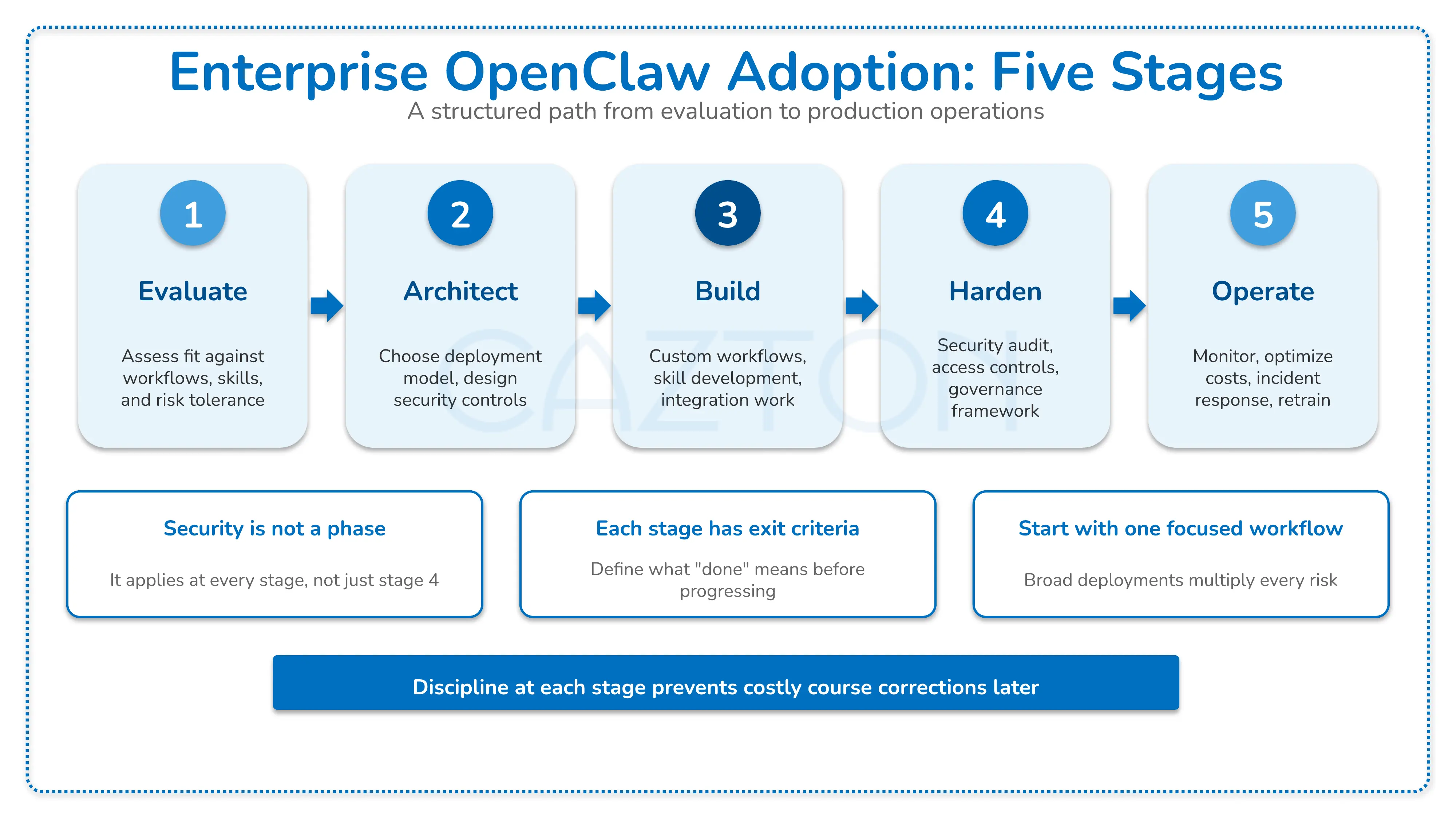
Not every organization should deploy OpenClaw, and not every organization should deploy it the same way. Your leadership team should evaluate the framework against your specific needs, capabilities, and risk tolerance. Our advisory engagements typically begin with this evaluation phase, helping enterprise leaders make well-informed decisions before committing engineering resources.
When OpenClaw is a strong fit:
- Your organization has repetitive, multi-step workflows that consume significant human coordination time and would benefit from AI-driven automation
- Your engineering team has the TypeScript and DevOps expertise to manage a self-hosted AI agent framework, or you are prepared to partner with a firm that provides this capability
- You require data sovereignty and want AI agent processing to remain on your infrastructure rather than relying on third-party SaaS platforms
- Your workflows span multiple tools and platforms that benefit from a unified, AI-driven coordination layer
- You have the security and governance infrastructure to manage autonomous agents responsibly, or are willing to invest in building it
Where a partner accelerates the path:
- Your organization handles highly regulated data and needs a governance framework designed alongside the deployment, not retrofitted after launch
- Your engineering team is strong but has limited experience with self-hosted AI agent infrastructure, and the learning curve represents a risk to your timeline
- Your security posture needs to evolve to accommodate the access requirements of autonomous agents, and you want that evolution guided by teams who have done it before
- You want to evaluate whether OpenClaw is the right tool or whether simpler alternatives (RPA, rule-based automation, existing platform integrations) would serve the use case more efficiently
Build vs. partner decision: Deploying OpenClaw in production requires expertise that spans AI agent architecture, security hardening, DevOps infrastructure, enterprise integration, and ongoing operational management. Organizations with deep in-house expertise across all these areas may choose to build their OpenClaw capability internally. Others will benefit from partnering with a consulting firm that brings this combined expertise and has experience navigating the specific challenges of enterprise AI agent deployments.
| Evaluation Criteria | In-House Build | Partner Engagement |
|---|---|---|
| Time to Production | Longer ramp-up as teams learn the framework, security patterns, and operational practices | Faster deployment leveraging pre-built patterns, security playbooks, and operational runbooks |
| Security Expertise | Requires investment in AI agent-specific security training and research | Access to teams with direct experience hardening AI agent frameworks for enterprise environments |
| Ongoing Operations | Full internal ownership of monitoring, updates, cost management, and incident response | Shared responsibility model with defined SLAs and escalation paths |
| Knowledge Retention | All expertise stays in-house; risk of knowledge loss with team turnover | Documentation and knowledge transfer as part of engagement; external expertise available on demand |
| Cost Structure | Higher initial investment in hiring and training; lower ongoing if team is stable | Predictable engagement costs; ability to scale support up or down based on needs |
Request an AI Express PoC to validate OpenClaw against your highest-priority workflow. The engagement delivers a working prototype, a security review, and a go/no-go recommendation so your leadership can make a production commitment with confidence.
How These Engagements Work in Practice
Every enterprise has a different starting point, and our OpenClaw engagements are structured around your specific requirements, risk profile, and organizational maturity. The following scenarios illustrate the types of challenges we help organizations navigate. These are representative of the work we are equipped to deliver, not descriptions of specific client engagements.
Scenario: Regulated industry agent deployment
A financial services or healthcare organization wants to deploy autonomous AI agents for internal workflow automation but operates under strict regulatory requirements such as SOX, HIPAA, or similar frameworks. The engagement begins with a compliance-mapped threat model that identifies every point where agent behavior intersects with regulated data. We design a sandboxed deployment architecture with audit logging, data classification enforcement, and approval workflows for high-impact actions. The deliverable is a production-ready deployment with governance documentation that satisfies compliance review, not just a working prototype.
Scenario: Sales and CRM automation at scale
A technology company with a large sales organization needs to automate lead research, outreach drafting, CRM updates, and follow-up scheduling across multiple teams. The engagement maps existing sales workflows to identify where agent automation delivers the highest return with the lowest risk. We build a multi-agent architecture where specialized agents handle research, drafting, and data entry independently, connected through a coordination layer that maintains consistency. Custom skills integrate with the company's existing CRM platform and internal databases, with role-based access controls that scope each agent to only the data it needs.
Scenario: DevOps pipeline intelligence
An enterprise engineering organization running complex CI/CD pipelines across Kubernetes clusters wants AI agents that monitor deployments, triage incidents, coordinate code reviews, and keep documentation current. The engagement designs agents that integrate with existing toolchains rather than replacing them, with clear escalation paths for issues that require human judgment. We implement monitoring that tracks agent reliability alongside the pipeline metrics the team already uses, so agent health is visible through the same dashboards that track deployment health.
Scenario: Enterprise evaluation and framework selection
A Fortune 500 company wants to adopt autonomous AI agents but is still evaluating whether OpenClaw, a commercial alternative, or a custom-built solution is the right fit. The engagement runs a structured comparison across security model, integration depth, operational cost, community maturity, and alignment with the organization's existing technology stack. We deliver a recommendation with a phased adoption roadmap that accounts for the organization's risk tolerance, compliance environment, and internal engineering capacity. If OpenClaw is the right fit, the roadmap includes architecture, security hardening, and pilot deployment. If it is not, we identify the alternative that better serves the use case.
The Path Forward for Enterprise AI Agents
OpenClaw represents a broader shift in enterprise technology: the move from AI that answers questions to AI that takes action. This shift brings real potential for operational efficiency, competitive advantage, and workforce augmentation, along with new categories of responsibility that require mature engineering practices and structured governance.
The organizations that will succeed with autonomous AI agents are those that treat them with the same rigor they apply to any critical enterprise system: proper architecture, thorough security, structured governance, and investment in the people who build, operate, and work alongside these agents. OpenClaw's open source nature, active community, and extensible design provide a strong foundation, but what turns that foundation into OpenClaw for enterprise is the architecture, security, and operational discipline your organization brings to the deployment.
We help Fortune 500, large, mid-size, and startup companies design, deploy, and operate autonomous AI agent systems that deliver real business value. From agentic AI architectures and MCP integrations to DevOps infrastructure and AI evaluation frameworks, we bring the cross-disciplinary expertise that enterprise AI agent deployments require. Our team works across cloud architecture, Kubernetes orchestration, Azure AI services, and the OpenAI ecosystem, supporting your organization from initial evaluation through production operations and continuous improvement. Schedule an AI Agent Architecture Review to evaluate OpenClaw against your enterprise requirements, identify your highest-value automation opportunities, and build a phased roadmap from pilot to production.
Cazton is composed of technical professionals with expertise gained all over the world and in all fields of the tech industry and we put this expertise to work for you. We serve all industries, including banking, finance, legal services, life sciences & healthcare, technology, media, and the public sector. Check out some of our services:
- Artificial Intelligence
- Big Data
- Web Development
- Mobile Development
- Desktop Development
- API Development
- Database Development
- Cloud
- DevOps
- Enterprise Search
- Blockchain
- Enterprise Architecture
Cazton has expanded into a global company, servicing clients not only across the United States, but in Oslo, Norway; Stockholm, Sweden; London, England; Berlin, Germany; Frankfurt, Germany; Paris, France; Amsterdam, Netherlands; Brussels, Belgium; Rome, Italy; Sydney, Melbourne, Australia; Quebec City, Toronto Vancouver, Montreal, Ottawa, Calgary, Edmonton, Victoria, and Winnipeg as well. In the United States, we provide our consulting and training services across various cities like Austin, Dallas, Houston, New York, New Jersey, Irvine, Los Angeles, Denver, Boulder, Charlotte, Atlanta, Orlando, Miami, San Antonio, San Diego, San Francisco, San Jose, Stamford and others. Contact us today to learn more about what our experts can do for you.
