

Apigee Consulting
- API operating model: Establish a governed API product model that connects business strategy, architecture, security, delivery, and measurable adoption.
- Multicloud architecture: Position Apigee, Azure API Management, AWS API Gateway, SAP Integration Suite, Kubernetes, and Istio in a coherent enterprise control plane.
- Private and public connectivity: Design separate but coordinated paths for internet-facing, partner, employee, private, hybrid, and service-to-service traffic.
- Security at scale: Combine identity, policy enforcement, threat detection, quotas, mTLS, network controls, secrets management, auditability, and incident response.
- SAP modernization: Expose SAP and non-SAP capabilities as governed products without turning the API gateway into an uncontrolled integration bottleneck.
- Executive scenarios: Apply repeatable API management patterns across financial services, insurance, SAP, partner ecosystems, and regulated enterprise operations.
- Consulting support: We help organizations connect API strategy to software architecture, implementation, DevSecOps, observability, and operational ownership through Cazton consulting services.
- Enterprise training: We support architecture and engineering leaders with practical enterprise technology training for API product management, cloud platforms, Kubernetes, and secure delivery.
- Top clients: We help Fortune 500, large, mid-size, SMB, and startup companies with Apigee strategy, API management, multicloud architecture, security, implementation, integration, consulting, and hands-on training services; our clients include Microsoft, Google, Broadcom, Thomson Reuters, Bank of America, Macquarie, Dell, and more. Learn more about our top clients.
Apigee Consulting For The Modern Enterprise
Apigee is Google Cloud’s native API management platform for designing, securing, publishing, analyzing, and operating APIs across public cloud, private infrastructure, hybrid environments, and distributed enterprise estates. The current platform provides API proxies, policy enforcement, traffic management, analytics, developer experience, lifecycle controls, and AI gateway capabilities.
The executive question is practical: can the organization turn APIs into reliable business products across public cloud, private infrastructure, SaaS platforms, data platforms, and regulated workloads? A gateway alone cannot answer that question. The operating model must cover ownership, product design, policy, delivery, runtime, telemetry, resilience, and risk.
Our API development and consulting approach is designed for Fortune 500 and comparable enterprises that need to modernize without breaking the systems that already run the business. We help leadership teams make the API estate understandable, reduce duplicated integration work, establish secure exposure patterns, and create a roadmap that works across Google Cloud, Azure, AWS, SAP landscapes, Kubernetes platforms, and existing data centers.
What Apigee Is And Where It Fits
Apigee is Google Cloud’s fully managed API management service, while Apigee hybrid extends the model to a customer-managed Kubernetes runtime. Apigee Edge is the older product line and should not be treated as the current target architecture. Apigee provides a controlled interface between API consumers and backend capabilities, allowing the enterprise to apply authentication, authorization, traffic management, transformation, analytics, developer experience, and lifecycle controls without forcing every backend team to implement the same concerns independently. Commercial planning should evaluate both Apigee subscription and pay-as-you-go models, including API traffic, analytics, security add-ons, runtime, and operating costs.
Apigee does not replace every integration platform, service mesh, web application firewall, identity provider, event broker, or observability system. A durable architecture assigns each control to the layer that can enforce it most consistently.
| Architecture layer | Primary responsibility | Typical enterprise technology |
|---|---|---|
| Business API product | Defines the consumer promise, product owner, service levels, commercial model, and adoption goals. | API product catalog, developer portal, product analytics |
| API management | Publishes and governs APIs, applies policies, manages traffic, exposes analytics, and protects the north-south boundary. | Apigee, Azure API Management, AWS API Gateway |
| Integration and orchestration | Transforms messages, coordinates processes, connects applications, and manages enterprise integration patterns. | SAP Integration Suite, application integration, event platforms |
| Service runtime | Runs business services, microservices, workloads, jobs, and data access components. | Kubernetes, managed compute, serverless, virtual machines |
| Service-to-service security | Provides workload identity, encrypted east-west traffic, authorization, and mesh telemetry. | Istio or Cloud Service Mesh, workload identity, policy engines |
| Network and data protection | Controls routing, private connectivity, segmentation, encryption, keys, secrets, data loss prevention, and threat response. | Private endpoints, VPC or VNet controls, firewalls, WAF, KMS, SIEM |
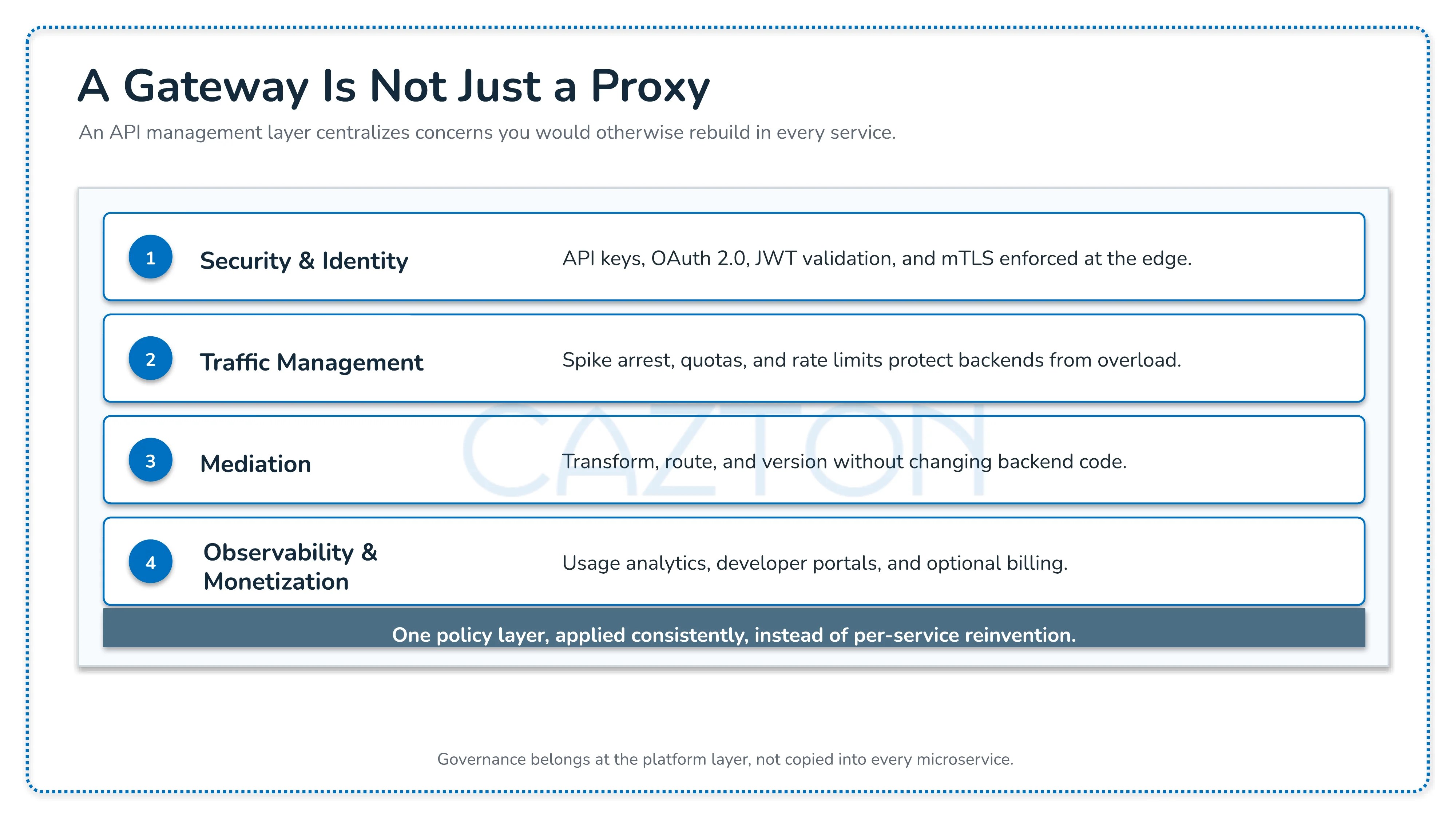
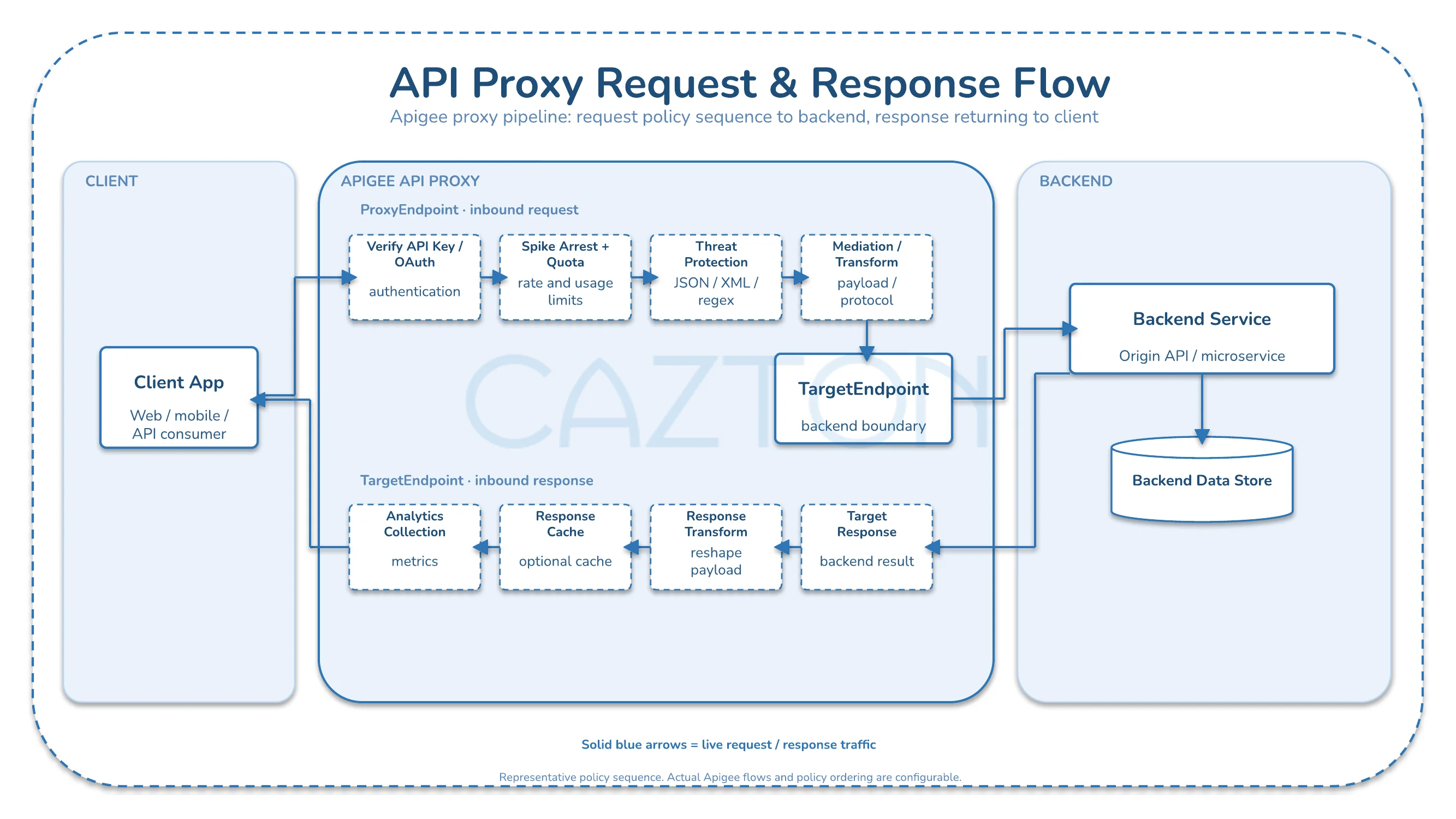
The executive benefit is separation of concerns with a shared operating model. The organization can change a backend implementation, migrate a workload, or add a new consumer without renegotiating every security and integration decision from the beginning.
Where Apigee Fits In A Multicloud Estate
Modern enterprises rarely run one cloud in a clean, greenfield pattern. They operate combinations of Google Cloud, Microsoft Azure, AWS, private cloud, colocation, SaaS, packaged applications, and regulated environments. Apigee is particularly relevant when the enterprise needs a consistent API management model while runtime ownership, data residency, latency, or operational constraints vary by workload.
Apigee hybrid uses a management plane hosted by Apigee in Google Cloud and a runtime plane installed and managed on a supported Kubernetes platform. Depending on the validated support matrix and deployment requirements, that runtime may be placed on GKE on Google Cloud, GKE on AWS, GKE on Azure, Google Distributed Cloud on VMware or bare metal, Amazon EKS, Microsoft AKS, Red Hat OpenShift, Rancher Kubernetes Engine, VMware Tanzu, or another supported platform. Platform eligibility, Kubernetes versions, and support windows change, so every production design must be checked against the current matrix before implementation or upgrade.
Apigee hybrid is not an Azure-only or Google Cloud-free deployment. Even when the runtime plane runs on Azure Kubernetes Service or another supported non-Google platform, the management plane, Apigee organization, environments, environment groups, Google Cloud APIs, service accounts, and supporting Google Cloud services remain part of the platform. The practical distinction is where the API runtime runs, not whether Google Cloud is involved.
That flexibility is not a reason to deploy everything everywhere. It is a reason to make placement decisions deliberately. We help the executive team decide which APIs require public reach, which require private reach, which can use a managed runtime, which require a customer-controlled runtime, and which should never be exposed outside a tightly bounded trust zone. The resulting decisions should be recorded in a reusable reference architecture, not left to individual project teams.
Apigee is not the lowest-cost option for every API program. A single-cloud, low-volume, or tightly budget-constrained estate may be better served by the native gateway of its primary cloud. The decision should weigh multicloud governance, regulatory control, API-product maturity, and portability against subscription, consumption, security, runtime, and operational costs.
The Enterprise API Control Model
The enterprise API control model organizes the estate into three zones. On one side sit consumer applications, including mobile, web, partner, and internal callers. In the center sits an Apigee policy and API product boundary that applies identity, authorization, traffic management, and analytics consistently. On the other side sit the systems that do the work: private services, SAP capabilities, Kubernetes workloads, legacy systems, and data platforms. Runtime requests flow from consumers through edge protection and Apigee to the selected backend, while a separate management path carries configuration, analytics, and operational telemetry. Holding these paths apart makes public, private, and hybrid placement a deliberate decision rather than an accident of network topology.
The executive question is whether the organization can change a backend, cloud, or consumer without reopening every security and integration decision. Because the control model is defined independently of the runtime and data planes, the answer can be yes. Exact placement still depends on identity, data classification, residency, latency, and regulatory requirements, so the model documents choices rather than assuming a single shared network path.
For private workloads, the network path should be explicit. Public API consumers may reach an internet-facing gateway, while internal consumers may use private DNS, private endpoints, private service connectivity, or a private gateway path. The two paths can share API products and policy intent, but they should not be treated as identical from a risk, routing, or operational perspective.
From Business Request To Governed API
A successful API program begins before a proxy is created. The lifecycle moves from business demand and domain ownership through contract design, risk classification, and runtime placement, into policy and delivery, and finally into operations. Each stage is tied to a concrete artifact: an outcome statement, an OpenAPI contract, a threat model, a deployment decision, CI/CD evidence, an SLO dashboard, and an incident runbook. The artifact is the proof that the stage was completed, not just discussed.
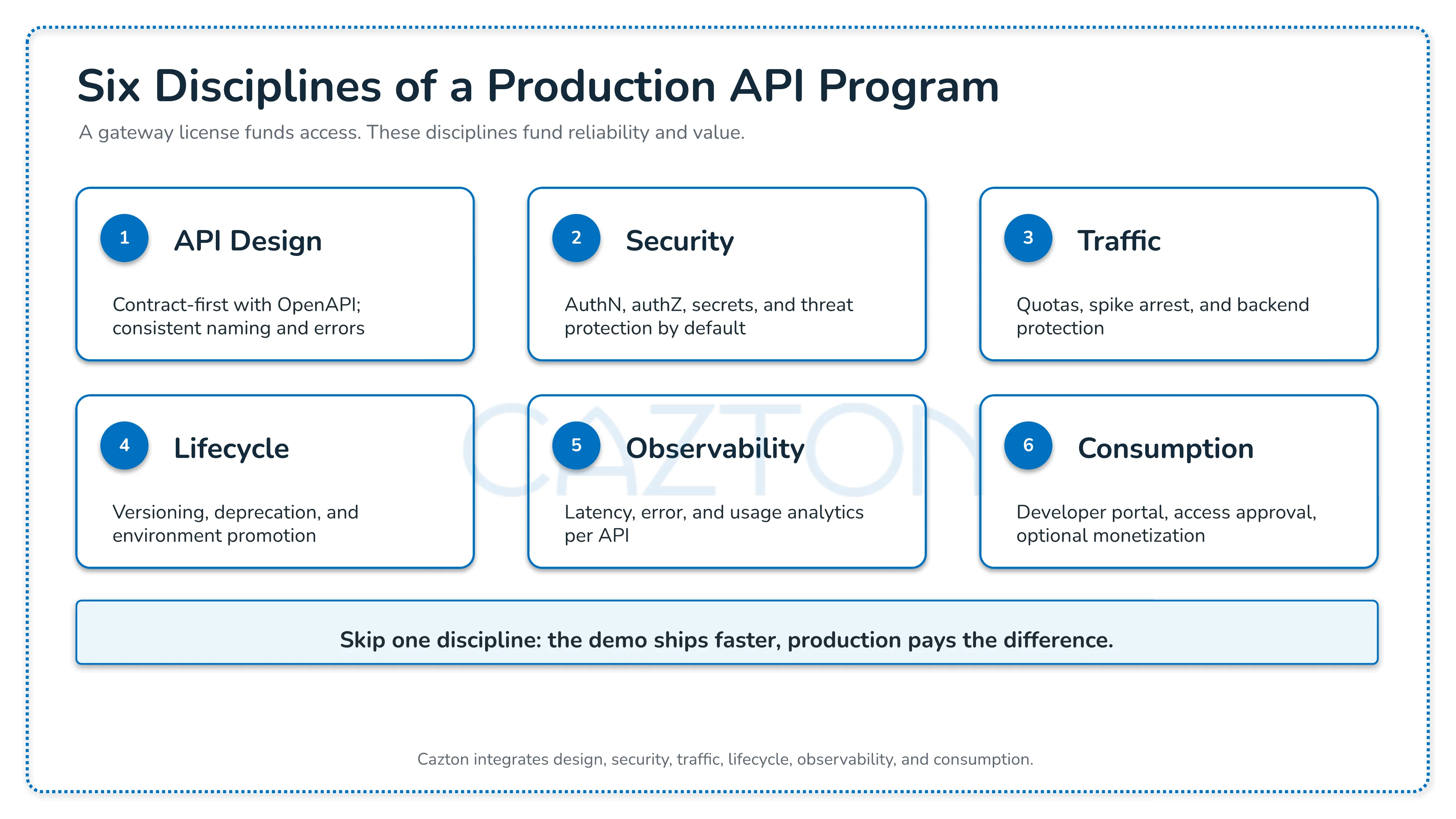
The lifecycle runs forward through delivery, but it does not end at deployment. A feedback path returns from operations to design, carrying versioning, deprecation, and policy improvement into the next iteration. This is the distinction between a design-time artifact and runtime adoption: an API product is more than a deployed proxy. The contract-first discipline connects to API architecture and design, while the delivery evidence connects to DevOps consulting.
Security And Scale Are Architecture Decisions
API security is not a final checklist applied after the interface has been published. Every exposure decision changes the threat model. A customer-facing payment API, a partner claims API, an internal employee API, and a Kubernetes service-to-service call should not inherit the same assumptions merely because they use HTTP.
At the external boundary, the architecture should address identity, token validation, authorization, schema and payload controls, rate limits, quotas, bot and abuse detection, WAF protections, threat intelligence, logging, and response ownership. Within the service estate, the design should address workload identity, mTLS, authorization policy, secrets, certificate rotation, service discovery, and east-west observability. These concerns align with broader microservices architecture and DevSecOps delivery practices.
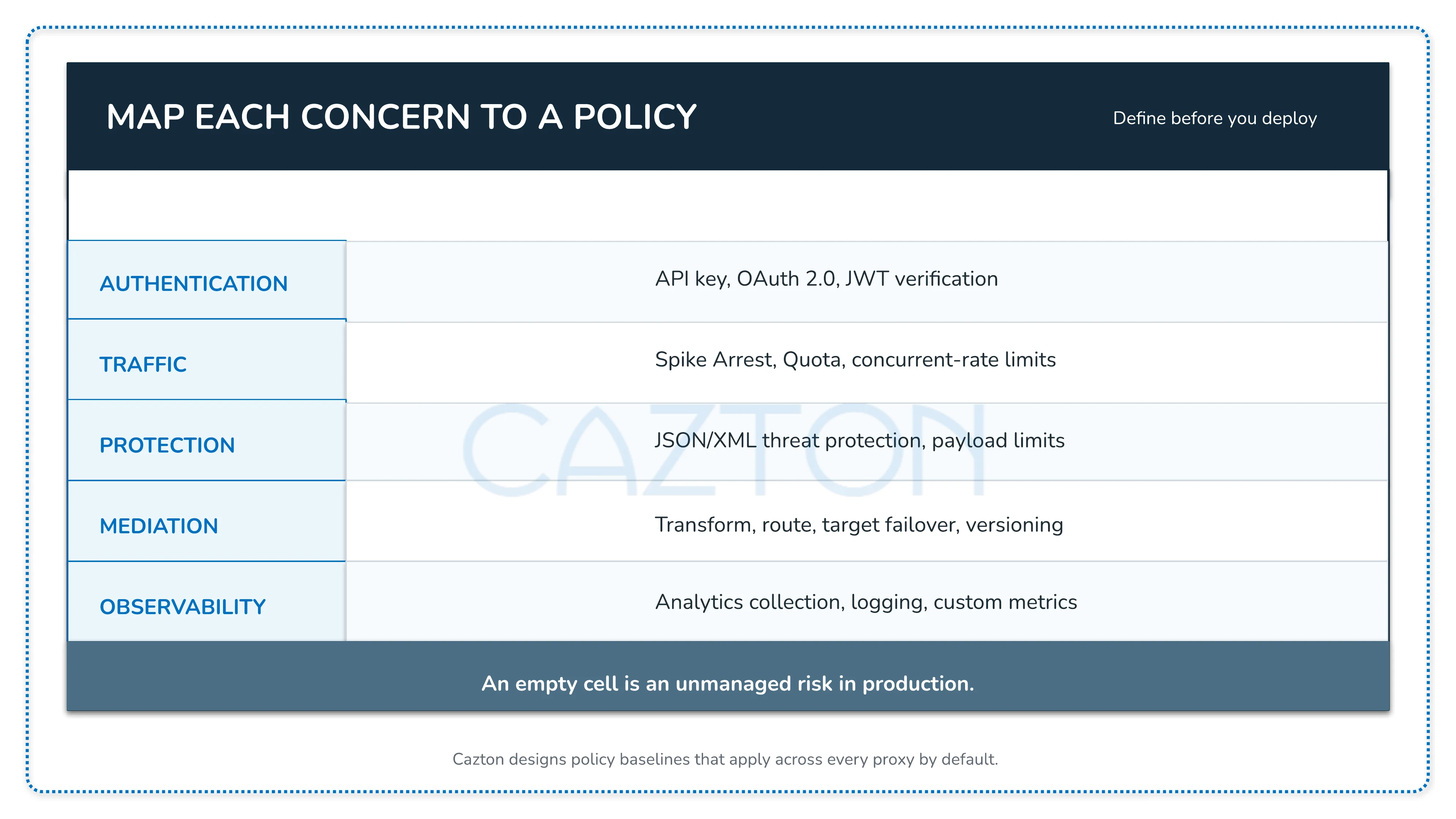
| Risk area | Control pattern | Executive evidence |
|---|---|---|
| Unauthorized access | OIDC or OAuth validation, issuer and audience checks, scoped authorization, workload identity, least privilege | Access policy, identity inventory, exception register |
| Abuse and automated attacks | Quotas, spike arrest, rate limits, anomaly detection, bot controls, threat intelligence, automated response | Abuse dashboard, alert thresholds, response playbook |
| Data exposure | Payload minimization, field filtering, tokenization, encryption, data classification, private routing | Data-flow diagram, retention decision, audit record |
| Service compromise | mTLS, service identity, authorization policy, namespace controls, network policy, runtime protection | Mesh policy, certificate status, segmentation evidence |
| Operational failure | Timeouts, retries with limits, circuit breaking, fallback, idempotency, canary release, rollback | SLO report, incident review, tested recovery procedure |
| Supply-chain risk | Signed artifacts, dependency scanning, policy-as-code, provenance, controlled registries, approval gates | Build evidence, vulnerability exceptions, release approval |
Apigee should protect the north-south API boundary. Istio or another service mesh should protect the east-west service boundary where it is the right operational choice. The mesh does not eliminate the need for API management, and API management does not eliminate the need for workload-level security. Teams can pair this model with evaluation and testing practices when APIs expose AI or agent capabilities.
Private And Public Endpoints Without Confusion
Public and private endpoints are not two labels on the same diagram. They represent different network and governance choices. A public endpoint may be reachable from the internet but still require strong identity and policy. A private endpoint may reduce exposure but still be vulnerable to compromised identities, misconfigured routes, excessive permissions, or trusted internal callers.
For Google Cloud, the design may use Apigee public access, private connectivity, Private Service Connect, VPC Service Controls where applicable, and private backend routes. These serve different purposes and should not be treated as interchangeable: Private Service Connect provides private producer-to-consumer network connectivity, while VPC Service Controls establishes a data-exfiltration perimeter around services and their APIs. For Azure-hosted or AWS-hosted backends, Apigee can govern APIs reached through public or private connectivity, but the production design must explicitly document routing, DNS, identity federation, firewall controls, private endpoints, and the approved path between Google Cloud and the other cloud. Azure API Management also supports private endpoint and virtual network patterns that vary by tier and deployment model, while AWS API Gateway supports private API endpoints and private integrations through VPC constructs. Apigee can work with Azure and AWS APIs, but current Apigee deployments still require Google Cloud involvement. For cross-cloud governance, Apigee API Hub and Azure API Center should be evaluated as catalog and inventory surfaces, with one authoritative ownership model rather than fragmented API records. The design should document the exact path rather than using “private” as a substitute for a threat model. The cloud-specific implementation should be reviewed alongside Cazton’s Azure, AWS, and Google Cloud comparison.
| Endpoint pattern | Best fit | Questions to answer |
|---|---|---|
| Internet-facing gateway | Consumer, mobile, web, and approved partner access | Which identities are accepted? What data is returned? Which abuse controls are mandatory? |
| Private gateway path | Employee, branch, internal platform, and restricted partner access | How are DNS, routing, segmentation, and private service dependencies controlled? |
| Hybrid runtime | Workloads requiring customer-controlled runtime placement or network locality | Which plane remains managed by Google Cloud? Which runtime responsibilities remain with the enterprise or Azure, AWS, or other platform owner? |
| Service mesh path | East-west calls among services in Kubernetes or compatible platforms | How are workload identities, mTLS, authorization, and telemetry enforced? |
| Direct private integration | Controlled access to SAP, databases, legacy systems, or private services | What prevents bypassing the governed API product and reaching the system of record directly? |
Kubernetes, Istio, And Apigee Hybrid
Apigee hybrid is an operating model as much as a product deployment. The enterprise owns the Kubernetes runtime, platform prerequisites, upgrades, network integration, observability, backup and recovery decisions, and operational response for the runtime plane. Google Cloud hosts the management plane and provides the control experience defined by the product. Running the runtime on AKS can keep gateway traffic within an Azure-controlled network boundary, but it does not remove the Google Cloud management-plane dependency.
Google Cloud publishes the current Apigee hybrid release line and its supported-platform matrix. That matrix must be validated before each production install or upgrade because Kubernetes compatibility, platform support windows, and release requirements change on Google’s schedule.
Istio provides a separate security and traffic-management layer for services. Its current security model includes workload identity, mutual TLS, authorization, and audit-oriented controls. Enterprises should also decide between Istio sidecar and ambient modes: ambient mode uses node-level ztunnel proxies rather than a sidecar for every workload, which can materially affect resource overhead, operational complexity, and platform cost at scale. The enterprise should decide whether mesh responsibilities are centralized in a platform team, embedded in product teams, or delivered through a shared paved road. Without that decision, the technology can create policy fragmentation instead of reducing it. Cazton’s Kubernetes consulting and microservices work provide the adjacent platform context for that decision.
| Component | Primary concern | Failure mode to prevent |
|---|---|---|
| Apigee | External and productized API exposure, policy, traffic management, analytics, developer experience | Every team exposes APIs differently and consumers cannot find or trust the contract |
| Kubernetes | Workload scheduling, service runtime, scaling, deployment primitives | Runtime drift, unsupported versions, weak ownership, and untested recovery |
| Istio | East-west identity, mTLS, authorization, routing, and service telemetry | Service traffic is trusted by location rather than by verified workload identity |
| Integration platform | Process orchestration, transformations, connectors, events, and packaged application integration | Business process logic is hidden inside gateway policies that are difficult to test and operate |
SAP Integration And API Management
SAP is often the system of record for finance, procurement, supply chain, manufacturing, HR, and other enterprise processes. The API strategy must expose useful business capabilities without allowing every consumer to couple directly to SAP implementation details.
SAP modernization and AI-agent programs often depend on Integration Suite capabilities for securely exposing existing and new APIs across SAP and non-SAP environments. In a large enterprise, Apigee and SAP Integration Suite may coexist. The right question is not which product wins. The right question is which platform owns each boundary, how policies are kept consistent, and where integration logic should live.
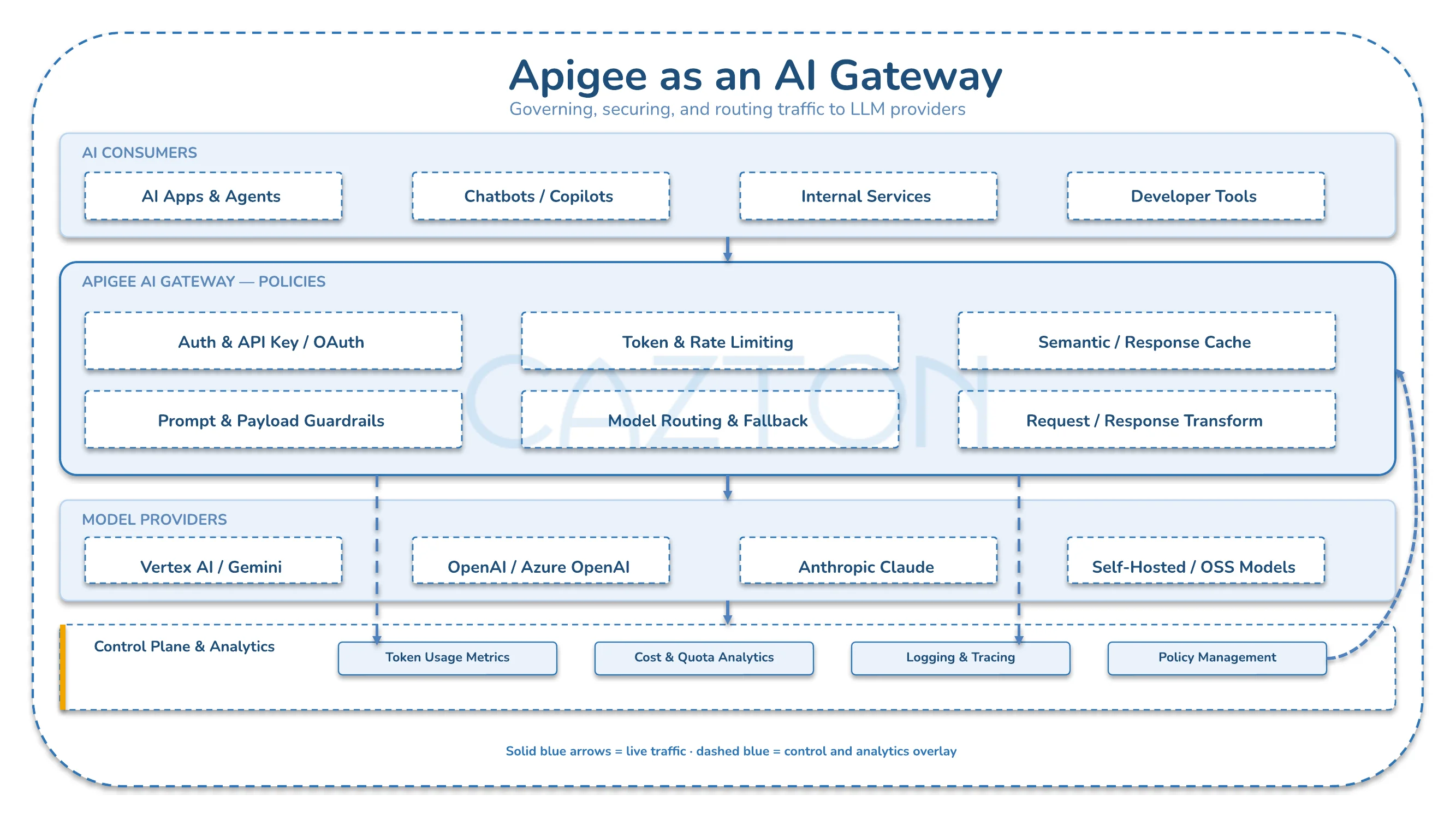
For API estate visibility, Apigee API Hub can provide a catalog and governance surface across distributed API assets, including MCP APIs and their associated tools. Apigee Advanced API Security should be evaluated alongside the organization’s existing WAF, SIEM, identity, and security operations capabilities for API risk assessment and threat monitoring. For generative AI and agent traffic, the API layer should address token-based cost governance, model routing, tool authorization, prompt and response inspection, semantic caching where appropriate, and human approval for high-impact actions. Google Cloud Model Armor can be integrated with Apigee to screen prompts and responses for risks such as prompt injection, harmful content, and sensitive-data exposure. Where the enterprise adopts MCP or Agent2Agent patterns, identity, authorization, approval, and audit controls must extend to agent-to-tool and agent-to-agent calls. The same governance logic applies to AI agents.
| SAP scenario | Recommended boundary | Control emphasis |
|---|---|---|
| External partner needs order status | Apigee API product → SAP Integration Suite or controlled service → SAP system of record | Partner identity, product approval, field minimization, quota, audit, and versioning |
| Internal finance application needs supplier data | Private API path → governed domain API → SAP capability | Private routing, employee identity, authorization, data classification, and separation of duties |
| Process requires multiple systems | API product → integration and orchestration layer → SAP, CRM, data, and event systems | Compensation, retry behavior, idempotency, transaction boundaries, and operational ownership |
| AI application needs enterprise action | Agent or application → governed API or MCP-facing capability → policy-controlled integration | Tool authorization, prompt and payload controls, human approval for high-impact actions, and full audit |
The gateway should not become a second process engine. Keep orchestration where it can be modeled, tested, monitored, and owned. Use the API layer to protect and productize the capability, while the integration layer coordinates the underlying enterprise process.
Operating More Than 10,000 Services Behind Apigee
We helped a fully compliant financial-services organization operate more than 10,000 services behind an Apigee gateway. At that scale, the first task is not simply tuning latency. It is establishing a shared vocabulary, because 10,000 services and 10,000 APIs are not the same statement. A durable program separates the backend services that run business logic, the API proxies that expose them, the API products that package capabilities for defined audiences, the backends those proxies route to, and the consumers, including applications, partners, and internal teams, that hold credentials.
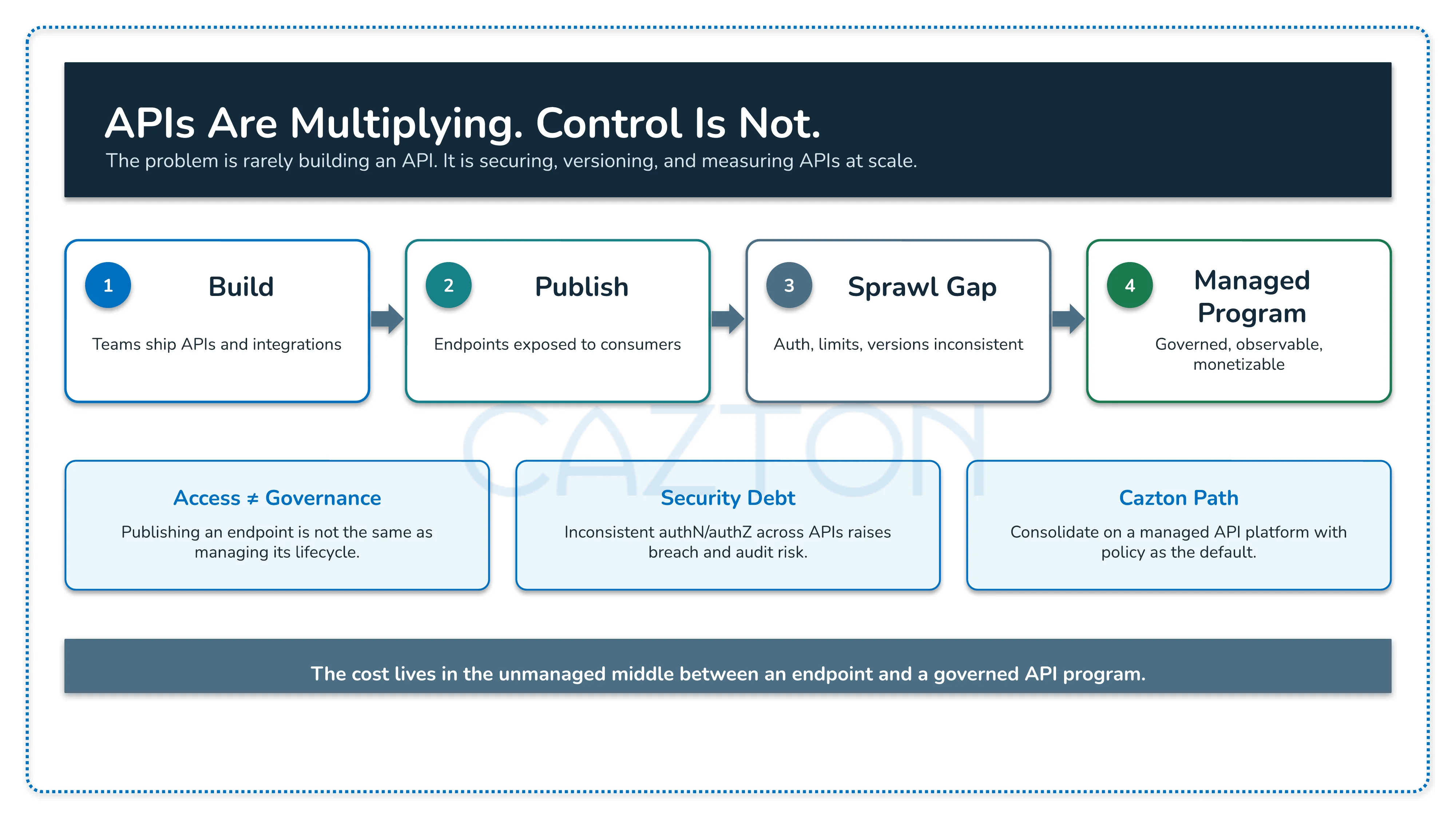
The controls that hold an estate of this size together must be applied consistently rather than left to individual teams. That means an authoritative API inventory, shared flows and reusable policy bundles, a consistent identity and token-validation model at the gateway boundary, quota and spike-arrest patterns that protect backends from abuse and accidental overload, observability that connects proxy telemetry to the service and product behind it, and a named owner for every API product, proxy, and backend dependency. In a regulated setting, each control must produce evidence that a reviewer can examine, which makes environment promotion, exception registers, and audit trails part of the platform.
| Scale dimension | Measure | Leadership question |
|---|---|---|
| Consumer scale | Registered applications, partners, and developer accounts holding credentials | Which consumers are contractually committed and strategically important? |
| Service and API scale | Backend services, API proxies, API products, versions, and environments, counted separately | Can we distinguish a service from the proxy and product that expose it? |
| Dependency scale | Backend dependencies per proxy and downstream call graph | Can we name the blast radius of a change or incident? |
| Risk and compliance scale | Interfaces handling sensitive data, privileged actions, public exposure, and active exceptions | Which interfaces require the strongest controls and fastest response, and can we prove it? |
| Business scale | Product ownership, adoption, and operational cost | Which API products deserve investment rather than maintenance-only funding? |
The risks that grow fastest at this scale are structural, not performance-related: undocumented dependencies, inconsistent authentication across proxies, duplicate APIs, unclear data ownership, and unbounded retry behavior that can turn a single backend slowdown into estate-wide pressure. Dependency mapping and blast-radius analysis address these risks directly. Leadership should be able to determine, for any proposed change or incident, which API products and consumers are affected. The measure of success is not the service count. It is whether the organization can change a backend, rotate an identity, deprecate a version, or respond to an incident without reopening every security and integration decision across the remaining estate.
Enterprise API Case Studies
API Governance That Scales Across Financial Services
The challenge: A financial-services enterprise has accumulated thousands of APIs across payments, branches, partner channels, and internal platforms. Different teams apply different authentication, quota, versioning, and monitoring practices, making it difficult to launch new products or prove control effectiveness.
The solution: A governed Apigee program creates reusable API products, shared flows and policy bundles, developer onboarding, environment promotion controls, analytics, and clear ownership. Public APIs, private employee APIs, and restricted partner APIs receive separate exposure decisions while remaining visible through a common operating model. Evidence to capture includes standardized onboarding, fewer duplicated policy implementations, clearer ownership, and repeatable control evidence for internal and external review.
Insurance APIs That Connect Policyholder Journeys
The challenge: An insurance enterprise needs to connect claims, policy, billing, broker, mobile, and customer-service capabilities while protecting sensitive personal and financial data. Point-to-point integration has created duplicated transformations and unclear dependency ownership.
The solution: The organization creates domain APIs for policy, claims, customer, and payment capabilities. Apigee manages consumer access, threat controls, quotas, spike arrest, and analytics, while integration services handle orchestration and transformation. Data minimization, field-level authorization, audit trails, and recovery testing become part of the product contract. Evidence to capture includes reduced point-to-point coupling, more predictable partner and channel onboarding, and clearer dependency ownership.
SAP Business Services Without Backend Coupling
The challenge: A regulated enterprise is modernizing SAP capabilities and wants partners, internal applications, and AI agents to use business services without coupling directly to S/4HANA implementation details or bypassing separation-of-duties controls.
The solution: SAP Integration Suite or a controlled integration service handles SAP-specific mediation, while Apigee exposes approved business capabilities as governed API products. High-impact actions require scoped authorization, approval workflows, full auditability, and explicit controls for agent or MCP tool access. Evidence to capture includes reduced direct coupling to S/4HANA implementation details, stronger separation-of-duties evidence, and a controlled path for partners, internal applications, and AI agents. This aligns with our SAP AI agents consulting work.
Multicloud APIs With Consistent Control
The challenge: A distributed enterprise is moving services across Google Cloud, Azure, AWS, private infrastructure, and Kubernetes clusters. Leadership wants consistent API governance without forcing every workload into one cloud or exposing private systems through public routes.
The solution: The organization separates the managed API control model from runtime placement. Apigee serves workloads suited to managed operation, while Apigee hybrid supports customer-controlled Kubernetes runtimes where required. An Azure AKS runtime can keep gateway traffic within an Azure-controlled network boundary, but the design retains Google Cloud for the Apigee management plane and associated platform services. Istio or another service mesh handles east-west identity and mTLS inside the service estate. The design also distinguishes Azure API Management and API Center responsibilities from Apigee responsibilities, rather than treating every gateway and catalog as interchangeable. Placement decisions are documented by data classification, residency, latency, resilience, and regulatory need. Evidence to capture includes a repeatable cloud-placement decision record, fewer exceptions for private workloads, and consistent policy ownership across cloud boundaries.
Partner APIs That Scale Without Losing Visibility
The challenge: A high-volume partner ecosystem is growing quickly, but the enterprise cannot distinguish valuable API consumption from abusive traffic, accidental overload, or uncontrolled retry behavior. API growth is producing more operational risk than business visibility.
The solution: API products use quotas, spike arrest, rate limits, threat detection, consumer registration, analytics, and incident runbooks from the beginning. The enterprise measures adoption, latency, errors, capacity, cost, and business outcomes together, then retires or redesigns APIs that no longer serve a clear product purpose. Evidence to capture includes improved visibility into valuable versus abusive consumption, more predictable partner capacity, and a defensible basis for API rationalization and retirement.
Regulated API programs also require segregation of duties, regional data handling, third-party risk management, business continuity, recovery testing, fraud monitoring, privacy controls, and evidence that can withstand internal and external review.
A Fortune 500 Delivery Model
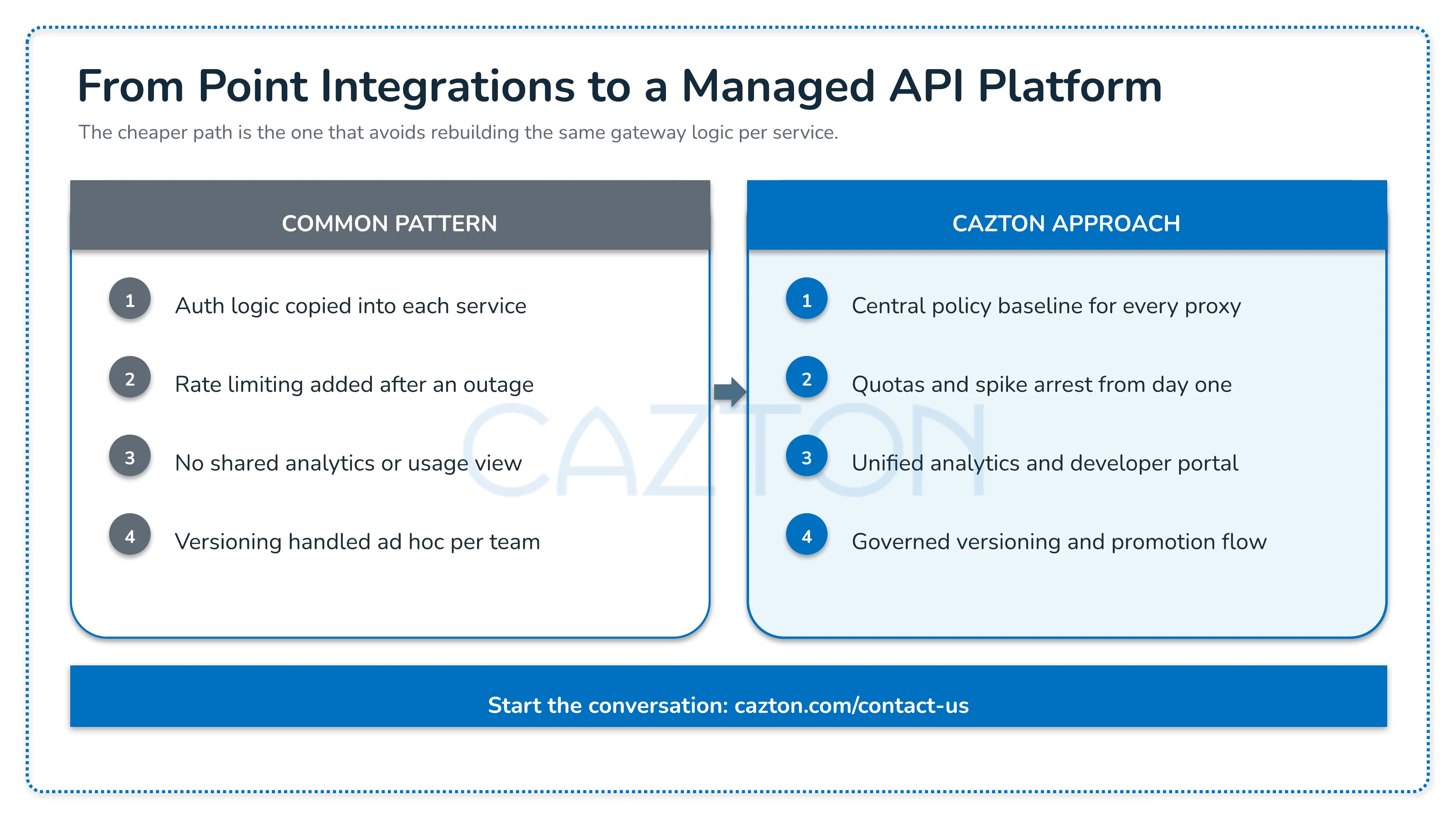
A large API transformation should not begin with a platform installation. It should begin with a small number of business-critical journeys and a clear decision framework. The first releases should prove the operating model across architecture, security, delivery, and operations before the organization expands the pattern to every domain.
| Phase | Executive outcome | Delivery evidence |
|---|---|---|
| Discover | A shared view of APIs, services, consumers, data, risk, and duplication | API estate inventory, domain map, top business journeys, risk heat map |
| Design | A target architecture that separates public, private, hybrid, SAP, mesh, and integration responsibilities | Reference architecture, endpoint decision matrix, security model, ownership model |
| Prove | A production-relevant pilot with measurable business and operational outcomes | Working API products, CI/CD, security tests, dashboards, incident exercise |
| Scale | Reusable platform patterns adopted by domain teams | Templates, paved roads, platform SLOs, governance council, training, reusable policy |
| Optimize | Lower integration cost and stronger API business value over time | Adoption analytics, rationalization, version retirement, cost controls, product reviews |
We help organizations pair the platform work with organizational work. That includes defining platform ownership, setting standards for domain teams, training engineers and architects, creating implementation accelerators, strengthening internal capability, and building operational feedback loops that survive the initial program. The program can be reinforced through microservices training, Kubernetes training, and targeted API workshops.
The CEO Scorecard
The CEO, board, CIO, CISO, and business leaders do not need a proxy count. They need evidence that the API estate is creating durable enterprise value while controlling risk.
| Scorecard area | Positive evidence | Warning signs |
|---|---|---|
| Business value | API products have owners, consumers, adoption measures, and measurable business outcomes. | The organization reports deployment activity but cannot explain consumer or revenue impact. |
| Security | Policies are automated, exceptions are visible, abuse is monitored, and response responsibilities are tested. | Security depends on team-by-team judgment and manual evidence collection. |
| Resilience | Timeouts, retries, fallbacks, capacity, recovery, and dependency failure modes are tested. | Teams discover dependency behavior during production incidents. |
| Scale | New APIs can be delivered through a paved road without multiplying platform exceptions. | Every new domain requires a bespoke architecture review and custom gateway configuration. |
| Capability | Ownership is clear across product, platform, security, SRE, architecture, and delivery teams. | The enterprise owns the technology but lacks the capability to operate it confidently. |
| Modernization | Legacy and SAP capabilities are progressively wrapped, governed, measured, and retired or replaced. | The gateway becomes a permanent mask over unmanaged backend complexity. |
The most important measure is not how many APIs exist. It is whether the enterprise can safely change, reuse, protect, observe, and retire capabilities as business conditions change.
How Cazton Helps
How Cazton Helps: We support Apigee and multicloud API programs from strategy through delivery and operations. Our work can include API estate discovery, target architecture, Apigee and Apigee hybrid design, Azure and AWS integration, SAP API strategy, Kubernetes and Istio platform engineering, security architecture, CI/CD, observability, DevSecOps, training, and executive operating-model design. Explore our consulting services and training programs, or contact us to discuss a specific enterprise environment.
Implementation note: Product versions, supported Kubernetes platforms, feature availability, security advisories, and cloud networking options change over time. Before production deployment, validate the final design against current vendor documentation and your organization’s approved architecture and security standards.
Cazton is composed of technical professionals with expertise gained all over the world and in all fields of the tech industry and we put this expertise to work for you. We serve all industries, including banking, finance, legal services, life sciences & healthcare, technology, media, and the public sector. Check out some of our services:
- Artificial Intelligence
- Big Data
- Web Development
- Mobile Development
- Desktop Development
- API Development
- Database Development
- Cloud
- DevOps
- Enterprise Search
- Blockchain
- Enterprise Architecture
Cazton has expanded into a global company, servicing clients not only across the United States, but in Oslo, Norway; Stockholm, Sweden; London, England; Berlin, Germany; Frankfurt, Germany; Paris, France; Amsterdam, Netherlands; Brussels, Belgium; Rome, Italy; Sydney, Melbourne, Australia; Quebec City, Toronto Vancouver, Montreal, Ottawa, Calgary, Edmonton, Victoria, and Winnipeg as well. In the United States, we provide our consulting and training services across various cities like Austin, Dallas, Houston, New York, New Jersey, Irvine, Los Angeles, Denver, Boulder, Charlotte, Atlanta, Orlando, Miami, San Antonio, San Diego, San Francisco, San Jose, Stamford and others. Contact us today to learn more about what our experts can do for you.
